在
特殊的 CO-Index 中,除了
UintIndex,还有
CompositeUintIndex:
仍以 MySQL 为例
还是 UintIndex 中的那个表:
CREATE TABLE Student(
    id INT PRIMARY KEY AUTO_INCREMENT,
    name VARCHAR(255) INDEX,
    dorm_id INT INDEX,
    -- others ...
);
这次我们看 dorm_id(宿舍ID)上的
Secondary Index,对于 MyRocks,
Secondary Index 对应到底层的
KeyValue 模型,
KeyValue中
Key 的逻辑结构为:
| PrefixID | SecondaryKey | PrimaryKey |
KeyValue 中的
Value就直接为空。
我们可以通过配置
keyPrefixLen 将
PrefixID 消除,这样,
Key 就只剩下
SecondaryKey + PrimaryKey。
当索引是 unique 索引时
此时
SecondaryKey 和
PrimaryKey 是一对一的,这个索引可以看成是一个
StaticSortedMap<SecondaryKey, PrimaryKey>。这个优化实现就非常简单了:
- 以 UintIndex 的方式对待 SecondaryKey
- 后面的
PrimaryKey,直接以数组的形式保存,我们只考虑 PrimaryKey 为定长的情况 - PrimaryKey 为变长(例如String)时,占用空间可能会过多,此时将整个
SecondaryKey + PrimaryKey使用 Nested Succinct Trie 表达会更合算 - PrimaryKey 为变长(例如String)的情况比较罕见
当索引非唯一时
此时同一个
SecondaryKey 可能会对应多个
PrimaryKey,这个索引就可以看成是一个
StaticSortedMap<SecondaryKey, Group<PrimaryKey> > ,同样,我们只考虑 PrimaryKey 为定长的情况。
当习惯了 Rank-Select 思维方式时,很自然的,我们仍以
UintIndex 的方式对待 SecondaryKey,对后面的
Group<PrimaryKey>,则使用
Rank-Select + 数组 的形式保存:
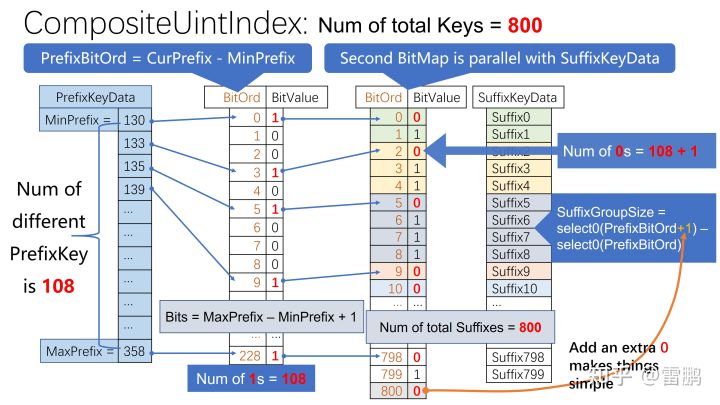
- · 把所有的 PrimaryKey 平铺开来,放到一个巨大的数组
- · 在 Rank-Select 的 BitMap 中,为每个
Group<PrimaryKey>添加起始标识和长度 - · 每个 Group 以 0 开始,Group 中有多少个 PrimaryKey,就再紧接着添加多少个 1
- · 在所有 Group 都结束后,末尾添加一个额外的 0(用于简化代码)
- · 我们已知,只要某个 SecondaryKey 存在,其对应的
Group<PrimaryKey>的长度就至少为 1,所以我们可以省 去一个 bit -
· 也就是说,起始 0 后面 1 的个数,等于
Group.size - 1 - · 从而,每个 Group 对应的总的 bit 个数就等于
Group.size - · 如果该 BitMap 所有的 bit 都是 0,那说明,这个 index 实际上是 unique 的
图示如下
图中总共有
800 个 Key,其中有
108 个不同的
PrefixKey,
MinPrefix = 130,
MaxPrefix = 358:
结论
最终,我们得到了这样一个设计:
template<class RankSelect1, class RankSelect2>
class CompositeUintIndex {...};
RankSelect1 对应于
UintIndex 中的 RankSelect,RankSelect2 用来表达
Group<PrimaryKey>。同理,根据 0 和 1 的相对数量,RankSelect2 可以是:
- · RankSelectBitMap
- · RankSelectAllZero
- · RankSelectFewOne
- · RankSelectFewZero
在这个设计中,我们不用区分 Unique Index 和 Non Unique Index,当 RankSelect2 是 AllZero 时,它就是 Unique Index。恰好,MyRocks 的 Index 结构中,也没有区分 Unique Index 和 Non Unique Index……
推广到 MongoDB
我们将 UintIndex 中 MongoDB 的 Index 简介 Copy 过来:
MongoDB 有两大类 Key Value 数据,RecordStore(即 Collection) 和 Index:

这样,MongoDB 的
RecordStore 可以使用
UintIndex,
UniqueIndex 和
StandardIndex 则可以使用
CompositeUintIndex。
以最常用的
_id 索引为例,
_id 是
UniqueIndex,通常是
ObjectId 类型:

实际上,存储为 IndexKey 的时候,因为可以为任意类型,例如
String,或者
Long,而不光是
ObjectId,所以最前面还有个一字节的
type 前缀,这样,
type+time 部分就对应
CompositeUintIndex 的
PrefixKey,余下的就是
Suffix。
彩蛋:我们可以看到,
machine+pid 在一个 MongoDB Server 进程中是永远不变的,所以,还可以进一步压缩……
来自 “ ITPUB博客 ” ,链接:https://blog.itpub.net/70013015/viewspace-2908555/ ,如需转载,请注明出处,否则将追究法律责任。

