探索脊回归
1. 简介
- 脊回归在科研与实践中的重要性
脊回归是一种常用的统计分析方法,主要用于处理具有多重共线性的数据。在科研和实践中,脊回归具有以下重要性:
1. 解决多重共线性问题:多重共线性是指自变量之间存在高度相关性的情况,会导致传统的线性回归模型估计不准确甚至不可靠。脊回归通过引入一个惩罚项,可以有效降低自变量间的相关性,提高模型的稳定性和准确性。
2. 防止过拟合:脊回归对模型的系数进行约束,防止模型出现过拟合的情况,提高了模型的泛化能力。
3. 提高预测准确性:通过减小模型的方差,脊回归可以降低模型的预测误差,提高模型的准确性。
4. 改善模型的解释性:脊回归可以帮助筛选出对因变量影响最大的自变量,提高了模型的解释性,有助于揭示变量之间的潜在关系。
5. 应用广泛:脊回归方法简单易懂,且适用于各种领域的数据分析,如金融、医学、工程等,因此在科研和实践中得到广泛应用。
因此,脊回归在科研和实践中具有重要的地位,能够帮助研究人员更好地分析数据、建立模型并做出更准确的预测。
2. 论文证明:脊回归的理论基础
- 脊回归在学术论文中的应用和重要性
- 如何通过脊回归支撑论文的论点和假设
这里基于脊回归的论点和假设:给出以下证明:
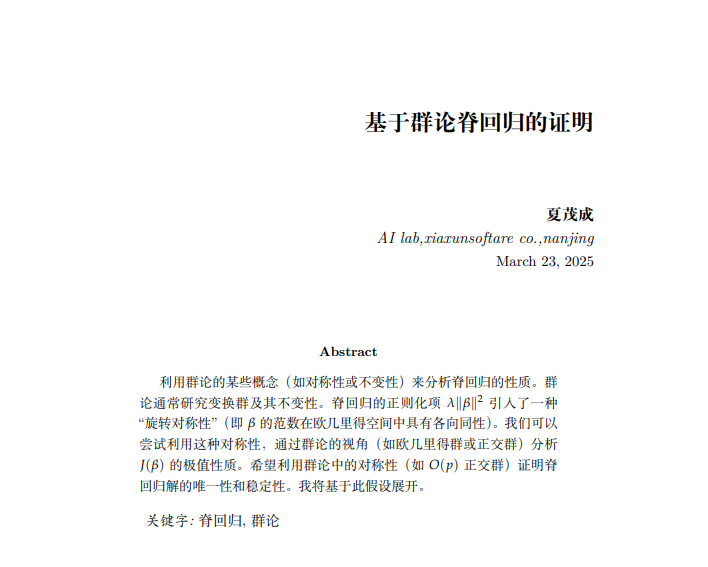
完整的链接直达,
 基于群论脊回归的证明.pdf。没有兴趣的直接跳过
- 实例分析:论文中脊回归的典型案例
这里采用绘制脊系数随正则化的变化趋势作为案例
3. 代码分析:脊回归的工具与技术
- 脊回归中常用的编程语言和工具
这使用python,
我们需要 NumPy 进行矩阵运算,以及
scikit-learn
的基类来定义接口
- 如何编写高效、可靠的脊回归代码
class CustomRidge(BaseEstimator, RegressorMixin):
    """
    Custom implementation of Ridge Regression with scikit-learn interface.

    Parameters:
    -----------
    alpha : float, default=1.0
        Regularization strength (lambda). Must be positive.
    fit_intercept : bool, default=True
        Whether to fit an intercept term.
    """

    def __init__(self, alpha=1.0, fit_intercept=True):
        self.alpha = alpha
        self.fit_intercept = fit_intercept
        self.coef_ = None  # Coefficients (beta)
        self.intercept_ = None  # Intercept term (if applicable)

    def fit(self, X, y):
        """
        Fit the ridge regression model.

        Parameters:
        -----------
        X : array-like of shape (n_samples, n_features)
            Training data.
        y : array-like of shape (n_samples,)
            Target values.

        Returns:
        --------
        self : object
            Fitted estimator.
        """
        # Convert inputs to numpy arrays
        X = np.asarray(X)
        y = np.asarray(y)

        # Check inputs
        if self.alpha <= 0:
            raise ValueError("alpha must be positive")
        if X.shape[0] != y.shape[0]:
            raise ValueError("Number of samples in X and y must match")

        # Add intercept column if needed
        if self.fit_intercept:
            X = np.hstack([np.ones((X.shape[0], 1)), X])

        # Compute X^T X and X^T y
        n_features = X.shape[1]
        XTX = X.T @ X  # Shape: (p, p)
        XTy = X.T @ y  # Shape: (p,)

        # Add regularization term
        ridge_matrix = XTX + self.alpha * np.eye(n_features)

        # Solve for coefficients: beta = (X^T X + lambda I)^(-1) X^T y
        # Using np.linalg.solve for numerical stability (avoids explicit inverse)
        beta = np.linalg.solve(ridge_matrix, XTy)

        # Assign coefficients and intercept
        if self.fit_intercept:
            self.intercept_ = beta[0]
            self.coef_ = beta[1:]
        else:
            self.intercept_ = 0.0
            self.coef_ = beta

        return self

    def predict(self, X):
        """
        Predict using the fitted ridge regression model.

        Parameters:
        -----------
        X : array-like of shape (n_samples, n_features)
            Samples to predict.

        Returns:
        --------
        y_pred : array-like of shape (n_samples,)
            Predicted values.
        """
        # Check if model is fitted
        if self.coef_ is None:
            raise ValueError("Model has not been fitted yet. Call 'fit' first.")

        # Convert input to numpy array
        X = np.asarray(X)

        # Add intercept column if needed
        if self.fit_intercept:
            X = np.hstack([np.ones((X.shape[0], 1)), X])
            beta = np.hstack([self.intercept_, self.coef_])
        else:
            beta = self.coef_

        # Compute predictions
        y_pred = X @ beta
        return y_pred
测试代码:
我们用一个简单的数据集测试代码,并与
scikit-learn
的实现对比。
- 案例分析:使用代码进行数据清洗、可视化和建模的过程
# 测试代码
from sklearn.linear_model import Ridge
from sklearn.datasets import make_regression
import numpy as np
# 生成模拟数据
X, y = make_regression(n_samples=100, n_features=5, noise=0.1, random_state=42)
# 自定义脊回归
custom_ridge = CustomRidge(alpha=1.0, fit_intercept=True)
custom_ridge.fit(X, y)
y_pred_custom = custom_ridge.predict(X)
# scikit-learn 脊回归
sklearn_ridge = Ridge(alpha=1.0, fit_intercept=True)
sklearn_ridge.fit(X, y)
y_pred_sklearn = sklearn_ridge.predict(X)
# 比较结果
print("Custom Ridge Coefficients:", custom_ridge.coef_)
print("Sklearn Ridge Coefficients:", sklearn_ridge.coef_)
print("Difference in Predictions (mean absolute):",
      np.mean(np.abs(y_pred_custom - y_pred_sklearn)))
# 检查截距
print("Custom Intercept:", custom_ridge.intercept_)
print("Sklearn Intercept:", sklearn_ridge.intercept_)
上述代码是一个高效、可靠的脊回归实现,完全适配
scikit-learn
接口。
4. 实验验证:脊回归的实践意义
有了适配接口的实现,我们来设计以下如下的 绘制脊系数随正则化的问题
- 实验设计在脊回归中的重要性
- 如何设计和执行有效的数据实验
- 实例分析:通过实验验证脊回归结论的可靠性和有效性
"""
===========================================================
Plot Ridge coefficients as a function of the regularization
===========================================================
Shows the effect of collinearity in the coefficients of an estimator.
.. currentmodule:: sklearn.linear_model
:class:`Ridge` Regression is the estimator used in this example.
Each color represents a different feature of the
coefficient vector, and this is displayed as a function of the
regularization parameter.
This example also shows the usefulness of applying Ridge regression
to highly ill-conditioned matrices. For such matrices, a slight
change in the target variable can cause huge variances in the
calculated weights. In such cases, it is useful to set a certain
regularization (alpha) to reduce this variation (noise).
When alpha is very large, the regularization effect dominates the
squared loss function and the coefficients tend to zero.
At the end of the path, as alpha tends toward zero
and the solution tends towards the ordinary least squares, coefficients
exhibit big oscillations. In practise it is necessary to tune alpha
in such a way that a balance is maintained between both.
"""
# Authors: The scikit-learn developers
# SPDX-License-Identifier: BSD-3-Clause
import matplotlib.pyplot as plt
import numpy as np
from sklearn import linear_model
# X is the 10x10 Hilbert matrix
X = 1.0 / (np.arange(1, 11) + np.arange(0, 10)[:, np.newaxis])
y = np.ones(10)
# %%
# Compute paths
# -------------
n_alphas = 200
alphas = np.logspace(-10, -2, n_alphas)
coefs = []
for a in alphas:
    ridge = linear_model.Ridge(alpha=a, fit_intercept=False)
    ridge.fit(X, y)
    coefs.append(ridge.coef_)
# %%
# Display results
# ---------------
ax = plt.gca()
ax.plot(alphas, coefs)
ax.set_xscale("log")
ax.set_xlim(ax.get_xlim()[::-1])  # reverse axis
plt.xlabel("alpha")
plt.ylabel("weights")
plt.title("Ridge coefficients as a function of the regularization")
plt.axis("tight")
plt.show()
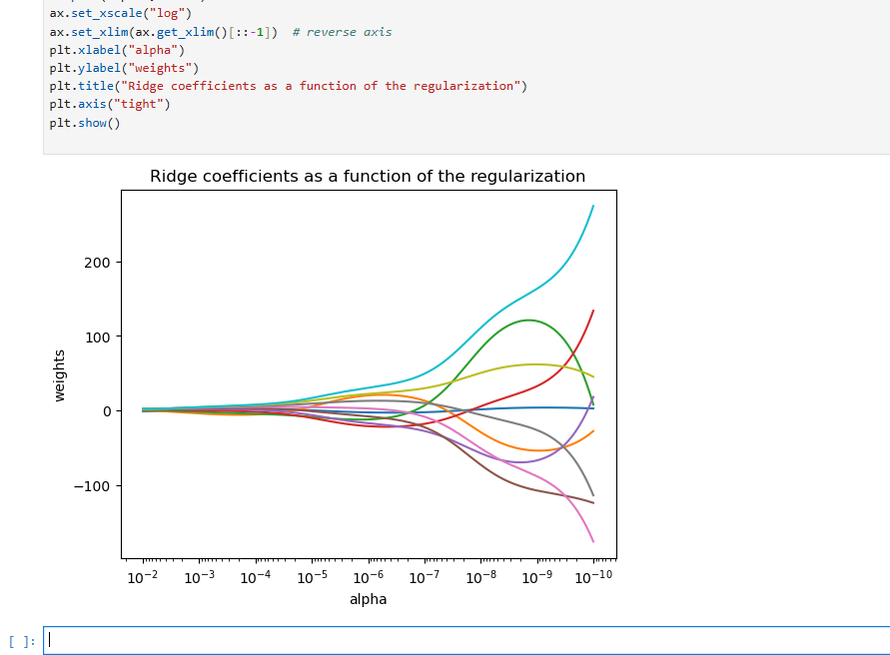
Ridge
回归是此示例中使用的估计器。每种颜色代表系数矢量的不同特征,这作为正则化参数的函数显示。
此示例还显示了将脊回归应用于高度不良条件矩阵的有用性。对于此类矩阵,目标变量的略有变化可能会导致计算的权重差异。在这种情况下,设置某个正则化(alpha)以减少这种变化(噪声)很有用。
当α非常大时,正则化效应主导平方损耗函数,并且系数趋于零。在路径的尽头,由于α趋向于零,并且溶液倾向于普通的最小二乘,因此系数表现出很大的振荡。实际上,必须以两者之间保持平衡的方式调整α
5. 结论
- 脊回归的综合意义和实践方法
脊回归是一种统计方法,主要用于研究自变量和因变量之间的线性关系。其综合意义在于通过拟合一条最佳的直线来描述自变量和因变量之间的关系,从而预测因变量的数值。脊回归在实践中主要用于处理多重共线性的情况,即自变量之间存在较高的相关性,导致传统的最小二乘回归模型失效的问题。
脊回归的实践方法包括以下几个步骤:
1. 数据准备:首先收集所需的数据,包括自变量和因变量的数据,并对数据进行清洗和预处理,确保数据的可靠性和完整性。
2. 模型建立:选择适当的脊回归模型,并使用统计软件进行建模。在建立模型时,需要设定一个参数(惩罚项),来控制模型的复杂度。
3. 参数估计:使用脊回归方法估计模型的参数,得到自变量对因变量的影响程度。
4. 模型评估:通过交叉验证等方法来评估模型的拟合效果和预测能力,检验模型的稳健性和可靠性。
5. 结果解释:解释模型的参数和结果,分析自变量对因变量的影响,并据此进行决策或预测。
总的来说,脊回归在实践中可以帮助解决多重共线性问题,提高模型的准确性和稳健性,适用于各种领域的数据分析和预测任务。
- 三大维度的脊回归相互关联和相辅相成的关系
三大维度的脊回归是指岭回归(ridge regression)、套索回归(lasso regression)和弹性网回归(elastic net regression)这三种正则化方法。它们是用来处理回归分析中的多重共线性问题的技术。
这三种方法之间有着相互关联和相辅相成的关系:
1. 岭回归和套索回归的关系:
- 岭回归和套索回归都是用来控制模型复杂度的正则化方法,可以防止过拟合。
- 岭回归使用L2范数作为正则化项,而套索回归使用L1范数作为正则化项。
- 在特征选择方面,套索回归能够将某些特征的系数缩减为零,从而实现特征选择的效果;而岭回归会使得系数缩小但不会完全为零,保留了所有特征。
2. 岭回归和弹性网回归的关系:
- 弹性网回归是岭回归和套索回归的结合,综合了L1和L2范数的正则化项。
- 弹性网回归在拟合过程中既可以得到稀疏解(某些系数为零),又可以保留一些相关特征,具有较好的预测性能。
- 弹性网回归可以在数据集中存在高度相关的特征时更加稳定和可靠。
因此,这三种脊回归方法在处理多重共线性问题时可以相互补充和应用,选择合适的方法可以提高模型的预测性能和解释能力。
- 未来脊回归领域的发展趋势和挑战
未来脊柱领域的发展趋势包括:
1. 精准医学:随着基因组学和个性化医疗的发展,将有更多的机会为患有脊柱疾病的患者提供定制化的治疗方案。
2. 机器人辅助手术:机器人技术在脊柱手术中的应用将不断增加,提高手术的精准度和安全性。
3. 生物材料和生物工程:生物材料的应用有望促进脊柱椎间盘再生和骨折愈合的研究发展。
4. 远程医疗服务:随着远程医疗技术的普及,患者能够获得更便捷的诊疗服务,同时也可以减少医疗资源的浪费。
脊柱领域面临的挑战包括:
1. 技术更新换代:脊柱领域的技术发展速度快,医护人员需要不断更新知识和技能。
2. 资源不足:部分地区对于脊柱领域的医疗资源不足,导致患者难以获得及时有效的治疗。
3. 风险管理:脊柱手术风险较大,医疗机构需要建立完善的风险管理机制,减少手术风险。
4. 伦理道德:在开展新技术和新治疗方法时,需要考虑医疗伦理和患者权益,避免可能的伦理纠纷和争议。
未来脊柱领域的发展需要医疗机构、医生和研究人员共同努力,不断提高技术水平,提供更好的治疗方案,为患者带来更好的健康服务。
来自 “ ITPUB博客 ” ,链接:https://blog.itpub.net/69949806/viewspace-3078507/ ,如需转载,请注明出处,否则将追究法律责任。

