数据库管理-第184期 23ai:干掉MongoDB的不一定是另一个JSON数据库(20240507)
数据库管理-第184期 23ai:干掉MongoDB的不一定是另一个JSON数据库(20240507)
作者:胖头鱼的鱼缸(尹海文)
Oracle ACE Associate: Database(Oracle与MySQL)
PostgreSQL ACE Partner
10年数据库行业经验,现主要从事数据库服务工作
拥有OCM 11g/12c/19c、MySQL 8.0 OCP、Exadata、CDP等认证
墨天轮MVP、认证技术专家、年度墨力之星,ITPUB认证专家、专家百人团成员,OCM讲师,PolarDB开源社区技术顾问,OceanBase观察团成员
圈内拥有“总监”、“保安”、“国产数据库最大敌人”等称号,非著 名社恐(社交恐怖分子)
公众号:胖头鱼的鱼缸;CSDN:胖头鱼的鱼缸(尹海文);墨天轮:胖头鱼的鱼缸;ITPUB:yhw1809。
除授权转载并标明出处外,均为“非法”抄袭
最早接触JSON数据库还是2015年我在尚观的时候,也算是刚刚入行的时候,那时候了解到了MongoDB,当时对比一般的关系型数据库,对其副本分片架构很感兴趣。后面还是在一些项目上,如用于近期数据快速分析、智能客服、用户信息等场景。
在最新版本Oracle Database还叫23c的时候,也就是
第130期的时候,我根据官方PPT加上自己理解内容介绍了JSON关系型二元性视图,Oracle JSON Relational Duality Views,这个功能算是颠覆了关系型表和JSON在数据库层面的使用方式,如需查看相关详细介绍请在CSDN、墨天轮、公众号、ITPUB查看相关内容。那时候并没有做什么实验,今天尝试自己整一个简单场景来使用JSON关系型二元性视图。
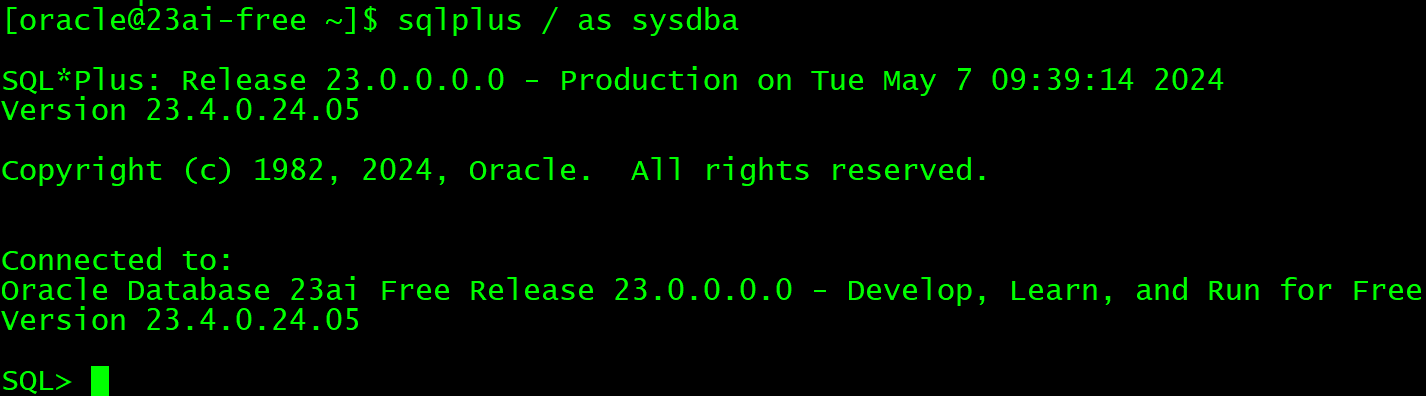
为了合理的进行实验,我还是安装了23ai Free版本:
1 JSON需求
这里模拟一个订单系统输出:
{ "_id"         : "12345678",
  "ordertime"   : "2024-05-07 09:42:21",
  "customer"    : "Cary", "details"     :
   [  {
        "pn"      : "98765",
        "pname"   : "Laptop mode A",
        "price"   : "2000",
        "type"    : "computer"
      },
      {
        "pn"      : "87654",
        "pname"   : "CD A",
        "price"   : "40",
        "type"    : "music"
      },
   ]
}
其中:
order: 订单编号
customer: 订单用户
order_time: 订单时间
order_detail: 订单详情
- pn: 商品编号
- pname: 商品名称
- price: 商品价格
- type: 商品分类
2 关系型表设计
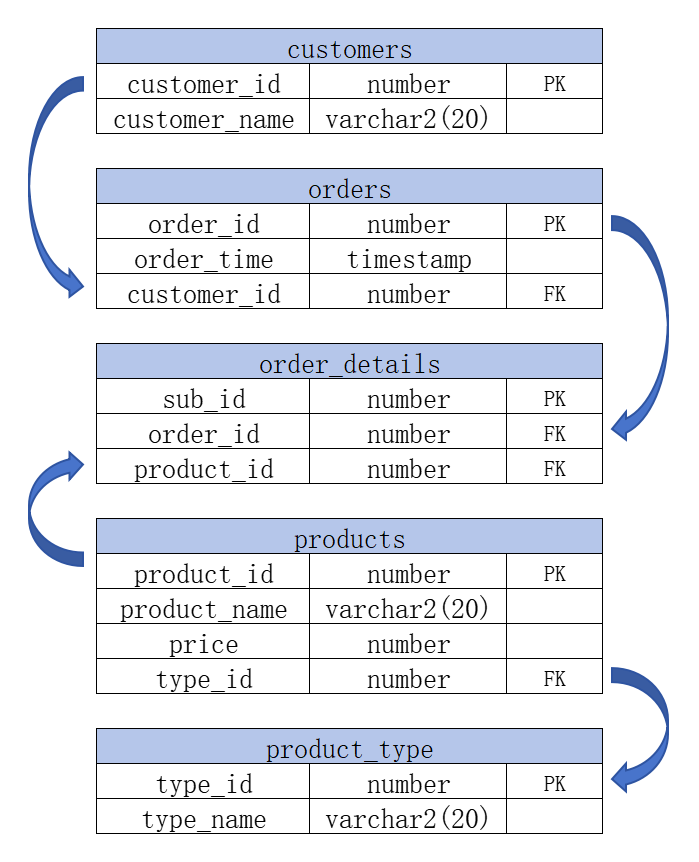
分别设计用户表customers、然后是订单表orders、订单详情表order_details、商品表products、商品分类表product_type:
 建表并插入一些数据:
--drop tables if exist
drop table order_details purge;
drop table products purge;
drop table product_type purge;
drop table orders purge;
drop table customers purge;
--customers
create table customers (customer_id number,  customer_name varchar2(20),  CONSTRAINT customers_pk PRIMARY KEY(customer_id));
insert into customers values(123456,'Cary');
insert into customers values(234567,'Calvin');
insert into customers values(345678,'Haiwen');
insert into customers values(456789,'Xiaogang');
--product_type
create table product_type (type_id number,  type_name varchar2(20),  CONSTRAINT type_pk PRIMARY KEY(type_id));
insert into product_type values(1234,'computer');
insert into product_type values(2345,'music');
insert into product_type values(3456,'food');
insert into product_type values(4567,'book');
--products
create table products (product_id number,  product_name varchar2(20),  price_number number,  type_id number,  CONSTRAINT products_pk PRIMARY KEY(product_id),  CONSTRAINT products_fk FOREIGN KEY(type_id) REFERENCES product_type(type_id));
insert into products values(98765,'Laptop mode A',2000,1234);
insert into products values(87654,'CD A',40,2345);
insert into products values(76543,'Pork',15,3456);
insert into products values(65432,'Oracle 23ai Document',100,4567);
--orders
create table orders (order_id number,  order_time timestamp,  customer_id number,  CONSTRAINT orders_pk PRIMARY KEY(order_id),  CONSTRAINT orders_fk FOREIGN KEY(customer_id) REFERENCES customers(customer_id));
insert into orders values(12345678,to_timestamp('2024-05-07 09:42:21','yyyy-mm-dd hh24:mi:ss'),123456);
insert into orders values(12345679,to_timestamp('2024-05-07 09:45:25','yyyy-mm-dd hh24:mi:ss'),234567);
insert into orders values(12345680,to_timestamp('2024-05-07 09:48:01','yyyy-mm-dd hh24:mi:ss'),456789);
insert into orders values(12345681,to_timestamp('2024-05-07 09:51:44','yyyy-mm-dd hh24:mi:ss'),345678);
--order_details
create table order_details (sub_id number,  order_id number,  product_id number,  CONSTRAINT od_pk PRIMARY KEY(sub_id),  CONSTRAINT od_fk1 FOREIGN KEY(order_id) REFERENCES orders(order_id),  CONSTRAINT od_fk2 FOREIGN KEY(product_id) REFERENCES products(product_id));
insert into order_details values(1,12345678,98765);
insert into order_details values(2,12345678,87654);
insert into order_details values(3,12345679,87654);
insert into order_details values(4,12345679,65432);
insert into order_details values(5,12345679,76543);
insert into order_details values(6,12345680,98765);
insert into order_details values(7,12345681,98765);
insert into order_details values(8,12345681,87654);
insert into order_details values(9,12345681,76543);
insert into order_details values(10,12345681,65432);
commit;
检查数据:
select o.order_id orderid,c.customer_name customer,o.order_time ordertime,p.product_name pn,p.product_name pname,p.price_number price,pt.type_name type from orders o,customers c,order_details od,products p,product_type pt where o.customer_id=c.customer_id and o.order_id=od.order_id and od.product_id=p.product_id and p.type_id=pt.type_id order by o.order_id;
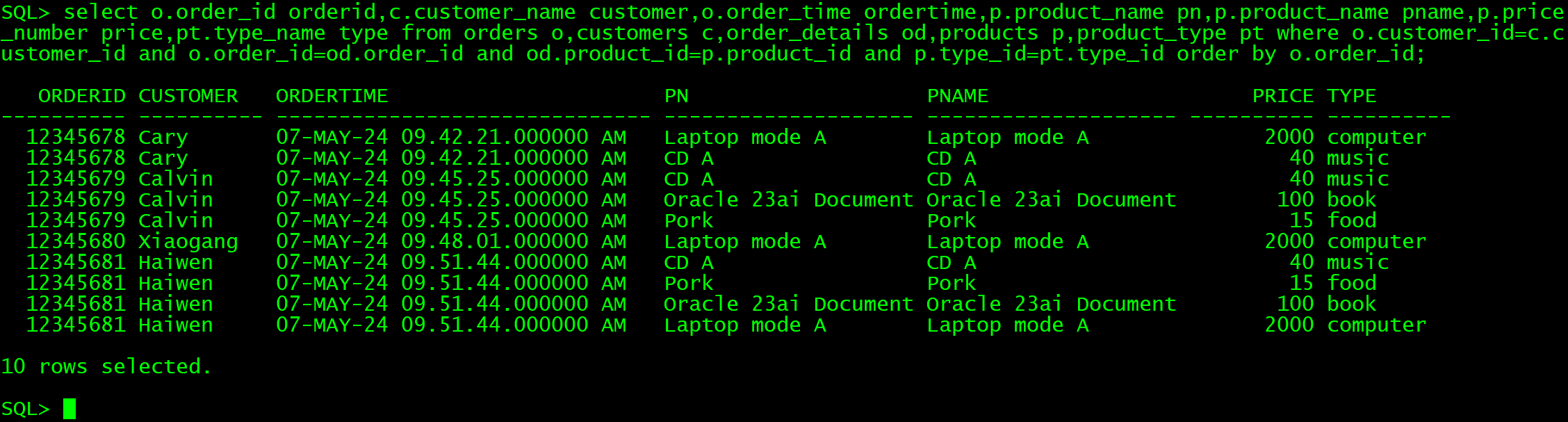
通过SQL查询传统关系型表的订单信息会有一些问题,会有重复的上层数据,在本案例中就是orderid、customer、ordertime相关信息。(原谅我用了个比较low的方式写SQL,我写SQL的能力确实一般般)
3 JSON关系型二元性视图
CREATE JSON DUALITY VIEW orders_jdv ASorders @insert @update @delete{
   _id          : order_id,
   ordertime    : order_time,
   customers @unnest
   {
     cid        : customer_id,
     customer   : customer_name
   },
   details      : order_details
   [ {
    subid       : sub_id
    products
      {
         pn        : product_id,
         pname     : product_name,
         price     : price_number,
         product_type @unnest
         {
           typeid  : type_id,           type    : type_name
         }
       }
     } ]
};

这里需要注意以下一些限制:
- 所有表必须有主键
- 表之间有关联关系的列需要用外键连接
- JSON关系二元性视图必须包含表中所有主键和唯 一约束的列
- 必须包含_id字段
3 查询视图
SQL方式:
select * from orders_jdv;

MongoDB API
&REST:
Oracle现在提供了MongoDB API和REST接口用于操作Oracle数据库中的JSON数据,目前该部分还在摸索之中。
Oracle Database API for MongoDB相关文档可参考官方文档:
https://docs.oracle.com/en/database/oracle/mongodb-api/mgapi/preface.html
更多JSON关系二元性视图的用法及案例可参考官方文档:
https://docs.oracle.com/en/database/oracle/oracle-database/23/jsnvu/preface.html
总结
本期对JSON关系二元性视图做了一个简单案例实操,可以看到使用JSON关系二元性视图可以极大减少文档型数据库的存储冗余问题,是一种颠覆性的数据存储与使用方式,但使用还是有一些限制。
老规矩,知道写了些啥。
来自 “ ITPUB博客 ” ,链接:https://blog.itpub.net/31466763/viewspace-3014565/ ,如需转载,请注明出处,否则将追究法律责任。

最新文章
- 胖头鱼的技术专栏-479 如何高效地将喂给 AI 的数据搬过去(20261015)
- 胖头鱼的技术专栏-478 Agent 成了新用户,数据库要接住它的下一步(20261014)
- 胖头鱼的技术专栏-477 26ai新特性实战:表达式分区(20261013)
- 胖头鱼的技术专栏-476 26ai新特性实战:聚合过滤(20261012)
- 胖头鱼的技术专栏-475 蹭到最后,就没人摆摊了(20261010)
- 胖头鱼的技术专栏-474 从能跑到能上线:PG SplitJSON 0.2.0 和 0.1.0 差在哪
- 胖头鱼的技术专栏-473 26ai新特性实战:日历函数(20261004)
- 胖头鱼的技术专栏-473 改JSON的一个字段不再重写整篇:我给PostgreSQL 18写了个扩展
- 胖头鱼的技术专栏-472 26ai新特性实战:无 FROM 子句的 SELECT 语句(20261003)
- 胖头鱼的技术专栏-471 数据库优化的三层楼——为什么多数人总在第二层打转
