Enable Oracle E-Business Suite Integrated SOA Gateway
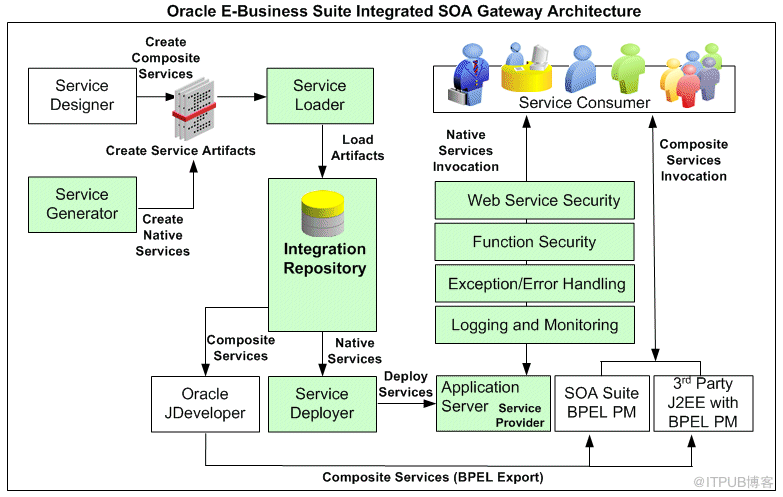
All the native packaged public integration interfaces are published in the Oracle Integration Repository by default. Integration repository administrators can then transform these native integration interfaces into Web services through service generator. Service loader uploads service artifacts to Oracle Integration Repository. Service deployer deploys service artifacts from the Integration Repository to the application server where services can be exposed to customers through service provider.(说明Service发布到Integration Repository后,还需要一个发布的动作,把Native Interface发布到Application Server,消费方才能调用。)
Service provider identifies and processes inbound SOAP requests from service consumers, reinforces function security and Web service security, as well as passes all SOAP request and response messages to SOA Monitor (if the monitoring feature is enabled) for further monitoring SOAP messages to ensure the seamless service invocations throughout the entire service life cycle.
For composite services, system integration developers orchestrate composite services using Oracle JDeveloper. Service loader then uploads these service artifacts to Oracle Integration Repository. Users granted with the Download Composite Service privilege can further download the BPEL files to their local directories. Integration repository developers can open the downloaded BPEL files in Oracle JDeveloper, modify and deploy them if needed. Oracle BPEL Process Manager (BPEL PM) or 3rd party J2EE BPEL PM will then pick up deployed composite services which can be invoked from the Oracle E-Business Suite.
* 556540.1: Installing Oracle E-Business Suite Integrated SOA Gateway, Release 12(重点阅读)
* 1144313.1: Setting Up SAML Token Security for Oracle E-Business Suite Integrated SOA Gateway Release 12.1.3
* 1096553.1: Oracle E-Business Suite Integrated SOA Gateway Release Notes for Release 12.1.3
* 1081100.1: Configuring Oracle E-Business Suite Integrated SOA Gateway Release 12.1.2 and Release 12.1.3 in a Multinode Environment
* 953482.1: Oracle E-Business Suite Integrated SOA Gateway Release Notes, Release 12.1.2
* 1196642.1: Configuring Oracle E-Business Suite Integrated SOA Gateway Release 12.1.1 in a Multinode Environment
* 565922.1: Oracle E-Business Suite Integrated SOA Gateway Release Notes, Release 12.1.1
* 726414.1: Oracle E-Business Suite Integrated SOA Gateway Troubleshooting Guide, Release 12
* 815196.1: Oracle E-Business Suite Integrated SOA Gateway 12.1.1 Consolidated One-Off
* 946192.1: Oracle E-Business Suite Integrated SOA Gateway 12.1.1 Integration Repository Parser One-Off
Oracle E-Business Suite Integrated SOA Gateway User\'s Guide
Oracle E-Business Suite Integrated SOA Gateway Implementation Guide R12.1
Oracle E-Business Suite Integrated SOA Gateway Developer\'s Guide
来自 “ ITPUB博客 ” ,链接:https://blog.itpub.net/26687597/viewspace-1207520/ ,如需转载,请注明出处,否则将追究法律责任。

