引子
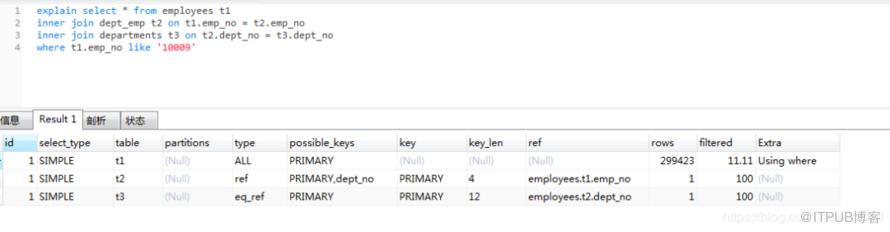
EXPLAIN的输出列
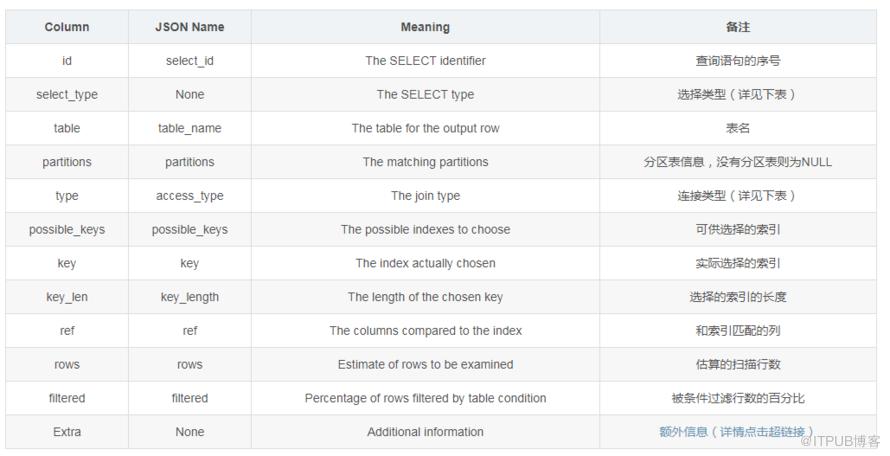
select_type(选择类型)
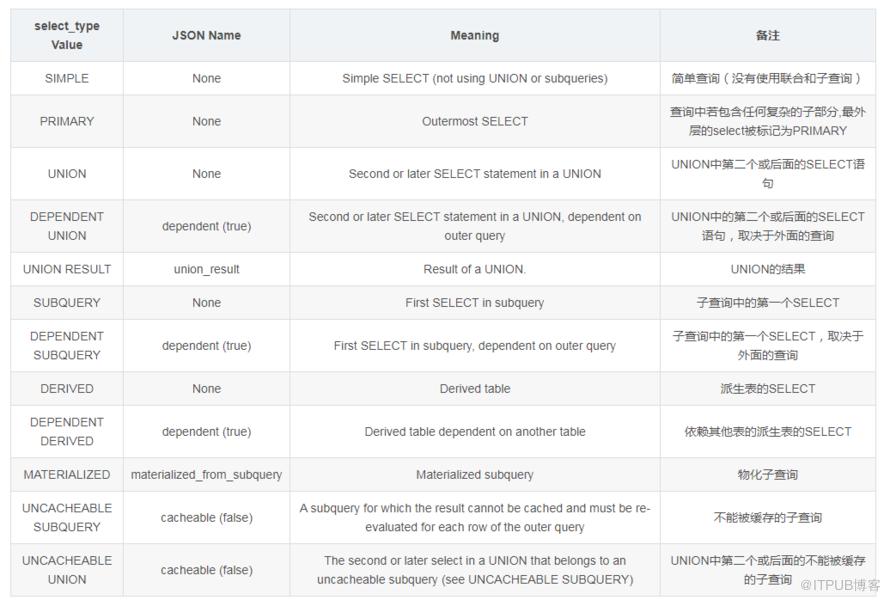
type(连接类型)
The table has only one row (= system table). This is a special case of the const join type.
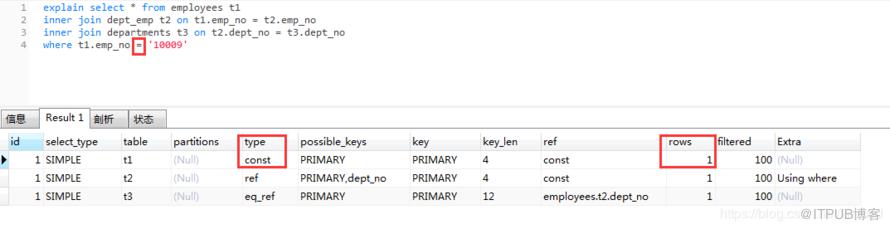
The table has at most one matching row, which is read at the start of the query. Because there is only one row, values from the column in this row can be regarded as constants by the rest of the optimizer. const tables are very fast because they are read only once. const is used when you compare all parts of a PRIMARY KEY or UNIQUE index to constant values. In the following queries, tbl_name can be used as a const table:
// 通过主键查找SELECT * FROM tbl_name WHERE primary_key=1;// 通过唯一索引查找SELECT * FROM tbl_nameWHERE primary_key_part1=1 AND primary_key_part2=2;
One row is read from this table for each combination of rows from the previous tables. Other than the system and const types, this is the best possible join type. It is used when all parts of an index are used by the join and the index is a PRIMARY KEY or UNIQUE NOT NULL index. eq_ref can be used for indexed columns that are compared using the = operator. The comparison value can be a constant or an expression that uses columns from tables that are read before this table. In the following examples, MySQL can use an eq_ref join to process ref_table:
// 多表关联查询,单行匹配SELECT * FROM ref_table,other_tableWHERE ref_table.key_column=other_table.column;// 多表关联查询,联合唯一索引,单行匹配SELECT * FROM ref_table,other_tableWHERE ref_table.key_column_part1=other_table.columnAND ref_table.key_column_part2=1;
All rows with matching index values are read from this table for each combination of rows from the previous tables.
ref is used if the join uses only a leftmost prefix of the key or if the key is not a PRIMARY KEY or UNIQUE index (in other words, if the join cannot select a single row based on the key value). If the key that is used matches only a few rows, this is a good join type.
ref can be used for indexed columns that are compared using the = or <=> operator. In the following examples, MySQL can use a ref join to process ref_table:
// 根据索引(非主键,非唯一索引),多行匹配SELECT * FROM ref_table WHERE key_column=expr;// 多表关联查询,多行匹配SELECT * FROM ref_table,other_tableWHERE ref_table.key_column=other_table.column;// 多表关联查询,联合索引,多行匹配SELECT * FROM ref_table,other_tableWHERE ref_table.key_column_part1=other_table.columnAND ref_table.key_column_part2=1;
The join is performed using a FULLTEXT index.
This join type is like ref, but with the addition that MySQL does an extra search for rows that contain NULL values. This join type optimization is used most often in resolving subqueries. In the following examples, MySQL can use a ref_or_null join to process ref_table:
SELECT * FROM ref_table WHERE key_column=exprOR key_column IS NULL;
This join type indicates that the Index Merge optimization is used. In this case, the key column in the output row contains a list of indexes used, and key_len contains a list of the longest key parts for the indexes used.
This type replaces eq_ref for some IN subqueries of the following form:
value IN (SELECT primary_key FROM single_table WHERE some_expr)unique_subquery is just an index lookup function that replaces the subquery completely for better efficiency.
This join type is similar to unique_subquery. It replaces IN subqueries, but it works for nonunique indexes in subqueries of the following form:
value IN (SELECT key_column FROM single_table WHERE some_expr)Only rows that are in a given range are retrieved, using an index to select the rows. The key column in the output row indicates which index is used. The key_len contains the longest key part that was used. The ref column is NULL for this type.
range can be used when a key column is compared to a constant using any of the =, <>, >, >=, <, <=, IS NULL, <=>, BETWEEN, LIKE, or IN() operators:
// 多行结果SELECT * FROM tbl_nameWHERE key_column = 10;// 范围查找SELECT * FROM tbl_nameWHERE key_column BETWEEN 10 and 20;// 范围查找SELECT * FROM tbl_nameWHERE key_column IN (10,20,30);// 范围查找SELECT * FROM tbl_nameWHERE key_part1 = 10 AND key_part2 IN (10,20,30);
The index join type is the same as ALL, except that the index tree is scanned. This occurs two ways:
If the index is a covering index for the queries and can be used to satisfy all data required from the table, only the index tree is scanned. In this case, the Extra column says Using index. An index-only scan usually is faster than ALL because the size of the index usually is smaller than the table data.
A full table scan is performed using reads from the index to look up data rows in index order. Uses index does not appear in the Extra column.
MySQL can use this join type when the query uses only columns that are part of a single index.
-
如果索引是查询的覆盖索引,就是说查询的数据在索引中都能找到,只需扫描索引树,不需要回表查询。在这种情况下,explain 的 Extra 列的结果是 Using index。仅索引扫描通常比ALL快,因为索引的大小通常小于表数据。
全表扫描会按索引的顺序来查找数据行。使用索引不会出现在Extra列中。
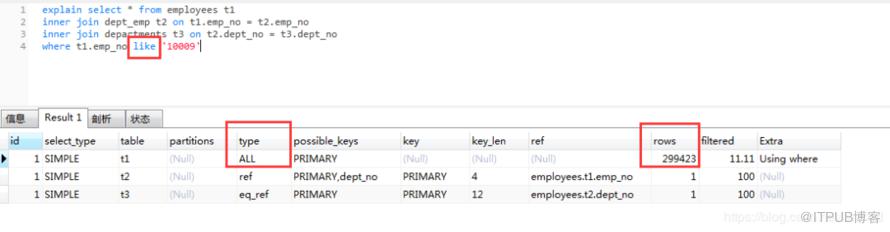
A full table scan is done for each combination of rows from the previous tables. This is normally not good if the table is the first table not marked const, and usually very bad in all other cases. Normally, you can avoid ALL by adding indexes that enable row retrieval from the table based on constant values or column values from earlier tables.

原文作者:编程我也会;如有侵权,请联系管理员删除。
上一篇:
凡事都要追求公平?还真不一定!
下一篇:
MySQL8从零数据开始主从复制

请登录后发表评论
登录
全部评论
