瀚高数据库
1.MemoryContex机制
内存上下文是pg相关的内存控制结构,树形结构组织下的内存上下文能在频繁的内存分配和回收有效的避免内存泄漏,而且通过pg本身维护的一块内存池,能不通过操作系统取得适配内存,在一定程度上提高效率。该机制广泛的存在于后端进程,下面将从4种数据类型开始介绍。
2.内 存上下文的4种数据类型
4种数据类型自上而下分别控制内存上下文的不同部分。
2.1 MemoryContext结构
|
typedef struct MemoryContextData { NodeTag type; /* identifies exact kind of context */
/* these two fields are placed here to minimize alignment wastage: */ bool isReset; /* T = no space alloced since last reset */ bool allowInCritSection; /* allow palloc in critical section */ Size mem_allocated; /* track memory allocated for this context */ const MemoryContextMethods *methods; /* virtual function table */ MemoryContext parent; /* NULL if no parent (toplevel context) */ MemoryContext firstchild; /* head of linked list of children */ MemoryContext prevchild; /* previous child of same parent */ MemoryContext nextchild; /* next child of same parent */ const char *name; /* context name (just for debugging) */ const char *ident; /* context ID if any (just for debugging) */ MemoryContextCallback *reset_cbs; /* list of reset/delete callbacks */ } MemoryContextData;
/* utils/palloc.h contains typedef struct MemoryContextData *MemoryContext */ typedef struct MemoryContextData *MemoryContext |
上述成员变量意义:
1. type是枚举类型变量,表示内存上下文的类型:
|
/* src/include/nodes/nodes.h */ typedef enum NodeTag { T_Invalid = 0,
#include "nodes/nodetags.h" // src/include/nodes/nodetags.h } NodeTag; |
2.isReset如果为true,表明该上下文自从上次Reset(重置)后没有在上面分配过内存。如果为false,则表明已经发生内存申请。
3.allowInCritSection是否允许在临界区中分配内存,主要用于代码调试,一般生产环境都为false。
4.mem_allocated记录为此上下文分配的内存大小。
5.methods记录了内存上下文使用的函数指针。methods的数据类型是MemoryContextMethods ,其结构如下:
|
/* src/include/nodes/memnodes.h */ typedef struct MemoryContextMethods { void *(*alloc) (MemoryContext context, Size size); /* call this free_p in case someone #define's free() */ void (*free_p) (void *pointer); void *(*realloc) (void *pointer, Size size); void (*reset) (MemoryContext context); void (*delete_context) (MemoryContext context);
Size (*get_chunk_space) (void *pointer);
bool (*is_empty) (MemoryContext context); void (*stats) (MemoryContext context, MemoryStatsPrintFunc printfunc, void *passthru, MemoryContextCounters *totals, bool print_to_stderr); } MemoryContextMethods; |
pg实现了上面的函数,并用这些函数进行对内存上下文的操作。
6.parent内存上下文的父节点,对于TopMemoryContext,其parent字段为NULL,因为TopMemoryContext是所有内存上下文的父节点。
7.firstchild指向第一个子内存上下文,在树形结构中同一层级的内存上下文(父亲相同)以双向链表组织。
8.prevchild 指向前一个兄弟节点
9.nextchild指向下一个兄弟节点
10.name具体MemoryContext的名称,比如对于TopMemoryContext内存上下文,则name即为“TopMemoryContext”,ErrorContext内存上下文,其name成员的值就是“ErrorContext”。不同的MemoryContext具有不同的名称,主要用于调试使用。
11.ident主要用于调试使用,一般跟name相同。
12.reset_cbs回调函数列表。在下一次重置或删除上下文之前,将调用一次此类函数。它可以用来放弃在某种意义上与上下文中分配的对象相关联的资源。其数据类型为MemoryContextCallback ,结构如下所示:
|
/* src/include/utils/palloc.h /* * A memory context can have callback functions registered on it. Any such * function will be called once just before the context is next reset or * deleted. The MemoryContextCallback struct describing such a callback * typically would be allocated within the context itself, thereby avoiding * any need to manage it explicitly (the reset/delete action will free it). */ typedef void (*MemoryContextCallbackFunction) (void *arg);
typedef struct MemoryContextCallback { MemoryContextCallbackFunction func; /* function to call */ void *arg; /* argument to pass it */ struct MemoryContextCallback *next; /* next in list of callbacks */ } MemoryContextCallback; |
MemoryContextCallback是结构体类型,每个具体对象都将包含一个func,该函数接收一个arg,并且返回void;一个func需要的arg;一个指向下个节点的指针。
2.2 AllocSetContext
AllocSetContext是MemoryContext的标准实现,结构如下:
|
/* src/backend/utils/mmgr/aset.c */ /* * AllocSetContext is our standard implementation of MemoryContext. * * Note: header.isReset means there is nothing for AllocSetReset to do. * This is different from the aset being physically empty (empty blocks list) * because we will still have a keeper block. It's also different from the set * being logically empty, because we don't attempt to detect pfree'ing the * last active chunk. */ typedef struct AllocSetContext { MemoryContextData header; /* Standard memory-context fields */ /* Info about storage allocated in this context: */ AllocBlock blocks; /* head of list of blocks in this set */ MemoryChunk *freelist[ALLOCSET_NUM_FREELISTS]; /* free chunk lists */ /* Allocation parameters for this context: */ Size initBlockSize; /* initial block size */ Size maxBlockSize; /* maximum block size */ Size nextBlockSize; /* next block size to allocate */ Size allocChunkLimit; /* effective chunk size limit */ AllocBlock keeper; /* keep this block over resets */ /* freelist this context could be put in, or -1 if not a candidate: */ int freeListIndex; /* index in context_freelists[], or -1 */ } AllocSetContext; typedef AllocSetContext *AllocSet; |
1.header标准的内存上下文区域,即抽象类型MemoryContext(可理解为子类对象中的基类对象的内存区域),通过这个字段可以区分各内存上下文的层次关系,header作为AllocSetContext的第一个成员,有助于AllocSet和MemoryContext之间的相互转换。
2.blocks内存块链表,记录内存上下文向操作系统申请的连续大块内存。它是实际分配内存的地方,AllocSetContext中内存的分配是以Block(块)为单位向OS申请的,多个Block之间以双向链表的方式连接起来。此blocks存储了此内存上下文的第一个block的地址,可以由它开始遍历该内存上下文的所有block。
3.freelist组织该内存上下文里所有内存块中已释放的内存片的链表结构。它是一个数组成员,其数组大小是ALLOCSET_NUM_FREELISTS(该值是11)。freelist数组中各成员分别表示不同大小的AllocChunkData。在AllocSetContext的实现中,对于小的内存块(8 ~ 8192Byte)来说,当释放的时候不会归还给OS,而是将其缓存到freelist中。
4.initBlockSizeBlock的初始化大小,默认8KB。
5.maxBlockSizeBlock的最大大小。
6.nextBlockSize下一个Block的大小。
7.allocChunkLimit内存片的阈值,申请的内存超过此阀值直接分配新的block,默认是8KB。
8.keeper保留第一次申请的block。
9.freeListIndex在context_freelists全局数组中的顺序,0表示默认freelist,1表示小内存的freelist,-1表示不需要进入freelist(比如超过allocChunkLimit的Block)。context_freelists的的数据类型是AllocSetFreeList ,结构如下所示:
|
/* src/backend/utils/mmgr/aset.c */
// 为了提升效率,避免重复的删除和创建内存上下文,维护了一个freelist存放一些之前撤下来的内存上下文。当把一个内存上下文放入freelist之前,必须对这个内存上下文执行reset操作,这样就能保证内存上下文只有初始化时的内存片;同时要保证这个内存上下文要和list中的其他内存上下文在minContextSize和initBlockSize有相同的值。MaxBlockSize只是对我们初始化时与其他值做比较使用,与此操作并不相关。 typedef struct AllocSetFreeList { int num_free; /* current list length */ AllocSetContext *first_free; /* list header */ } AllocSetFreeList; /* context_freelists[0] is for default params, [1] for small params */ static AllocSetFreeList context_freelists[2] = { { 0, NULL }, { 0, NULL } }; |
注意:上面的AllocSetFreeList和AllocSetContext中的freelist不同,这里指的是空闲的AllocSetContextData,而非AllocChunkData。当发生delete时候,会将删除后的AllocSetContextData放入到AllocSetFreeList。
2.3 AllocBlockData
PostgreSQL向OS申请内存分配的基本单位是Block(块),一个Block可能被拆分为若干个Chunk,也可能只包含一个Chunk(比如较大块内存)。在chunk释放时候 "某些chunk" 会放入freelist链表中,以便于下次分配,最后由Block统一释放归还给OS。
AllocBlockData的结构如下图所示:
|
/* src/backend/utils/mmgr/aset.c */ /* * AllocBlock * An AllocBlock is the unit of memory that is obtained by aset.c * from malloc(). It contains one or more MemoryChunks, which are * the units requested by palloc() and freed by pfree(). MemoryChunks * cannot be returned to malloc() individually, instead they are put * on freelists by pfree() and re-used by the next palloc() that has * a matching request size. * * AllocBlockData is the header data for a block --- the usable space * within the block begins at the next alignment boundary. */ typedef struct AllocBlockData { AllocSet aset; /* aset that owns this block */ AllocBlock prev; /* prev block in aset's blocks list, if any */ AllocBlock next; /* next block in aset's blocks list, if any */ char *freeptr; /* start of free space in this block */ char *endptr; /* end of space in this block */ } AllocBlockData; typedef struct AllocBlockData *AllocBlock; /* forward reference */ |
下面是该数据结构中各成员所代表的含义:
1. aset指向该AllocBlockData所属的AllocSetContext。
2. prev指向AllocSetContext块列表中的上一块(如果有的话)。
3. next指向AllocSetContext块列表中的下一块(如果有的话)。
4. freeptr指向块中可用空闲区域的起始地址。
5. endptr指向块中可用空闲区域的结束地址。
2.4 AllocChunkData
|
/* src/backend/utils/mmgr/aset.c */ /* * AllocChunk * The prefix of each piece of memory in an AllocBlock * * Note: to meet the memory context APIs, the payload area of the chunk must * be maxaligned, and the "aset" link must be immediately adjacent to the * payload area (cf. GetMemoryChunkContext). We simplify matters for this * module by requiring sizeof(AllocChunkData) to be maxaligned, and then * we can ensure things work by adding any required alignment padding before * the "aset" field. There is a static assertion below that the alignment * is done correctly. */ typedef struct AllocChunkData { /* size is always the size of the usable space in the chunk */ Size size; // 分配出去的大小 #ifdef MEMORY_CONTEXT_CHECKING /* when debugging memory usage, also store actual requested size */ /* this is zero in a free chunk */ Size requested_size; // 用户实际需求大小
#define ALLOCCHUNK_RAWSIZE (SIZEOF_SIZE_T * 2 + SIZEOF_VOID_P) #else #define ALLOCCHUNK_RAWSIZE (SIZEOF_SIZE_T + SIZEOF_VOID_P) #endif /* MEMORY_CONTEXT_CHECKING */
/* ensure proper alignment by adding padding if needed */ #if (ALLOCCHUNK_RAWSIZE % MAXIMUM_ALIGNOF) != 0 char padding[MAXIMUM_ALIGNOF - ALLOCCHUNK_RAWSIZE % MAXIMUM_ALIGNOF]; // 为了保证对齐,padding数组用来做填充 #endif
/* aset is the owning aset if allocated, or the freelist link if free */ void *aset; // 该chunk如果被分配出去,aset指向一个AllocSetContext;如果没有被分配,aset指向一个freelist link。 /* there must not be any padding to reach a MAXALIGN boundary here! */ } AllocChunkData; |
3.启动内存上下文子系统
当使用pg_ctl或postmaster(postgres)启动PostgreSQL数据库服务时候,在main()函数中会先对名为TopMemoryContext、CurrentMemoryContext和ErrorContext的内存上下文全局变量进行初始化操作,由函数MemoryContextInit()负责完成。其中TopMemoryContext是所有其他内存上下文的祖先节点。
3.1 初始化内存上下文
|
/* src/backend/main/main.c */ …… /* * Fire up essential subsystems: error and memory management * Code after this point is allowed to use elog/ereport, though * localization of messages may not work right away, and messages won't go * anywhere but stderr until GUC settings get loaded. */ MemoryContextInit(); …… |
|
/* src/backend/utils/mmgr/mcxt.c */ /* * MemoryContextInit * Start up the memory-context subsystem. * * This must be called before creating contexts or allocating memory in * contexts. TopMemoryContext and ErrorContext are initialized here; * other contexts must be created afterwards. * * In normal multi-backend operation, this is called once during * postmaster startup, and not at all by individual backend startup * (since the backends inherit an already-initialized context subsystem * by virtue of being forked off the postmaster). But in an EXEC_BACKEND * build, each process must do this for itself. * * In a standalone backend this must be called during backend startup. */ void MemoryContextInit(void) { AssertState(TopMemoryContext == NULL);
/* * First, initialize TopMemoryContext, which is the parent of all others. */ TopMemoryContext = AllocSetContextCreate((MemoryContext) NULL, "TopMemoryContext", ALLOCSET_DEFAULT_SIZES);
/* * Not having any other place to point CurrentMemoryContext, make it point * to TopMemoryContext. Caller should change this soon! */ CurrentMemoryContext = TopMemoryContext;
/* * Initialize ErrorContext as an AllocSetContext with slow growth rate --- * we don't really expect much to be allocated in it. More to the point, * require it to contain at least 8K at all times. This is the only case * where retained memory in a context is *essential* --- we want to be * sure ErrorContext still has some memory even if we've run out * elsewhere! Also, allow allocations in ErrorContext within a critical * section. Otherwise a PANIC will cause an assertion failure in the error * reporting code, before printing out the real cause of the failure. * * This should be the last step in this function, as elog.c assumes memory * management works once ErrorContext is non-null. */ ErrorContext = AllocSetContextCreate(TopMemoryContext, "ErrorContext", 8 * 1024, 8 * 1024, 8 * 1024); MemoryContextAllowInCriticalSection(ErrorContext, true); } |
上面函数使用的宏定义如下:
|
/* src/include/utils/memutils.h */ /* * Recommended default alloc parameters, suitable for "ordinary" contexts * that might hold quite a lot of data. */ #define ALLOCSET_DEFAULT_MINSIZE 0 #define ALLOCSET_DEFAULT_INITSIZE (8 * 1024) #define ALLOCSET_DEFAULT_MAXSIZE (8 * 1024 * 1024) #define ALLOCSET_DEFAULT_SIZES \ ALLOCSET_DEFAULT_MINSIZE, ALLOCSET_DEFAULT_INITSIZE, ALLOCSET_DEFAULT_MAXSIZE |
3.2初始化TopMemoryContext
首先,需要初始化TopMemoryContext内存上下文,因为它是所有其他内存上下文的父节点。其初始化功能由函数AllocSetContextCreate()完成,该函数支持五个参数,其函数原型如下:
|
/ * src/include/utils/memutils.h */ /* * This wrapper macro exists to check for non-constant strings used as context * names; that's no longer supported. (Use MemoryContextSetIdentifier if you * want to provide a variable identifier.) */ #ifdef HAVE__BUILTIN_CONSTANT_P #define AllocSetContextCreate(parent, name, ...) \ (StaticAssertExpr(__builtin_constant_p(name), \ "memory context names must be constant strings"), \ AllocSetContextCreateInternal(parent, name, __VA_ARGS__)) #else #define AllocSetContextCreate \ AllocSetContextCreateInternal #endif |
|
/* src/backend/utils/mmgr/aset.c */ /* * AllocSetContextCreateInternal * Create a new AllocSet context. * * parent: parent context, or NULL if top-level context * name: name of context (must be statically allocated) * minContextSize: minimum context size * initBlockSize: initial allocation block size * maxBlockSize: maximum allocation block size * * Most callers should abstract the context size parameters using a macro * such as ALLOCSET_DEFAULT_SIZES. * * Note: don't call this directly; go through the wrapper macro * AllocSetContextCreate. */ MemoryContext AllocSetContextCreateInternal(MemoryContext parent, const char *name, Size minContextSize, Size initBlockSize, Size maxBlockSize) { int freeListIndex; Size firstBlockSize; AllocSet set; AllocBlock block;
/* Assert we padded AllocChunkData properly */ StaticAssertStmt(ALLOC_CHUNKHDRSZ == MAXALIGN(ALLOC_CHUNKHDRSZ), "sizeof(AllocChunkData) is not maxaligned"); StaticAssertStmt(offsetof(AllocChunkData, aset) + sizeof(MemoryContext) == ALLOC_CHUNKHDRSZ, "padding calculation in AllocChunkData is wrong");
/* * First, validate allocation parameters. Once these were regular runtime * test and elog's, but in practice Asserts seem sufficient because nobody * varies their parameters at runtime. We somewhat arbitrarily enforce a * minimum 1K block size. */ Assert(initBlockSize == MAXALIGN(initBlockSize) && initBlockSize >= 1024); Assert(maxBlockSize == MAXALIGN(maxBlockSize) && maxBlockSize >= initBlockSize && AllocHugeSizeIsValid(maxBlockSize)); /* must be safe to double */ Assert(minContextSize == 0 || (minContextSize == MAXALIGN(minContextSize) && minContextSize >= 1024 && minContextSize <= maxBlockSize));
/* * Check whether the parameters match either available freelist. We do * not need to demand a match of maxBlockSize. */ if (minContextSize == ALLOCSET_DEFAULT_MINSIZE && initBlockSize == ALLOCSET_DEFAULT_INITSIZE) freeListIndex = 0; else if (minContextSize == ALLOCSET_SMALL_MINSIZE && initBlockSize == ALLOCSET_SMALL_INITSIZE) freeListIndex = 1; else freeListIndex = -1;
/* * If a suitable freelist entry exists, just recycle that context. */ if (freeListIndex >= 0) { AllocSetFreeList *freelist = &context_freelists[freeListIndex];
if (freelist->first_free != NULL) { /* Remove entry from freelist */ set = freelist->first_free; freelist->first_free = (AllocSet) set->header.nextchild; freelist->num_free--;
/* Update its maxBlockSize; everything else should be OK */ set->maxBlockSize = maxBlockSize;
/* Reinitialize its header, installing correct name and parent */ MemoryContextCreate((MemoryContext) set, T_AllocSetContext, &AllocSetMethods, parent, name);
((MemoryContext) set)->mem_allocated = set->keeper->endptr - ((char *) set);
return (MemoryContext) set; } }
/* Determine size of initial block */ firstBlockSize = MAXALIGN(sizeof(AllocSetContext)) + ALLOC_BLOCKHDRSZ + ALLOC_CHUNKHDRSZ; if (minContextSize != 0) firstBlockSize = Max(firstBlockSize, minContextSize); else firstBlockSize = Max(firstBlockSize, initBlockSize);
/* * Allocate the initial block. Unlike other aset.c blocks, it starts with * the context header and its block header follows that. */ set = (AllocSet) malloc(firstBlockSize); if (set == NULL) { if (TopMemoryContext) MemoryContextStats(TopMemoryContext); ereport(ERROR, (errcode(ERRCODE_OUT_OF_MEMORY), errmsg("out of memory"), errdetail("Failed while creating memory context \"%s\".", name))); }
/* * Avoid writing code that can fail between here and MemoryContextCreate; * we'd leak the header/initial block if we ereport in this stretch. */
/* Fill in the initial block's block header */ block = (AllocBlock) (((char *) set) + MAXALIGN(sizeof(AllocSetContext))); block->aset = set; block->freeptr = ((char *) block) + ALLOC_BLOCKHDRSZ; block->endptr = ((char *) set) + firstBlockSize; block->prev = NULL; block->next = NULL;
/* Mark unallocated space NOACCESS; leave the block header alone. */ VALGRIND_MAKE_MEM_NOACCESS(block->freeptr, block->endptr - block->freeptr);
/* Remember block as part of block list */ set->blocks = block; /* Mark block as not to be released at reset time */ set->keeper = block;
/* Finish filling in aset-specific parts of the context header */ MemSetAligned(set->freelist, 0, sizeof(set->freelist));
set->initBlockSize = initBlockSize; set->maxBlockSize = maxBlockSize; set->nextBlockSize = initBlockSize; set->freeListIndex = freeListIndex;
/* * Compute the allocation chunk size limit for this context. It can't be * more than ALLOC_CHUNK_LIMIT because of the fixed number of freelists. * If maxBlockSize is small then requests exceeding the maxBlockSize, or * even a significant fraction of it, should be treated as large chunks * too. For the typical case of maxBlockSize a power of 2, the chunk size * limit will be at most 1/8th maxBlockSize, so that given a stream of * requests that are all the maximum chunk size we will waste at most * 1/8th of the allocated space. * * We have to have allocChunkLimit a power of two, because the requested * and actually-allocated sizes of any chunk must be on the same side of * the limit, else we get confused about whether the chunk is "big". * * Also, allocChunkLimit must not exceed ALLOCSET_SEPARATE_THRESHOLD. */ StaticAssertStmt(ALLOC_CHUNK_LIMIT == ALLOCSET_SEPARATE_THRESHOLD, "ALLOC_CHUNK_LIMIT != ALLOCSET_SEPARATE_THRESHOLD");
set->allocChunkLimit = ALLOC_CHUNK_LIMIT;
while ((Size) (set->allocChunkLimit + ALLOC_CHUNKHDRSZ) > (Size) ((maxBlockSize - ALLOC_BLOCKHDRSZ) / ALLOC_CHUNK_FRACTION)) set->allocChunkLimit >>= 1;
/* Finally, do the type-independent part of context creation */ MemoryContextCreate((MemoryContext) set, T_AllocSetContext, &AllocSetMethods, parent, name);
((MemoryContext) set)->mem_allocated = firstBlockSize;
return (MemoryContext) set; } |
3.2.1 静态断言是否正确填充AllocChunkData
|
#define StaticAssertStmt(condition, errmessage) \ static_assert(condition, errmessage) |
【注】关于static_assert,在编译时测试断言。 如果指定的常数表达式为 false,则编译器显示指定的消息,并且编译失败;否则,不会产生任何影响。 C11 中的新增功能。_Static_assert 是 C11 中引入的关键字。 static_assert 是 C11 中引入的宏,它映射到 _Static_assert 关键字:
|
/* assert.h */ #if defined __USE_ISOC11 && !defined __cplusplus /* Static assertion. Requires support in the compiler. */ # undef static_assert # define static_assert _Static_assert #endif |
condition:
可在编译时计算的整型常数表达式。 如果表达式为零 (false),则显示 string_literal 参数,并且编译因出错而失败。 如果表达式不为零 (true),则不会产生任何影响。
errmessage:
如果 constant-expression 计算结果为零 (false),则显示此消息。 此消息必须使用编译器的基本字符集来生成。 字符不能为多字节字符或宽字符。_Static_assert 关键字和 static_assert 宏均在编译时测试软件断言。 它们可用于全局或函数范围。相反,assert 宏、_assert 和 _wassert 函数在运行时测试软件断言,并产生运行时成本。
|
#define ALLOC_CHUNKHDRSZ sizeof(struct AllocChunkData) #define MAXALIGN(LEN) TYPEALIGN(MAXIMUM_ALIGNOF, (LEN)) #define TYPEALIGN(ALIGNVAL,LEN) \ (((uintptr_t) (LEN) + ((ALIGNVAL) - 1)) & ~((uintptr_t) ((ALIGNVAL) - 1))) /* Define as the maximum alignment requirement of any C data type. */ #define MAXIMUM_ALIGNOF 8 |
TYPEALIGN能够保证对齐之后向上取整, 用&运算实现除法或者说逻辑右移运算。
|
StaticAssertStmt(offsetof(AllocChunkData, aset) + sizeof(MemoryContext) == ALLOC_CHUNKHDRSZ, "padding calculation in AllocChunkData is wrong"); |
offsetof是编译器内置实现的:
|
/* Offset of member MEMBER in a struct of type TYPE. */ #define offsetof(TYPE, MEMBER) __builtin_offsetof (TYPE, MEMBER) #define offsetof(TYPE, MEMBER) ((size_t) &((TYPE *)0)->MEMBER) |
把0当做这个类型的首地址,member对0的偏移就是之前元素占据的字节数。
3.2.2 对参数进行校验
这里接着对函数AllocSetContextCreateInternal()中的第三、四、五个参数进行校验,用来判别其值是否合理、对齐。
|
/* * First, validate allocation parameters. Once these were regular runtime * test and elog's, but in practice Asserts seem sufficient because nobody * varies their parameters at runtime. We somewhat arbitrarily enforce a * minimum 1K block size. */ Assert(initBlockSize == MAXALIGN(initBlockSize) && initBlockSize >= 1024); Assert(maxBlockSize == MAXALIGN(maxBlockSize) && maxBlockSize >= initBlockSize && AllocHugeSizeIsValid(maxBlockSize)); /* must be safe to double */ Assert(minContextSize == 0 || (minContextSize == MAXALIGN(minContextSize) && minContextSize >= 1024 && minContextSize <= maxBlockSize)); |
AllocHugeSizeIsValid也是一个宏:
|
#define MaxAllocHugeSize (SIZE_MAX / 2) #define AllocHugeSizeIsValid(size) ((Size) (size) <= MaxAllocHugeSize) /* Limit of `size_t' type. */ #if __WORDSIZE == 64 #define SIZE_MAX (18446744073709551615UL) #else #ifdef __WORDSIZE32_SIZE_ULONG #define SIZE_MAX (4294967295UL) #else #define SIZE_MAX (4294967295U) #endif #endif |
MaxAllocHugeSize的值为: (unsigned long long)(-1) >> 1
3.2.3 检查参数是否与freelist匹配
|
/* * Check whether the parameters match either available freelist. We do * not need to demand a match of maxBlockSize. */ if (minContextSize == ALLOCSET_DEFAULT_MINSIZE && initBlockSize == ALLOCSET_DEFAULT_INITSIZE) freeListIndex = 0; else if (minContextSize == ALLOCSET_SMALL_MINSIZE && initBlockSize == ALLOCSET_SMALL_INITSIZE) freeListIndex = 1; else freeListIndex = -1;
// 关于这几个宏的定义: / * * Recommended default alloc parameters, suitable for "ordinary" contexts * that might hold quite a lot of data. */ #define ALLOCSET_DEFAULT_MINSIZE 0 #define ALLOCSET_DEFAULT_INITSIZE (8 * 1024) #define ALLOCSET_DEFAULT_MAXSIZE (8 * 1024 * 1024) #define ALLOCSET_DEFAULT_SIZES \ ALLOCSET_DEFAULT_MINSIZE, ALLOCSET_DEFAULT_INITSIZE, ALLOCSET_DEFAULT_MAXSIZE
/* * Recommended alloc parameters for "small" contexts that are never expected * to contain much data (for example, a context to contain a query plan). */ #define ALLOCSET_SMALL_MINSIZE 0 #define ALLOCSET_SMALL_INITSIZE (1 * 1024) #define ALLOCSET_SMALL_MAXSIZE (8 * 1024) #define ALLOCSET_SMALL_SIZES \ ALLOCSET_SMALL_MINSIZE, ALLOCSET_SMALL_INITSIZE, ALLOCSET_SMALL_MAXSIZE |
这里是对TomMemoryContext内存上下文进行初始化,且其实参是minContextSize = 0,initBlockSize = 8 * 1024。所以freeListIndex = 0。freeListIndex用于对全局结构体数组变量(context_freelists)中的成员进行释放操作,该结构体后面会详细说明。
3.2.4 如果有匹配的freelist,则释放其空间
由于这里freeListIndex = 0,且得到的freelist指针变量中其成员变量first_free的值为NULL,不会进入if (freelist->first_free != NULL)的函数体中。freelist的内容如何来的,在4.5节中有详细说明。
|
/* * If a suitable freelist entry exists, just recycle that context. */ // 如果在已有的freelist中有合适的项,直接拿来用,不再进行后续malloc操作。 if (freeListIndex >= 0) { AllocSetFreeList *freelist = &context_freelists[freeListIndex]; if (freelist->first_free != NULL) { /* Remove entry from freelist */ set = freelist->first_free; freelist->first_free = (AllocSet) set->header.nextchild; freelist->num_free--;
/* Update its maxBlockSize; everything else should be OK */ set->maxBlockSize = maxBlockSize;
/* Reinitialize its header, installing correct name and parent */ // 注释中Reinitialize代表这个freelist中的内存上下文已经被初始化一次了,实际上freelist中的内存上下文就是之前用过的,在删除的时候没有归还给系统,直接放到了freelist中,所以这里是根据当前的参数再次初始化。 MemoryContextCreate((MemoryContext) set, T_AllocSetContext, &AllocSetMethods, parent, name);
((MemoryContext) set)->mem_allocated = set->keeper->endptr - ((char *) set); return (MemoryContext) set; } } |
3.2.5 确定初始化块大小
|
/* Determine size of initial block */ firstBlockSize = MAXALIGN(sizeof(AllocSetContext)) + ALLOC_BLOCKHDRSZ + ALLOC_CHUNKHDRSZ; if (minContextSize != 0) firstBlockSize = Max(firstBlockSize, minContextSize); else firstBlockSize = Max(firstBlockSize, initBlockSize); |
ALLOC_BLOCKHDRSZ 和ALLOC_CHUNKHDRSZ都是一个宏,分别是:
|
#define ALLOC_BLOCKHDRSZ MAXALIGN(sizeof(AllocBlockData)) #define ALLOC_CHUNKHDRSZ sizeof(struct AllocChunkData) |
实参minContextSize 的值为0,所以走else{}分支。其中initBlockSize的值是8KB,显然这里的MAXALIGN(sizeof(AllocSetContext)) + ALLOC_BLOCKHDRSZ + ALLOC_CHUNKHDRSZ值是小于8KB的,因此firstBlockSize 最终的值是8KB。
3.2.6 分配AllocSetContextData块
在得到了初始化块分配大小(firstBlockSize,8KB)之后,接下来就需要为我们的set申请内存空间,然后将这片内存地址强制转换为AllocSet类型。在这里需要对其内存申请结果状态信息进行判断。
|
/* * Allocate the initial block. Unlike other aset.c blocks, it starts with * the context header and its block header follows that. */ set = (AllocSet) malloc(firstBlockSize); if (set == NULL) { if (TopMemoryContext) MemoryContextStats(TopMemoryContext); ereport(ERROR, (errcode(ERRCODE_OUT_OF_MEMORY), errmsg("out of memory"), errdetail("Failed while creating memory context \"%s\".", name))); } |
如果set的值为NULL,表明系统内存不足,申请失败。此时需要对TopMemoryContext内存向下文及其所有的子内存上下文进行打印其统计信息处理。由函数MemoryContextStats()负责,同时打印相应的错误日志提示信息。函数MemoryContextStats()实现如下:
|
/* * MemoryContextStats * Print statistics about the named context and all its descendants. * * This is just a debugging utility, so it's not very fancy. However, we do * make some effort to summarize when the output would otherwise be very long. * The statistics are sent to stderr. */ void MemoryContextStats(MemoryContext context) { /* A hard-wired limit on the number of children is usually good enough */ MemoryContextStatsDetail(context, 100, true); } |
在函数MemoryContextStats()的内部,直接通过调用MemoryContextStatsDetail()来实现子内存上下文的统计信息打印。
|
/* * MemoryContextStatsDetail * * Entry point for use if you want to vary the number of child contexts shown. * * If print_to_stderr is true, print statistics about the memory contexts * with fprintf(stderr), otherwise use ereport(). */ void MemoryContextStatsDetail(MemoryContext context, int max_children, bool print_to_stderr) { MemoryContextCounters grand_totals;
memset(&grand_totals, 0, sizeof(grand_totals));
MemoryContextStatsInternal(context, 0, true, max_children, &grand_totals, print_to_stderr);
if (print_to_stderr) fprintf(stderr, "Grand total: %zu bytes in %zu blocks; %zu free (%zu chunks); %zu used\n", grand_totals.totalspace, grand_totals.nblocks, grand_totals.freespace, grand_totals.freechunks, grand_totals.totalspace - grand_totals.freespace); else
/* * Use LOG_SERVER_ONLY to prevent the memory contexts from being sent * to the connected client. * * We don't buffer the information about all memory contexts in a * backend into StringInfo and log it as one message. Otherwise which * may require the buffer to be enlarged very much and lead to OOM * error since there can be a large number of memory contexts in a * backend. Instead, we log one message per memory context. */ ereport(LOG_SERVER_ONLY, (errhidestmt(true), errhidecontext(true), errmsg_internal("Grand total: %zu bytes in %zu blocks; %zu free (%zu chunks); %zu used", grand_totals.totalspace, grand_totals.nblocks, grand_totals.freespace, grand_totals.freechunks, grand_totals.totalspace - grand_totals.freespace))); } |
MemoryContextCounters类型如下:
|
/* * MemoryContextCounters * Summarization state for MemoryContextStats collection. * * The set of counters in this struct is biased towards AllocSet; if we ever * add any context types that are based on fundamentally different approaches, * we might need more or different counters here. A possible API spec then * would be to print only nonzero counters, but for now we just summarize in * the format historically used by AllocSet. */ typedef struct MemoryContextCounters { Size nblocks; /* Total number of malloc blocks */ Size freechunks; /* Total number of free chunks */ Size totalspace; /* Total bytes requested from malloc */ Size freespace; /* The unused portion of totalspace */ } MemoryContextCounters; |
3.2.7 填写初始块的块头
申请了firstBlockSize(8 * 1024Byte)大小的内存,并把这段内存的首地址转换为AllocSetContext的指针,接下来在AllocSetContext后面分配一个AllocBlockData大小的区域,对此区域做初始化工作。
|
/* * Avoid writing code that can fail between here and MemoryContextCreate; * we'd leak the header/initial block if we ereport in this stretch. */
/* Fill in the initial block's block header */ block = (AllocBlock) (((char *) set) + MAXALIGN(sizeof(AllocSetContext))); block->aset = set;
// freeptr 指向 block+MAXALIGN(sizeof(AllocBlockData)) 的位置处 block->freeptr = ((char *) block) + ALLOC_BLOCKHDRSZ; //endptr 指向大小为 firstBlockSize 的末尾 block->endptr = ((char *) set) + firstBlockSize; block->prev = NULL; block->next = NULL;
/* Mark unallocated space NOACCESS; leave the block header alone. */ VALGRIND_MAKE_MEM_NOACCESS(block->freeptr, block->endptr - block->freeptr); |
由于我们新增了block信息,所以要对set中的信息做相应的初始化或者修改:
|
/ * Remember block as part of block list */ set->blocks = block; /* Mark block as not to be released at reset time */ set->keeper = block; /* Finish filling in aset-specific parts of the context header */ MemSetAligned(set->freelist, 0, sizeof(set->freelist));
set->initBlockSize = initBlockSize; set->maxBlockSize = maxBlockSize; set->nextBlockSize = initBlockSize; set->freeListIndex = freeListIndex; |
注意set->keeper=block,当我们reset时会进行判断,不会释放keeper指向的block。
3.2.8 计算内存上下文分配内存片大小限制
接下来计算指定的内存上下文中的分配内存片大小限制。由于freelist成员数组大小固定(为数组大小是11),它不能超过ALLOC_CHUNK_LIMIT(8192 Byte)。8*1024 Byte以下当作chunk处理,以上会申请专用block,专用block有block header和chunk header。如果 maxBlockSize 很小,那么超过 maxBlockSize 甚至很大一部分的请求也应该被视为大内存片。对于maxBlockSize的2次方的典型情况,内存片大小的限制最多为maxBlockSize的1/8,因此,给定一个全部为最大块内存片大小的请求流,我们最多会浪费1/8的分配空间。
|
/* * Compute the allocation chunk size limit for this context. It can't be * more than ALLOC_CHUNK_LIMIT because of the fixed number of freelists. * If maxBlockSize is small then requests exceeding the maxBlockSize, or * even a significant fraction of it, should be treated as large chunks * too. For the typical case of maxBlockSize a power of 2, the chunk size * limit will be at most 1/8th maxBlockSize, so that given a stream of * requests that are all the maximum chunk size we will waste at most * 1/8th of the allocated space. * * We have to have allocChunkLimit a power of two, because the requested * and actually-allocated sizes of any chunk must be on the same side of * the limit, else we get confused about whether the chunk is "big". * * Also, allocChunkLimit must not exceed ALLOCSET_SEPARATE_THRESHOLD. */ StaticAssertStmt(ALLOC_CHUNK_LIMIT == ALLOCSET_SEPARATE_THRESHOLD, "ALLOC_CHUNK_LIMIT != ALLOCSET_SEPARATE_THRESHOLD");
set->allocChunkLimit = ALLOC_CHUNK_LIMIT; while ((Size) (set->allocChunkLimit + ALLOC_CHUNKHDRSZ) > (Size) ((maxBlockSize - ALLOC_BLOCKHDRSZ) / ALLOC_CHUNK_FRACTION)) set->allocChunkLimit >>= 1;
/*-------------------- * Chunk freelist k holds chunks of size 1 << (k + ALLOC_MINBITS), * for k = 0 .. ALLOCSET_NUM_FREELISTS-1. * * Note that all chunks in the freelists have power-of-2 sizes. This * improves recyclability: we may waste some space, but the wasted space * should stay pretty constant as requests are made and released. * * A request too large for the last freelist is handled by allocating a * dedicated block from malloc(). The block still has a block header and * chunk header, but when the chunk is freed we'll return the whole block * to malloc(), not put it on our freelists. * * CAUTION: ALLOC_MINBITS must be large enough so that * 1<<ALLOC_MINBITS is at least MAXALIGN, * or we may fail to align the smallest chunks adequately. * 8-byte alignment is enough on all currently known machines. * * With the current parameters, request sizes up to 8K are treated as chunks, * larger requests go into dedicated blocks. Change ALLOCSET_NUM_FREELISTS * to adjust the boundary point; and adjust ALLOCSET_SEPARATE_THRESHOLD in * memutils.h to agree. (Note: in contexts with small maxBlockSize, we may * set the allocChunkLimit to less than 8K, so as to avoid space wastage.) *-------------------- */
#define ALLOC_MINBITS 3 /* smallest chunk size is 8 bytes */ #define ALLOCSET_NUM_FREELISTS 11 #define ALLOC_CHUNK_LIMIT (1 << (ALLOCSET_NUM_FREELISTS-1+ALLOC_MINBITS)) /* Size of largest chunk that we use a fixed size for */ #define ALLOC_CHUNK_FRACTION 4 /* We allow chunks to be at most 1/4 of maxBlockSize (less overhead) */ |
3.2.9 执行与类型无关的上下文创建部分
执行与类型无关的内存上下文创建部分主要由函数MemoryContextCreate()负责完成,如下所示。其中参数set是指向malloc的(8KB)内存空间地址,T_AllocSetContext是该set的类型;AllocSetMethods是一个指针数组,里面的各成员是函数指针,表明用来对内存上下文进行相关操作的函数实现;parent是该内存上下文的父亲,如果是本次创建的内存上下文是TopMemoryContext,则parent参数为NULL;name是该内存上下文的名字。
|
/* * This is the virtual function table for AllocSet contexts. */ static const MemoryContextMethods AllocSetMethods = { AllocSetAlloc, AllocSetFree, AllocSetRealloc, AllocSetReset, AllocSetDelete, AllocSetGetChunkSpace, AllocSetIsEmpty, AllocSetStats #ifdef MEMORY_CONTEXT_CHECKING ,AllocSetCheck #endif };
void MemoryContextCreate(MemoryContext node, NodeTag tag, const MemoryContextMethods *methods, MemoryContext parent, const char *name) { /* Creating new memory contexts is not allowed in a critical section */ Assert(CritSectionCount == 0);
/* Initialize all standard fields of memory context header */ node->type = tag; node->isReset = true; node->methods = methods; node->parent = parent; node->firstchild = NULL; node->mem_allocated = 0; node->prevchild = NULL; node->name = name; node->ident = NULL; node->reset_cbs = NULL;
/* OK to link node into context tree */ if (parent) { node->nextchild = parent->firstchild; if (parent->firstchild != NULL) parent->firstchild->prevchild = node; parent->firstchild = node; /* inherit allowInCritSection flag from parent */ node->allowInCritSection = parent->allowInCritSection; } else { node->nextchild = NULL; node->allowInCritSection = false; }
VALGRIND_CREATE_MEMPOOL(node, 0, false); } |
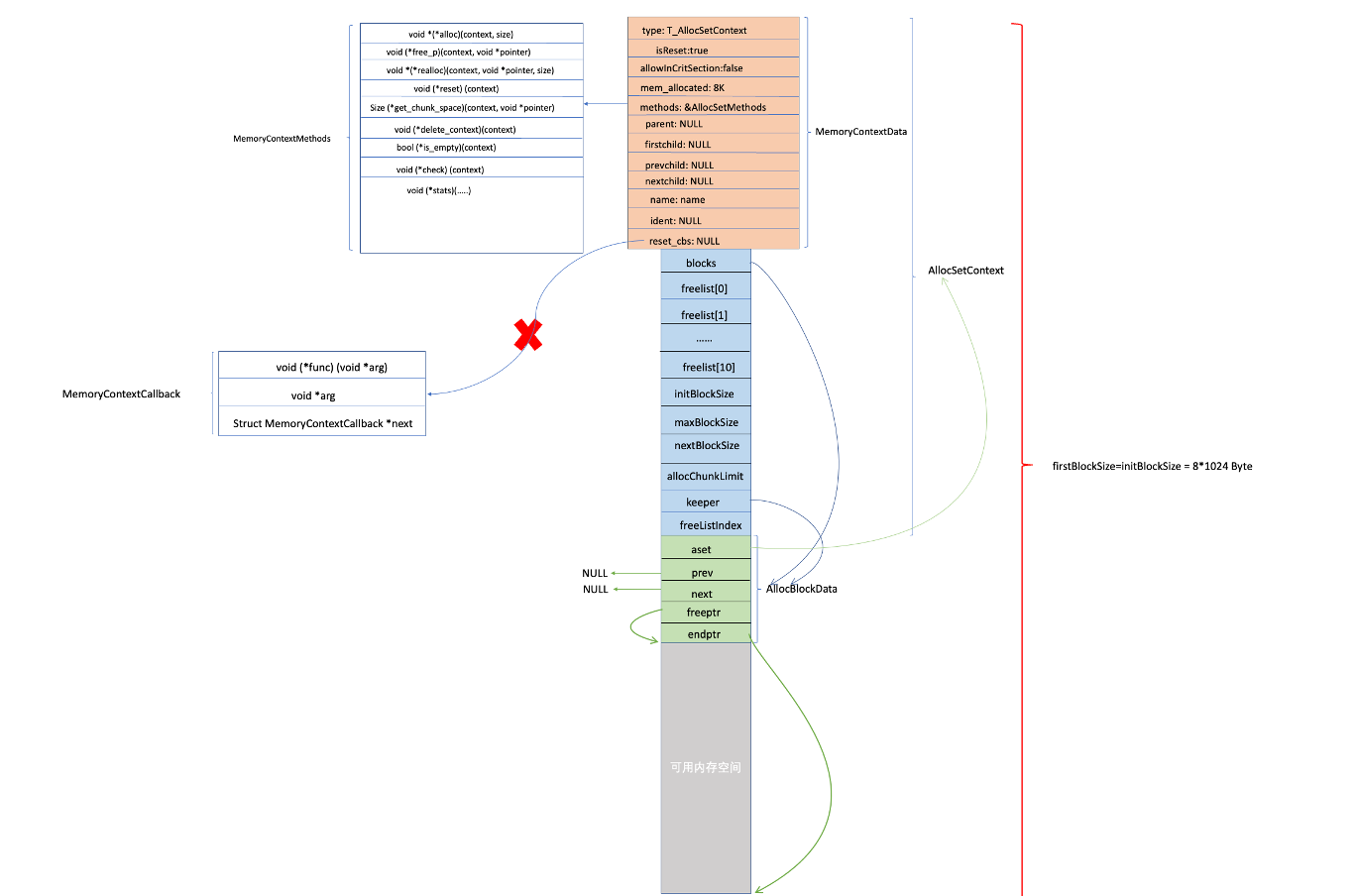
之后将整个MemoryContext返回:
|
((MemoryContext) set)->mem_allocated = firstBlockSize; return (MemoryContext) set; |
3.3初始化ErrorContext
|
ErrorContext = AllocSetContextCreate(TopMemoryContext, "ErrorContext", 8 * 1024, // minContextSize 8 * 1024, // initBlockSize 8 * 1024); // maxBlockSize |
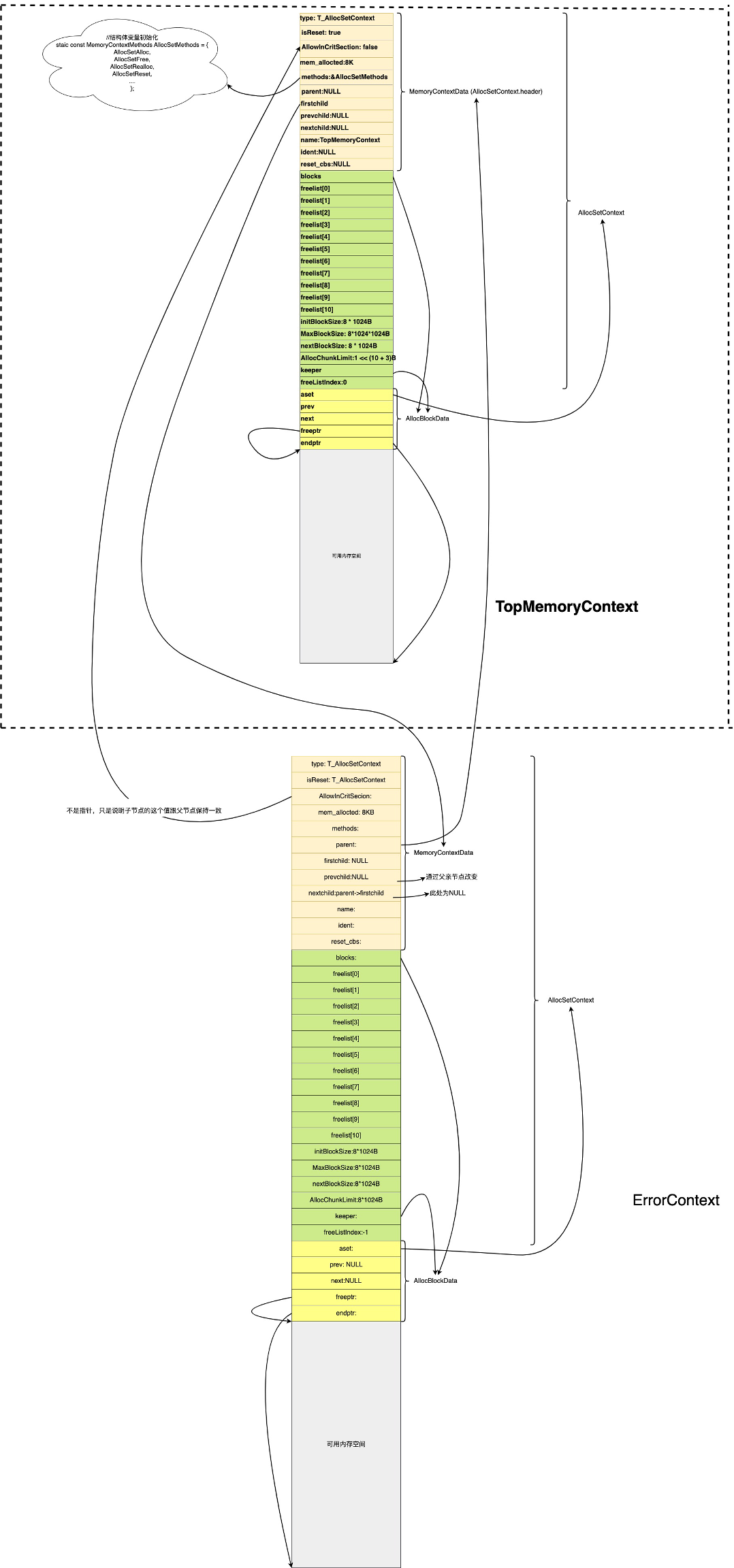
4、AllocSet contexts虚函数表的具体实现
4.1 AllocSetAlloc--内存分配
完整的AllocSetAlloc函数定义如下所示:
|
/* source file: src/backend/utils/mmgr/aset.c */ /* * AllocSetAlloc * Returns pointer to allocated memory of given size or NULL if * request could not be completed; memory is added to the set. * * No request may exceed: * MAXALIGN_DOWN(SIZE_MAX) - ALLOC_BLOCKHDRSZ - ALLOC_CHUNKHDRSZ * All callers use a much-lower limit. * * Note: when using valgrind, it doesn't matter how the returned allocation * is marked, as mcxt.c will set it to UNDEFINED. In some paths we will * return space that is marked NOACCESS - AllocSetRealloc has to beware! */ void * AllocSetAlloc(MemoryContext context, Size size) { AllocSet set = (AllocSet) context; AllocBlock block; AllocChunk *chunk; int fidx; Size chunk_size; Size blksize;
Assert(AllocSetIsValid(set));
/* * If requested size exceeds maximum for chunks, allocate an entire block * for this request. */ if (size > set->allocChunkLimit) { #ifdef MEMORY_CONTEXT_CHECKING /* ensure there's always space for the sentinel byte */ chunk_size = MAXALIGN(size + 1); #else chunk_size = MAXALIGN(size); #endif
blksize = chunk_size + ALLOC_BLOCKHDRSZ + ALLOC_CHUNKHDRSZ; block = (AllocBlock) malloc(blksize); if (block == NULL) return NULL;
context->mem_allocated += blksize;
block->aset = set; block->freeptr = block->endptr = ((char *) block) + blksize;
chunk = (MemoryChunk *) (((char *) block) + ALLOC_BLOCKHDRSZ);
/* mark the MemoryChunk as externally managed */ MemoryChunkSetHdrMaskExternal(chunk, MCTX_ASET_ID);
#ifdef MEMORY_CONTEXT_CHECKING chunk->requested_size = size; /* set mark to catch clobber of "unused" space */ Assert(size < chunk_size); set_sentinel(MemoryChunkGetPointer(chunk), size); #endif #ifdef RANDOMIZE_ALLOCATED_MEMORY /* fill the allocated space with junk */ randomize_mem((char *) MemoryChunkGetPointer(chunk), size); #endif
/* * Stick the new block underneath the active allocation block, if any, * so that we don't lose the use of the space remaining therein. */ if (set->blocks != NULL) { block->prev = set->blocks; block->next = set->blocks->next; if (block->next) block->next->prev = block; set->blocks->next = block; } else { block->prev = NULL; block->next = NULL; set->blocks = block; }
/* Ensure any padding bytes are marked NOACCESS. */ VALGRIND_MAKE_MEM_NOACCESS((char *) MemoryChunkGetPointer(chunk) + size, chunk_size - size);
/* Disallow external access to private part of chunk header. */ VALGRIND_MAKE_MEM_NOACCESS(chunk, ALLOCCHUNK_PRIVATE_LEN);
return MemoryChunkGetPointer(chunk); } |
注释中指出申请的内存大小最好不要超过如下表示的值:
|
MAXALIGN_DOWN(SIZE_MAX) - ALLOC_BLOCKHDRSZ - ALLOC_CHUNKHDRSZ
#define SIZE_MAX (~(size_t)0) // 当前系统所能表示的最大整数所需的二进制位都为1 #define MAXALIGN_DOWN(LEN) TYPEALIGN_DOWN(MAXIMUM_ALIGNOF, (LEN)) #define TYPEALIGN_DOWN(ALIGNVAL,LEN) \ (((uintptr_t) (LEN)) & ~((uintptr_t) ((ALIGNVAL) - 1))) /* Define as the maximum alignment requirement of any C data type. */ #define MAXIMUM_ALIGNOF 8 |
4.1.1 变量初始化和断言
|
AllocSet set = (AllocSet) context; //转换数据类型 AllocBlock block; AllocChunk *chunk; int fidx; Size chunk_size; Size blksize;
Assert(AllocSetIsValid(set)); / / 判断指针是否为空 |
4.1.2 待申请内存大于set->allocChunkLimit
|
* If requested size exceeds maximum for chunks, allocate an entire block * for this request. */ if (size > set->allocChunkLimit) { // 对用户申请的内存大小进行微调,保证申请内存大小时 8B 对齐,可能会比 size 大一点点。 chunk_size = MAXALIGN(size); // 整个 block 的大小 =chunk_size + AllocBlockData + AllocChunkData, 这三个都是保证向上 8 字节对齐的。 blksize = chunk_size + ALLOC_BLOCKHDRSZ + ALLOC_CHUNKHDRSZ; // 向操作系统申请内存,并转换为 AllocBlock 类型,即首地址开始的若干字节存储的是 AllocBlockData 类型数据 block = (AllocBlock) malloc(blksize); if (block == NULL) return NULL; // 修改 context :将申请的内存大小记录到此 MemoryContextData 中的 mem_allocated context->mem_allocated += blksize; // 将新分配的 block 的 aset 指向此内存上下文,可以对照前面的图或者下图理解。 block->aset = set; // block 空闲指针和结束指针都指向刚申请的内存块的结尾,因为一整个block分配的,不会在这个block上面划分chunk了 block->freeptr = block->endptr = ((char *) block) + blksize; // 存放 AllocChunkData 类型数据的位置 chunk = (AllocChunk) (((char *) block) + ALLOC_BLOCKHDRSZ); // 对 AllocChunkData 中的成员变量做初始化工作 chunk->aset = set; // size 存放程序微调后的大小 chunk->size = chunk_size; #ifdef MEMORY_CONTEXT_CHECKING // requested_size 存放用户真正所需的内存大小, chunk->size >= chunk->requested_size chunk->requested_size = size; /* set mark to catch clobber of "unused" space */ if (size < chunk_size) set_sentinel(AllocChunkGetPointer(chunk), size); #endif #ifdef RANDOMIZE_ALLOCATED_MEMORY /* fill the allocated space with junk */ randomize_mem((char *) AllocChunkGetPointer(chunk), size); #endif
// 双向链表组织 block ,根据原有链表信息先填充刚分配的 block 相关指针 // 再把它挂到已有链表上 // case 1: 该内存上下文没有 block ,那么 set->blocks 指向新分配的 block // case 2: 该内存上下文原先有 block ,新分配的 block 挂到第一个 block 之后,第一个 block 是 active allocation block 。 /* * Stick the new block underneath the active allocation block, if any, * so that we don't lose the use of the space remaining therein. */ if (set->blocks != NULL) { block->prev = set->blocks; block->next = set->blocks->next; if (block->next) block->next->prev = block; set->blocks->next = block; } else { block->prev = NULL; block->next = NULL; set->blocks = block; }
/* Ensure any padding bytes are marked NOACCESS. */ VALGRIND_MAKE_MEM_NOACCESS((char *) AllocChunkGetPointer(chunk) + size, chunk_size - size);
/* Disallow external access to private part of chunk header. */ VALGRIND_MAKE_MEM_NOACCESS(chunk, ALLOCCHUNK_PRIVATE_LEN); // 返回地址是 chunk 的起始地址 +AllocChunkData 的大小 return AllocChunkGetPointer(chunk); }
#define AllocChunkGetPointer(chk) \ ((AllocPointer)(((char *)(chk)) + ALLOC_CHUNKHDRSZ))
|
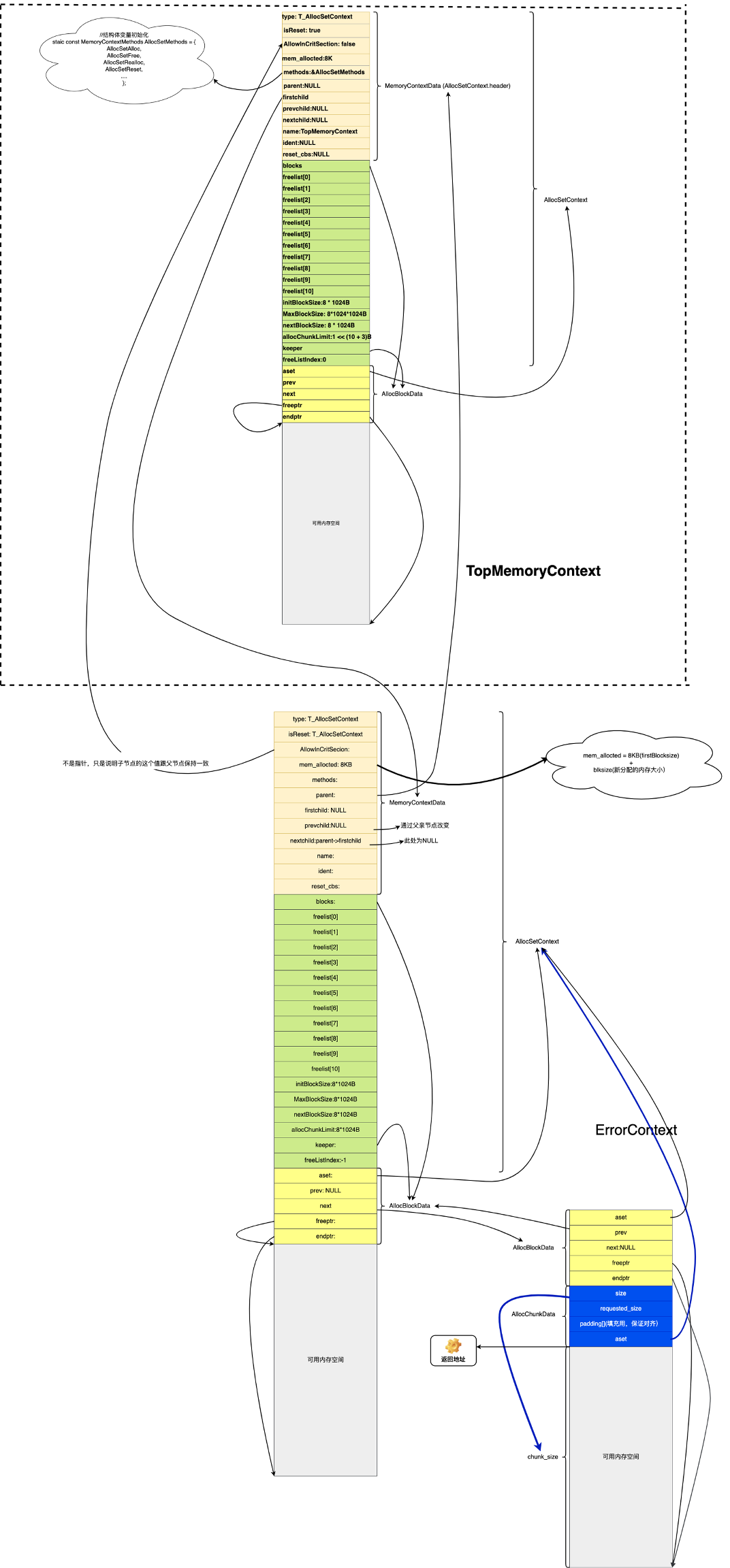
4.1.3 待申请内存小于等于set->allocChunkLimit
|
/* * Request is small enough to be treated as a chunk. Look in the * corresponding free list to see if there is a free chunk we could reuse. * If one is found, remove it from the free list, make it again a member * of the alloc set and return its data address. */ // 根据size,找freelist的下标 fidx = AllocSetFreeIndex(size); // 得到指向某个chunk的指针 chunk = set->freelist[fidx]; // 如果chunk不为NULL, 返回这个chunk,返回之前需调整freelist的单链表结构 if (chunk != NULL) {
Assert(chunk->size >= size); set->freelist[fidx] = (AllocChunk) chunk->aset; // 指向该chunk的下一个chunk, 在这里可以看到aset存储2种类型的地址。 chunk->aset = (void *) set; return AllocChunkGetPointer(chunk); } |
AllocSetFreeIndex()函数实现原理:
根据给定的size 查询该size 对应的freelist 数组的下标,下标为k(0,1,2......10) ,对应的下标的chunk size 为 chunk_size = f(k) = 1 << (k + ALLOC_MINBITS) ,所以 2^k*2^ALLOC_MINBITS >= size, k >= log2(size >> ALLOC_MINBITS) ,k=ceil(log2(size>>ALLOC_MINBITS)) 。
case 1: 假设 size = 2^k*2^ALLOC_MINBITS (size > 8) ,k = log2(size >> ALLOC_MINBITS) ,从位运算的角度来考虑,size >> ALLOC_MINBITS = 1 << k ,所以以2 为底的对数函数求值可以转换为位运算,在这种情况下 size >> ALLOC_MINBITS = 00.....001[0...0] ,k 的值就是这个1 右边0 的个数。
case 2: 假设 size < 2^k*2^ALLOC_MINBITS (size > 8) ,k > log2(size >> ALLOC_MINBITS) ,那么结果值要+1 。比如size=9=(1001)2, 右移3 位值为00.....01, 1 右边0 的个数位数为0 ,结果加1 得1 , 即2^(ALLOC_MINBITS+1)=16 > 9 ,所以size 为9 ,会从freelist 中分配下标为1 也就是chunk_size 为16 的片给用户。
case 3: 特殊情况,上述分类如果使用函数实现大概率会考虑条件分支,但是用户可以调整参数来避免这种实现。比如将case1 的这种情况通过算术运算让它归属到case 2 的情况,在case 1 要让size=2^k*2^ALLOC_MINBITS 变为size<2^k*2^ALLOC_MINBITS ,只需让size - 1。从size 的位级表示考虑,如果size-1 在位级表示没有在最高位产生借位,这种情况肯定隶属case 2 ,size-1 没有影响,因为-1 操作没有影响最高位的1 ;如果size-1 对最高位的1 产生了借位,最高位由1 变0 ,这时统计1 右边0 的个数将少了1 个,case2 通过+1 弥补了。
统计1 右边0 的个数:32-1- 前导0 的个数(有相关编译器提供了内置函数)。
|
static inline int AllocSetFreeIndex(Size size) { int idx; // 最小的 chunk_size 是 8B #define ALLOC_MINIBITS 3 if (size > (1 << ALLOC_MINBITS)) {
idx = 31 - __builtin_clz((uint32) size - 1) - ALLOC_MINBITS + 1;
} else idx = 0; return idx; |
4.1.4 context的第一个活动块有可用空间,空间不够本次size
|
/* * Choose the actual chunk size to allocate. */ chunk_size = (1 << ALLOC_MINBITS) << fidx; Assert(chunk_size >= size);
/* * If there is enough room in the active allocation block, we will put the * chunk into that block. Else must start a new one. */ if ((block = set->blocks) != NULL) { // 计算该内存上下文活动block剩余可用空间 Size availspace = block->endptr - block->freeptr; // 剩余空间不足本次分配大小,将划分该block剩余空间挂到freelist上。 // 因为空间不足意味着即将要分配一个新的block,而新的block将作为活动block,后续对该block的访问就通过freelist if (availspace < (chunk_size + ALLOC_CHUNKHDRSZ)) / / 划分起码能够画出一个最小的chunk来 { /* * The existing active (top) block does not have enough room for * the requested allocation, but it might still have a useful * amount of space in it. Once we push it down in the block list, * we'll never try to allocate more space from it . So, before we * do that, carve up its free space into chunks that we can put on * the set's freelists. * * Because we can only get here when there's less than * ALLOC_CHUNK_LIMIT left in the block, this loop cannot iterate * more than ALLOCSET_NUM_FREELISTS-1 times. */ // 将这些空间挂到 freelist 上,从大到小分配,分的快 while (availspace >= ((1 << ALLOC_MINBITS) + ALLOC_CHUNKHDRSZ)) { Size availchunk = availspace - ALLOC_CHUNKHDRSZ; int a_fidx = AllocSetFreeIndex(availchunk); /* * In most cases, we'll get back the index of the next larger * freelist than the one we need to put this chunk on. The * exception is when availchunk is exactly a power of 2. */ // 调整 availchunk 的大小,使之为 2 的幂,满足freelist的条件,8 16 32 .... 8KB if (availchunk != ((Size) 1 << (a_fidx + ALLOC_MINBITS))) { a_fidx--; Assert(a_fidx >= 0); availchunk = ((Size) 1 << (a_fidx + ALLOC_MINBITS)); }
chunk = (AllocChunk) (block->freeptr);
/* Prepare to initialize the chunk header. */ VALGRIND_MAKE_MEM_UNDEFINED(chunk, ALLOC_CHUNKHDRSZ); // 挂到freelist上,相当于分配出去了,移动freeptr block->freeptr += (availchunk + ALLOC_CHUNKHDRSZ); // 更新可用空闲空间 availspace -= (availchunk + ALLOC_CHUNKHDRSZ); chunk->size = availchunk; #ifdef MEMORY_CONTEXT_CHECKING chunk->requested_size = 0; /* mark it free */ #endif chunk->aset = (void *) set->freelist[a_fidx]; // aset变量存储两种类型的地址:1. 指向下个freelist的元素 2. 指向一个allocsetcontext set->freelist[a_fidx] = chunk; // 将chunk放在freelist[idx]的第一位置 }
/* Mark that we need to create a new block */ block = NULL; // 为NULL, 马上分配一个新的block } } |
假设用户需要的size 是7KB ,那么chunk_size 就是8KB ,现有的available space 是7KB+ ALLOC_CHUNKHDRSZ ,如下图所示,(此处没有根据ErrorContext 详细的去算available space 是多少,所以实际运行当中可能不会产生这样的数值),旨在了解freelist 的一个分配过程。
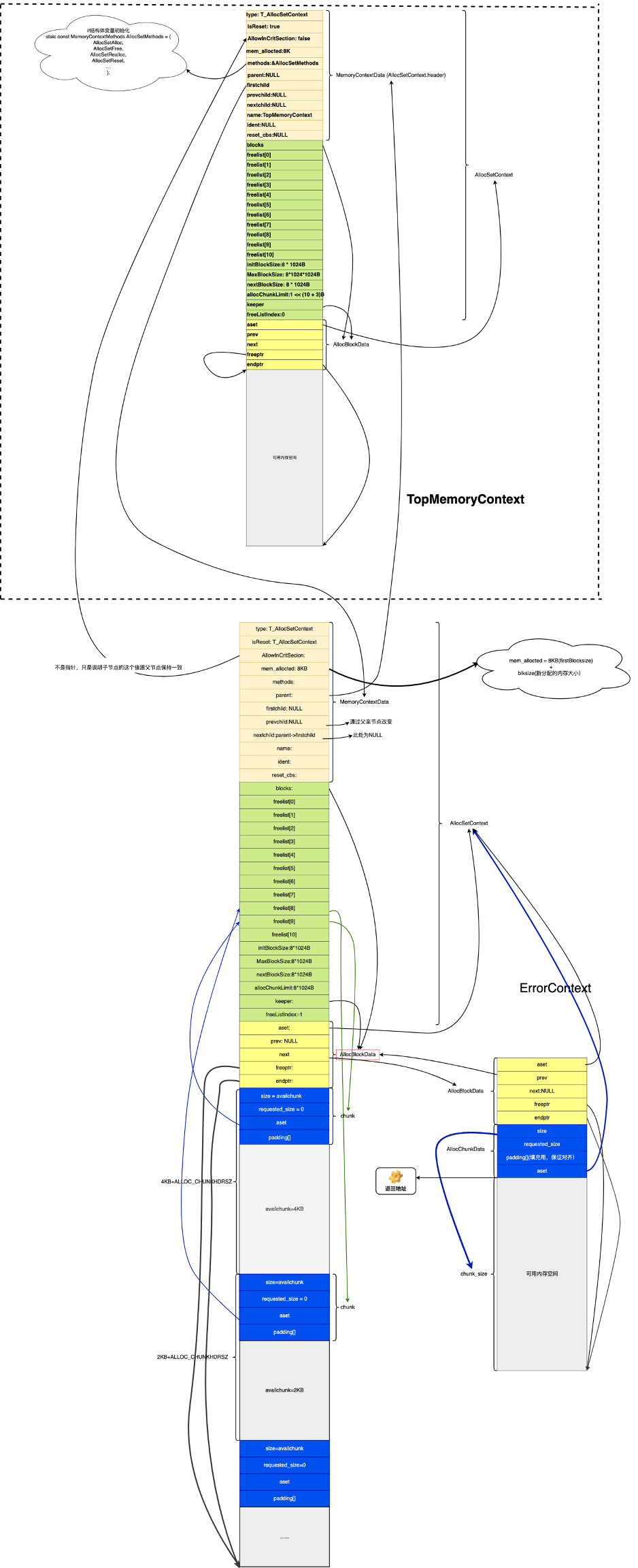
如果block 为NULL ,意味着目前还没有根据用户要求去分配指定的内存块,只是对目前的活动块做了切割,这时可以分配新的block了。该block将作为新的活动block。
|
/* * Time to create a new regular (multi-chunk) block? */ if (block == NULL) { Size required_size;
/* * The first such block has size initBlockSize, and we double the * space in each succeeding block, but not more than maxBlockSize. */ // 新分配的block大小为nextBlockSize blksize = set->nextBlockSize; // 下次再分配要 * 2, 所以新分配的block将会越来越大,可能出现当前OS没有足够的空间满足pg的要求 set->nextBlockSize <<= 1; if (set->nextBlockSize > set->maxBlockSize) set->nextBlockSize = set->maxBlockSize;
/* * If initBlockSize is less than ALLOC_CHUNK_LIMIT, we could need more * space... but try to keep it a power of 2. */ required_size = chunk_size + ALLOC_BLOCKHDRSZ + ALLOC_CHUNKHDRSZ; while (blksize < required_size) blksize <<= 1;
/* Try to allocate it */ block = (AllocBlock) malloc(blksize);
/* * We could be asking for pretty big blocks here, so cope if malloc * fails. But give up if there's less than 1 MB or so available... */ while (block == NULL && blksize > 1024 * 1024) { blksize >>= 1; if (blksize < required_size) break; block = (AllocBlock) malloc(blksize); }
if (block == NULL) return NULL; // 更新该内存上下文的内存分配字节数 context->mem_allocated += blksize; // 初始化block block->aset = set; block->freeptr = ((char *) block) + ALLOC_BLOCKHDRSZ; block->endptr = ((char *) block) + blksize;
/* Mark unallocated space NOACCESS. */ VALGRIND_MAKE_MEM_NOACCESS(block->freeptr, blksize - ALLOC_BLOCKHDRSZ); // 更新block双向链表, 很明显新分配的block已经是该内存上下文的活动block了。 block->prev = NULL; block->next = set->blocks; if (block->next) block->next->prev = block; set->blocks = block; } |
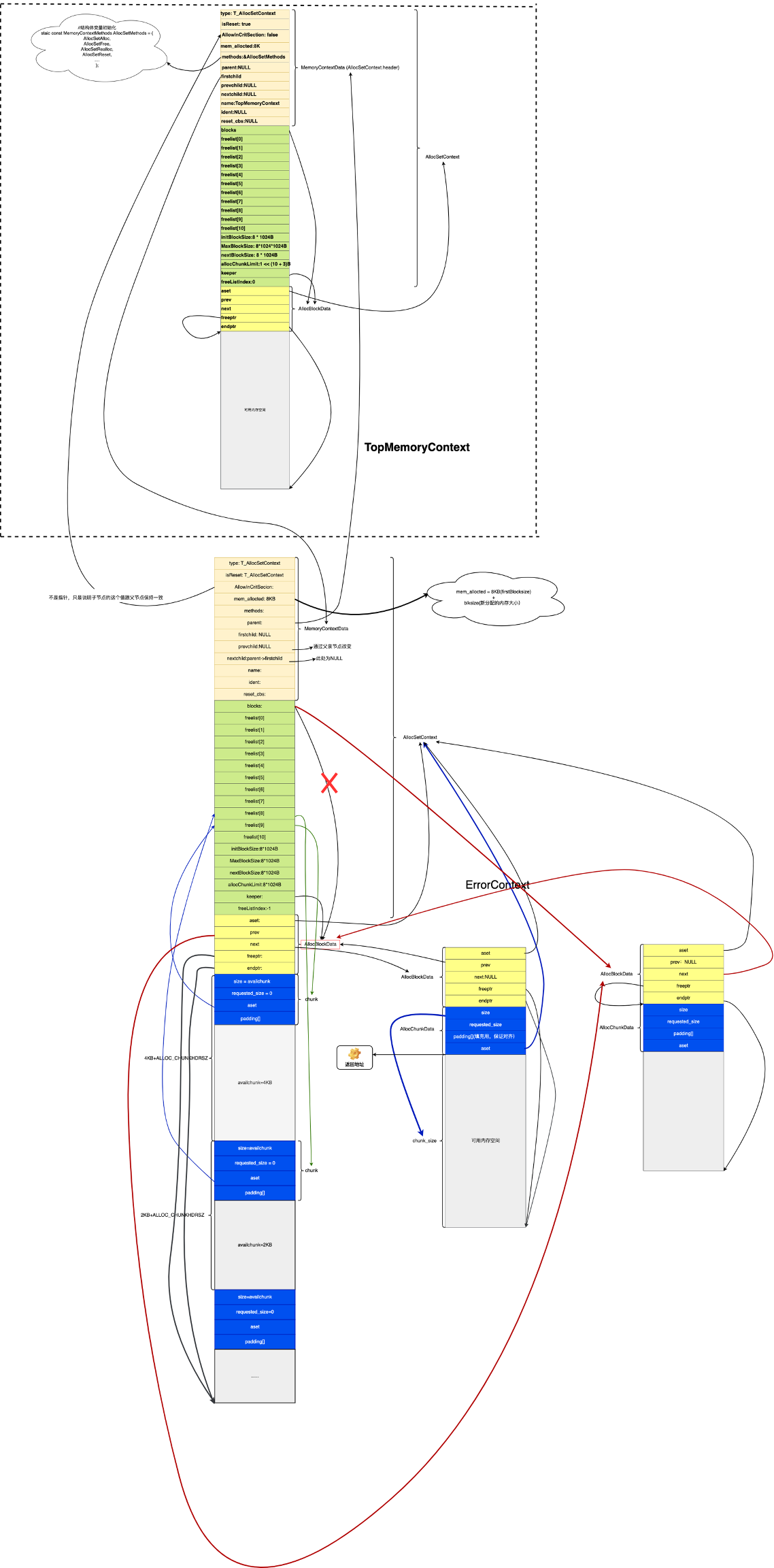
下面开始在block上进行分配,经过前面的处理这个block可以是新的block也可能是原有的block:
|
/* * OK, do the allocation */ //转换地址类型 chunk = (AllocChunk) (block->freeptr);
/* Prepare to initialize the chunk header. */ VALGRIND_MAKE_MEM_UNDEFINED(chunk, ALLOC_CHUNKHDRSZ); // 移动block空闲指针, freeptr - (void *) chunk就是包含chunk header在内的chunk大小 block->freeptr += (chunk_size + ALLOC_CHUNKHDRSZ); Assert(block->freeptr <= block->endptr); // 初始化chunk chunk->aset = (void *) set; chunk->size = chunk_size; #ifdef MEMORY_CONTEXT_CHECKING chunk->requested_size = size; /* set mark to catch clobber of "unused" space */ if (size < chunk->size) set_sentinel(AllocChunkGetPointer(chunk), size); #endif #ifdef RANDOMIZE_ALLOCATED_MEMORY /* fill the allocated space with junk */ randomize_mem((char *) AllocChunkGetPointer(chunk), size); #endif
/* Ensure any padding bytes are marked NOACCESS. */ VALGRIND_MAKE_MEM_NOACCESS((char *) AllocChunkGetPointer(chunk) + size, chunk_size - size);
/* Disallow external access to private part of chunk header. */ VALGRIND_MAKE_MEM_NOACCESS(chunk, ALLOCCHUNK_PRIVATE_LEN); // 返回的地址 return AllocChunkGetPointer(chunk); |
4.2 AllocSetFree--释放内存
|
/* * AllocSetFree * Frees allocated memory; memory is removed from the set. */ static void AllocSetFree(MemoryContext context, void *pointer) { // 转换地址类型 AllocSet set = (AllocSet) context; // 获取chunk header的地址 #define AllocPointerGetChunk(ptr) \ ((AllocChunk)(((char *)(ptr)) - ALLOC_CHUNKHDRSZ)) AllocChunk chunk = AllocPointerGetChunk(pointer);
/* Allow access to private part of chunk header. */ VALGRIND_MAKE_MEM_DEFINED(chunk, ALLOCCHUNK_PRIVATE_LEN);
#ifdef MEMORY_CONTEXT_CHECKING /* Test for someone scribbling on unused space in chunk */ if (chunk->requested_size < chunk->size) if (!sentinel_ok(pointer, chunk->requested_size)) elog(WARNING, "detected write past chunk end in %s %p", set->header.name, chunk); #endif // case 1: 4.1.2 对应这种情况,分配了一整个 block 给用户,这种 block 只有一个 chunk,那么 把这个 block 交还给操作系统 if (chunk->size > set->allocChunkLimit) { /* * Big chunks are certain to have been allocated as single-chunk * blocks. Just unlink that block and return it to malloc(). */ // block即是整个block的初始地址 AllocBlock block = (AllocBlock) (((char *) chunk) - ALLOC_BLOCKHDRSZ);
/* * Try to verify that we have a sane block pointer: it should * reference the correct aset, and freeptr and endptr should point * just past the chunk. */ // 校验,因为pointer是用户传递过来的,不一定是真的chunk地址 if (block->aset != set || block->freeptr != block->endptr || block->freeptr != ((char *) block) + (chunk->size + ALLOC_BLOCKHDRSZ + ALLOC_CHUNKHDRSZ)) elog(ERROR, "could not find block containing chunk %p", chunk); // 调整block双向链表 /* OK, remove block from aset's list and free it */ if (block->prev) block->prev->next = block->next; else set->blocks = block->next; if (block->next) block->next->prev = block->prev; // 总该内存上下文总的内存大小 context->mem_allocated -= block->endptr - ((char *) block);
#ifdef CLOBBER_FREED_MEMORY wipe_mem(block, block->freeptr - ((char *) block)); #endif // 释放该block free(block); } // case 2 :小于或者等于 8KB 的内存片: // 1: 对应于 4.1.3 ,这个内存片来源于这个 set 的 freelist ,重新挂到 freelist 中。 // 2: 对应于 4.1.4 ,这个内存片来源于新建的 block ,因为原来的活动 block 不能满足其大小,那么这个内存片将是第一次被加入到 freelist 中,注意这种情况不会更改此block的freeptr,因此不会影响该block的切割和以后的相关统计 else { /* Normal case, put the chunk into appropriate freelist */ int fidx = AllocSetFreeIndex(chunk->size);
// freelist 是指向 AllocChunkData 类型的头结点,单链表的形式 // chunk 中的 aset 被分配出去时, aset 指向的是具体的 AllocSetContext // 存在于 freelist 中的 chunk 没有被分配出去时, aset 指向的是下一个 AllocChunkData // 当把 chunk 放入到 freelist 中时, aset 就要指向下个节点, freelist[fidx] 指向它,它成为第一个节点,(单链表的头插法), requested_size 置 0. chunk->aset = (void *) set->freelist[fidx];
#ifdef CLOBBER_FREED_MEMORY wipe_mem(pointer, chunk->size); #endif
#ifdef MEMORY_CONTEXT_CHECKING /* Reset requested_size to 0 in chunks that are on freelist */ chunk->requested_size = 0; #endif set->freelist[fidx] = chunk; } } |
4.3 AllocSetRealloc--重新分配内存
|
/* * AllocSetRealloc * Returns new pointer to allocated memory of given size or NULL if * request could not be completed; this memory is added to the set. * Memory associated with given pointer is copied into the new memory, * and the old memory is freed. * * Without MEMORY_CONTEXT_CHECKING, we don't know the old request size. This * makes our Valgrind client requests less-precise, hazarding false negatives. * (In principle, we could use VALGRIND_GET_VBITS() to rediscover the old * request size.) */ static void * AllocSetRealloc(MemoryContext context, void *pointer, Size size) { AllocSet set = (AllocSet) context; AllocChunk chunk = AllocPointerGetChunk(pointer);
Size oldsize; oldsize = chunk->size; // case 1: 对应于 4.1.2 ,原先的内存存在于一个大的 block 中 if (oldsize > set->allocChunkLimit) { /* * The chunk must have been allocated as a single-chunk block. Use * realloc() to make the containing block bigger, or smaller, with * minimum space wastage. */ AllocBlock block = (AllocBlock) (((char *) chunk) - ALLOC_BLOCKHDRSZ); Size chksize; Size blksize; Size oldblksize;
/* * Try to verify that we have a sane block pointer: it should * reference the correct aset, and freeptr and endptr should point * just past the chunk. */ // 指针运算进行校验由用户传入的 pointer 是否合法 if (block->aset != set || block->freeptr != block->endptr || block->freeptr != ((char *) block) + (oldsize + ALLOC_BLOCKHDRSZ + ALLOC_CHUNKHDRSZ)) elog(ERROR, "could not find block containing chunk %p", chunk);
/* * Even if the new request is less than set->allocChunkLimit, we stick * with the single-chunk block approach. Therefore we need * chunk->size to be bigger than set->allocChunkLimit, so we don't get * confused about the chunk's status in future calls. */ // 这种大的 block 当时是因为用户传入的 size 大于 set->allocChunkLimit, 但是这次 重新分配的 size <= allocChunkLimit // 仍然采用新分配一整个 block的做法 。因此实际使用的 chksize 会比用户传入的 size 要大。 chksize = Max(size, set->allocChunkLimit + 1); chksize = MAXALIGN(chksize);
/* Do the realloc */ blksize = chksize + ALLOC_BLOCKHDRSZ + ALLOC_CHUNKHDRSZ; oldblksize = block->endptr - ((char *) block); // block的地址,可能跟之前地址一样也可能不一样 block = (AllocBlock) realloc(block, blksize); if (block == NULL) { return NULL; }
// 更新 context 中的内容 /* updated separately, not to underflow when (oldblksize > blksize) */ context->mem_allocated -= oldblksize; context->mem_allocated += blksize; // 更新 block 中的内容 block->freeptr = block->endptr = ((char *) block) + blksize; // 划分chunk /* Update pointers since block has likely been moved */ chunk = (AllocChunk) (((char *) block) + ALLOC_BLOCKHDRSZ); pointer = AllocChunkGetPointer(chunk); // realloc 之后 block 地址可能会发生改变,所以根据原来的 block 信息修改双向链表前后节点的指向 if (block->prev) block->prev->next = block; else set->blocks = block; if (block->next) block->next->prev = block; chunk->size = chksize; chunk->requested_size = size; return pointer; }
/* * Chunk sizes are aligned to power of 2 in AllocSetAlloc(). Maybe the * allocated area already is >= the new size. (In particular, we will * fall out here if the requested size is a decrease.) */ // case 2: oldsize >= size ,原先的内存够用了,把 requested_size 改一下就行。 else if (oldsize >= size) { chunk->requested_size = size; return pointer; } else case 3 : size > oldsize ,直接用 AllocSetAlloc 分配一块新的内存,把原有内存内容拷贝到新内存上,然后释放原有内存。 { /* * Enlarge-a-small-chunk case. We just do this by brute force, ie, * allocate a new chunk and copy the data . Since we know the existing * data isn't huge, this won't involve any great memcpy expense, so * it's not worth being smarter. (At one time we tried to avoid * memcpy when it was possible to enlarge the chunk in-place, but that * turns out to misbehave unpleasantly for repeated cycles of * palloc/repalloc/pfree: the eventually freed chunks go into the * wrong freelist for the next initial palloc request, and so we leak * memory indefinitely. See pgsql-hackers archives for 2007-08-11.) */
AllocPointer newPointer; // 相当于 void *newPointer /* allocate new chunk */ newPointer = AllocSetAlloc((MemoryContext) set, size);
/* leave immediately if request was not completed */ if (newPointer == NULL) { return NULL; }
/* transfer existing data (certain to fit) */ memcpy(newPointer, pointer, oldsize);
/* free old chunk */ AllocSetFree((MemoryContext) set, pointer);
return newPointer; } } |
4.4 AllocSetReset--释放set中除keeper指向的block之外的所有内存
|
/* * AllocSetReset * Frees all memory which is allocated in the given set. * * Actually, this routine has some discretion about what to do. * It should mark all allocated chunks freed, but it need not necessarily * give back all the resources the set owns. Our actual implementation is * that we give back all but the "keeper" block (which we must keep, since * it shares a malloc chunk with the context header) . In this way, we don't * thrash malloc() when a context is repeatedly reset after small allocations, * which is typical behavior for per-tuple contexts. */ static void AllocSetReset(MemoryContext context) { AllocSet set = (AllocSet) context; AllocBlock block; Size keepersize = set->keeper->endptr - ((char *) set);
AssertArg(AllocSetIsValid(set));
/* Clear chunk freelists */ // 下面要释放一些 block ,为了避免指针悬挂,所以在这里先把 set 中的 freelist 的指针全部赋值为 0 MemSetAligned(set->freelist, 0, sizeof(set->freelist)); // 从第一个block即活动block开始遍历 block = set->blocks; /* New blocks list will be just the keeper block */ // set->blocks指向初始化内存上下文时的block set->blocks = set->keeper;
while (block != NULL) { AllocBlock next = block->next;
if (block == set->keeper) { /* Reset the block, but don't return it to malloc */ char *datastart = ((char *) block) + ALLOC_BLOCKHDRSZ; block->freeptr = datastart; block->prev = NULL; block->next = NULL; } else { /* Normal case, release the block */ context->mem_allocated -= block->endptr - ((char *) block); free(block); } block = next; }
Assert(context->mem_allocated == keepersize); /* Reset block size allocation sequence, too */ set->nextBlockSize = set->initBlockSize; } |
4.5 AllocSetDelete--释放set中所有的内存
|
/* * AllocSetDelete * Frees all memory which is allocated in the given set, * in preparation for deletion of the set. * * Unlike AllocSetReset, this *must* free all resources of the set. */ static void AllocSetDelete(MemoryContext context) { AllocSet set = (AllocSet) context; AllocBlock block = set->blocks; Size keepersize = set->keeper->endptr - ((char *) set); AssertArg(AllocSetIsValid(set));
/* * If the context is a candidate for a freelist, put it into that freelist * instead of destroying it. */ // minContextSize == 0 && initBlockSize == 8*1024, freeListIndex = 0; // minContextSize == 0 && initBlockSize == 1*1024, freeListIndex = 1; // 其他情况 freeList = -1; // 内存上下文初始化时,会根据这个两个值确定 freeListIndex 的值,分别为 0 、 1 、 -1 ,如果为 0 或者 1 那么该内存上下文具备进入到 freelist 的条件。 if (set->freeListIndex >= 0) { AllocSetFreeList *freelist = &context_freelists[set->freeListIndex];
/* * Reset the context, if it needs it, so that we aren't hanging on to * more than the initial malloc chunk. */ // 在这个内存上下文产生内存的分配,比如调用了 alloc 、 realloc ,或者向这个内存上下文注册了回调函数, isReset 都为 false 。 if (!context->isReset) MemoryContextResetOnly(context);
/* * If the freelist is full, just discard what's already in it. See * comments with context_freelists[]. */ // MAX_FREE_CONTEXTS == 100 // 如果freelist元素的数量大于等于100,把freelist中的元素全部归还给系统 if (freelist->num_free >= MAX_FREE_CONTEXTS) { while (freelist->first_free != NULL) { AllocSetContext *oldset = freelist->first_free; freelist->first_free = (AllocSetContext *) oldset->header.nextchild; freelist->num_free--; /* All that remains is to free the header/initial block */ free(oldset); } Assert(freelist->num_free == 0); } // 我们修改了这个内存上下文的下个兄弟节点的指向,现在让它指向的是 freelist 中的下个节点。 /* Now add the just-deleted context to the freelist. */ set->header.nextchild = (MemoryContext) freelist->first_free; // freelist->first_free 指向函数参数指定的内存上下文 freelist->first_free = set; // 当前 freelist 中的内存上下文数 +1 freelist->num_free++; return; }
/* Free all blocks, except the keeper which is part of context header */ // 除了 keeper 指向的 block ,其他的 block 都 free 掉。 // keeper 指向的 block 是在初始化内存上下文时,这个 block 是同 AllocSetContext 一同分配的,但是 malloc 这块内存时返回的地址并不是 block 所在位置,而是 AllocSetContext 的首地址,函数 free 只能释放 malloc 、 calloc 、 realloc 的返回值,因此 free 掉这块内存只能用 free(set) 。 while (block != NULL) { AllocBlock next = block->next;
if (block != set->keeper) context->mem_allocated -= block->endptr - ((char *) block); if (block != set->keeper) free(block); block = next; }
Assert(context->mem_allocated == keepersize); /* Finally, free the context header, including the keeper block */ free(set); } |
|
/* * MemoryContextResetOnly * Release all space allocated within a context. * Nothing is done to the context's descendant contexts. */ // MemoryContxtResetOnly // 只释放由参数指定的内存上下文中的已分配的空间,该函数不会作用其后代的内存上下文 void MemoryContextResetOnly(MemoryContext context) { Assert(MemoryContextIsValid(context));
/* Nothing to do if no pallocs since startup or last reset */
// 如果在该内存上下文初始化之后,没有进行任何的分配(包括注册回调函数)等操作,那么就没有必要进行 reset 操作,不会进入到下面 if 的代码块。 if (!context->isReset) { MemoryContextCallResetCallbacks(context);
/* * If context->ident points into the context's memory, it will become * a dangling pointer. We could prevent that by setting it to NULL * here, but that would break valid coding patterns that keep the * ident elsewhere, e.g. in a parent context. So for now we assume * the programmer got it right. */ context->methods->reset(context); context->isReset = true; } } |
4.6 AllocSetGetChunkSpace
该函数简单地把包含AllocChunkData 的内存大小作为结果返回。
|
/* * AllocSetGetChunkSpace * Given a currently-allocated chunk, determine the total space * it occupies (including all memory-allocation overhead). */ static Size AllocSetGetChunkSpace(MemoryContext context, void *pointer) { AllocChunk chunk = AllocPointerGetChunk(pointer); Size result;
result = chunk->size + ALLOC_CHUNKHDRSZ;
return result;
|
4.7 AllocSetIsEmpty
简单的判断一下参数指定的内存上下文是否为“空”。“空”代表isReset是否为true,两种情况:刚初始化的未进行任何分配的内存上下文为true;该上下文执行过reset操作并在之后没有进行任何分配操作。如果isReset为true,意味着set中的freelist中的各项都为0。
|
/* * AllocSetIsEmpty * Is an allocset empty of any allocated space? */ static bool AllocSetIsEmpty(MemoryContext context) { /* * For now, we say "empty" only if the context is new or just reset. We * could examine the freelists to determine if all space has been freed, * but it's not really worth the trouble for present uses of this * functionality. */ if (context->isReset) return true; return false; } |
4.8 AllocSetStats
|
typedef void (*MemoryStatsPrintFunc) (MemoryContext context, void *passthru, const char *stats_string, bool print_to_stderr); /* * AllocSetStats * Compute stats about memory consumption of an allocset. * * printfunc: if not NULL, pass a human-readable stats string to this. * passthru: pass this pointer through to printfunc. * totals: if not NULL, add stats about this context into *totals. * print_to_stderr: print stats to stderr if true, elog otherwise. */ static void
AllocSetStats(MemoryContext context, MemoryStatsPrintFunc printfunc, void *passthru, MemoryContextCounters *totals, bool print_to_stderr) { AllocSet set = (AllocSet) context; Size nblocks = 0; Size freechunks = 0; Size totalspace; Size freespace = 0; AllocBlock block; int fidx;
/* Include context header in totalspace */ // totalspace 先初始化为 AllocSsetContext 类型大小, 8 字节对齐。 totalspace = MAXALIGN(sizeof(AllocSetContext)); // 遍历 block 链表,统计 totalspace 和 freespace for (block = set->blocks; block != NULL; block = block->next) { nblocks++; totalspace += block->endptr - ((char *) block); freespace += block->endptr - block->freeptr; } // 再统计 set 中 freelist 的空间, freelist 中 11 个元素,每个元素指向的是一个单链表的第一个节点。 for (fidx = 0; fidx < ALLOCSET_NUM_FREELISTS; fidx++) { AllocChunk chunk;
for (chunk = set->freelist[fidx]; chunk != NULL; chunk = (AllocChunk) chunk->aset) { freechunks++; freespace += chunk->size + ALLOC_CHUNKHDRSZ; } } // 如果定义了这个函数并且 printfunc 不为 NULL ,格式化参数,把参数传入这个函数 if (printfunc) { char stats_string[200];
snprintf(stats_string, sizeof(stats_string), "%zu total in %zd blocks; %zu free (%zd chunks); %zu used", totalspace, nblocks, freespace, freechunks, totalspace - freespace); printfunc(context, passthru, stats_string, print_to_stderr); } // totals 一个包含下面 4 个成员变量的全局数组 if (totals) { totals->nblocks += nblocks; totals->freechunks += freechunks; totals->totalspace += totalspace; totals->freespace += freespace; } } |
视图pg_backend_memory_contexts 存储了在当前会话下所有服务端进程的内存上下文:
| SELECT * FROM pg_backend_memory_contexts WHERE name = 'ErrorContext' |

5.应用举例
|
CronLoopContext = AllocSetContextCreate(CurrentMemoryContext, "pg_cron loop context", ALLOCSET_DEFAULT_MINSIZE, ALLOCSET_DEFAULT_INITSIZE, ALLOCSET_DEFAULT_MAXSIZE); |
2. 切换内存上下文:在切换之前保存当前内存上下文,然后在对全局变量 CurrentMemoryContext 赋值。
| MemoryContextSwitchTo(CronLoopContext); |
|
static inline MemoryContext MemoryContextSwitchTo(MemoryContext context) { MemoryContext old = CurrentMemoryContext;
CurrentMemoryContext = context; return old; } |
3. 切换后再当前内存上下文进行内存分配,比如palloc(1024)
|
void * palloc(Size size) { /* duplicates MemoryContextAlloc to avoid increased overhead */ void *ret; // Current 已经指向了新建的内存上下文 MemoryContext context = CurrentMemoryContext; // 校验部分 AssertArg(MemoryContextIsValid(context)); AssertNotInCriticalSection(context); if (!AllocSizeIsValid(size)) elog(ERROR, "invalid memory alloc request size %zu", size); // 马上进行分配工作,所以 isReset 设置为 false context->isReset = false; // 详细见 4.1 节 ret = context->methods->alloc(context, size); // 失败进行统计 if (ret == NULL) { MemoryContextStats(TopMemoryContext); ereport(ERROR, (errcode(ERRCODE_OUT_OF_MEMORY), errmsg("out of memory"), errdetail("Failed on request of size %zu in memory context \"%s\".", size, context->name))); }
return ret;
|
4. 释放内存:
|
/* * pfree * Release an allocated chunk. */ void pfree(void *pointer) { MemoryContext context = GetMemoryChunkContext(pointer); context->methods->free_p(context, pointer);
}
|
pointer 是chunk 的首地址,减去sizeof(void *) 是AllocChunkData 中aset 的变量的首地址,在这个地址存储的内容是AllocSetContext 的地址,在这里进行强转,*(MemoryContext *) (((char *) pointer) - sizeof(void *)) 就是这个意思 。
|
s tatic inline MemoryContext GetMemoryChunkContext(void *pointer) { MemoryContext context;
/* * Try to detect bogus pointers handed to us, poorly though we can. * Presumably, a pointer that isn't MAXALIGNED isn't pointing at an * allocated chunk. */ Assert(pointer != NULL); Assert(pointer == (void *) MAXALIGN(pointer));
/* * OK, it's probably safe to look at the context. */ context = *(MemoryContext *) (((char *) pointer) - sizeof(void *));
AssertArg(MemoryContextIsValid(context));
return context; } |
5.reset/delete 这个内存上下文:主要是递归的去删除后代节点,再对本节点做相应的reset 或者delete 操作,不再展开。
| MemoryContextReset(CronLoopContext); / MemoryContextDelete(CronLoopContext); |
来自 “ ITPUB博客 ” ,链接:https://blog.itpub.net/69994931/viewspace-2978381/ ,如需转载,请注明出处,否则将追究法律责任。

注册时间:2021-02-18
-
博文量184
-
访问量126058
