1 概述
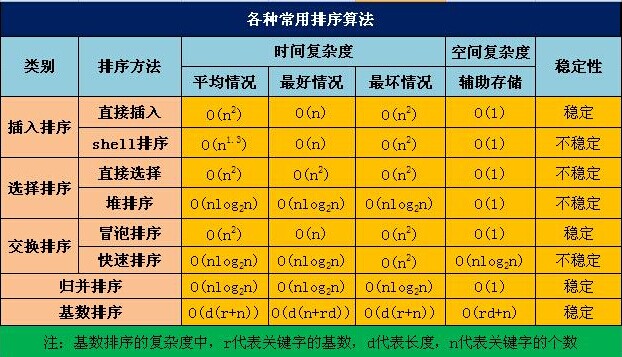
本文对比较常用且比较高效的排序算法进行了总结和解析,并贴出了比较精简的实现代码,包括选择排序、插入排序、归并排序、希尔排序、快速排序等。算法性能比较如下图所示:
2 选择排序
选择排序的第一趟处理是从数据序列所有n个数据中选择一个最小的数据作为有序序列中的第1个元素并将它定位在第一号存储位置,第二趟处理从数据序列的n-1个数据中选择一个第二小的元素作为有序序列中的第2个元素并将它定位在第二号存储位置,依此类推,当第n-1趟处理从数据序列的剩下的2个元素中选择一个较小的元素作为有序序列中的最后第2个元素并将它定位在倒数第二号存储位置,至此,整个的排序处理过程就已完成。
代码如下:
-
public class SelectionSort {
-
public void selectionSort(int[] array) {
-
int temp;
-
for (int i = 0; i < array.length - 1; i++) {
-
for (int j = i + 1; j <= array.length - 1; j++) {// 第i个和第j个比较j可以取到最后一位,所以要用j<=array.length-1
-
if (array[i] > array[j]) {// 注意和冒泡排序的区别,这里是i和j比较。
-
temp = array[i];
-
array[i] = array[j];
-
array[j] = temp;
-
}
-
}
-
// 打印每趟排序结果
-
for (int m = 0; m <= array.length - 1; m++) {
-
System.out.print(array[m] + "\t");
-
}
-
System.out.println();
-
}
-
}
-
-
public static void main(String[] args) {
-
SelectionSort selectionSort = new SelectionSort();
-
int[] array = { 5, 69, 12, 3, 56, 789, 2, 5648, 23 };
-
selectionSort.selectionSort(array);
-
for (int m = 0; m <= array.length - 1; m++) {
-
System.out.print(array[m] + "\t");
-
}
-
}
-
}
复制代码
3 插入排序
直接插入排序法的排序原则是:将一组无序的数字排列成一排,左端第一个数字为已经完成排序的数字,其他数字为未排序的数字。然后从左到右依次将未排序的数字插入到已排序的数字中。
代码如下:
-
public class InsertSort {
-
public void insertSort(int[] array, int first, int last) {
-
int temp, i, j;
-
for (i = first + 1; i <= last - 1; i++) {// 默认以第一个数为有序序列,后面的数为要插入的数。
-
temp = array[i];
-
j = i - 1;
-
while (j >= first && array[j] > temp) {// 从后进行搜索如果搜索到的数小于temp则该数后移继续搜索,直到搜索到小于或等于temp的数即可
-
array[j + 1] = array[j];
-
j--;
-
}
-
array[j + 1] = temp;
-
// 打印每次排序结果
-
for (int m = 0; m <= array.length - 1; m++) {
-
System.out.print(array[m] + "\t");
-
}
-
System.out.println();
-
}
-
}
-
-
public static void main(String[] args) {
-
InsertSort insertSort = new InsertSort();
-
int[] array = { 5, 69, 12, 3, 56, 789, 2, 5648, 23 };
-
insertSort.insertSort(array, 0, array.length);// 注意此处是0-9而不是0-8
-
for (int i = 0; i <= array.length - 1; i++) {
-
System.out.print(array[i] + "\t");
-
}
-
}
-
}
复制代码
4 归并排序
算法描述:
把序列分成元素尽可能相等的两半。
把两半元素分别进行排序。
把两个有序表合并成一个。
代码如下:
-
public class MergeSortTest {
-
public void sort(int[] array, int left, int right) {
-
if (left >= right)
-
return;
-
// 找出中间索引
-
int center = (left + right) / 2;
-
// 对左边数组进行递归
-
sort(array, left, center);
-
// 对右边数组进行递归
-
sort(array, center + 1, right);
-
// 合并
-
merge(array, left, center, right);
-
// 打印每次排序结果
-
for (int i = 0; i < array.length; i++) {
-
System.out.print(array[i] + "\t");
-
}
-
System.out.println();
-
-
}
-
-
/**
-
* 将两个数组进行归并,归并前面2个数组已有序,归并后依然有序
-
*
-
* @param array
-
* 数组对象
-
* @param left
-
* 左数组的第一个元素的索引
-
* @param center
-
* 左数组的最后一个元素的索引,center+1是右数组第一个元素的索引
-
* @param right
-
* 右数组最后一个元素的索引
-
*/
-
public void merge(int[] array, int left, int center, int right) {
-
// 临时数组
-
int[] tmpArr = new int[array.length];
-
// 右数组第一个元素索引
-
int mid = center + 1;
-
// third 记录临时数组的索引
-
int third = left;
-
// 缓存左数组第一个元素的索引
-
int tmp = left;
-
while (left <= center && mid <= right) {
-
// 从两个数组中取出最小的放入临时数组
-
if (array[left] <= array[mid]) {
-
tmpArr[third++] = array[left++];
-
} else {
-
tmpArr[third++] = array[mid++];
-
}
-
}
-
// 剩余部分依次放入临时数组(实际上两个while只会执行其中一个)
-
while (mid <= right) {
-
tmpArr[third++] = array[mid++];
-
}
-
while (left <= center) {
-
tmpArr[third++] = array[left++];
-
}
-
// 将临时数组中的内容拷贝回原数组中
-
// (原left-right范围的内容被复制回原数组)
-
while (tmp <= right) {
-
array[tmp] = tmpArr[tmp++];
-
}
-
}
-
-
public static void main(String[] args) {
-
int[] array = new int[] { 5, 69, 12, 3, 56, 789, 2, 5648, 23 };
-
MergeSortTest mergeSortTest = new MergeSortTest();
-
mergeSortTest.sort(array, 0, array.length - 1);
-
System.out.println("排序后的数组:");
-
for (int m = 0; m <= array.length - 1; m++) {
-
System.out.print(array[m] + "\t");
-
}
-
}
-
}
复制代码
5 希尔排序
希尔排序又称“缩小增量排序”,该方法的基本思想是:先将整个待排元素序列分割成若干个子序列(由相隔某 个“增量”的元素组成的)分别进行直接插入排序,然后依次缩减增量再进行排序,待整个序列中的元素基本有序(增量足够小)时,再对全体元素进行一次直接插 入排序。因为直接插入排序在元素基本有序的情况下(接近最好情况),效率是很高的,因此希尔排序在时间效率上比前两种方法有较大提高。
代码如下:
-
public class ShellSort {
-
public void shellSort(int[] array, int n) {
-
int i, j, gap;
-
int temp;
-
for (gap = n / 2; gap > 0; gap /= 2) {// 计算gap大小
-
for (i = gap; i < n; i++) {// 将数据进行分组
-
for (j = i - gap; j >= 0 && array[j] > array[j + gap]; j -= gap) {// 对每组数据进行插入排序
-
temp = array[j];
-
array[j] = array[j + gap];
-
array[j + gap] = temp;
-
}
-
// 打印每趟排序结果
-
for (int m = 0; m <= array.length - 1; m++) {
-
System.out.print(array[m] + "\t");
-
}
-
System.out.println();
-
}
-
}
-
}
-
-
public static void main(String[] args) {
-
ShellSort shellSort = new ShellSort();
-
int[] array = { 5, 69, 12, 3, 56, 789, 2, 5648, 23 };
-
shellSort.shellSort(array, array.length);// 注意为数组的个数
-
for (int m = 0; m <= array.length - 1; m++) {
-
System.out.print(array[m] + "\t");
-
}
-
}
-
}
复制代码
6 快速排序
快速排序(Quicksort)是对冒泡排序的一种改进。由C. A. R. Hoare在1962年提出。它的基本思想是:通过一趟排序将要排序的数据分割成独立的两部分,其中一部分的所有数据都比另外一部分的所有数据都要小,然 后再按此方法对这两部分数据分别进行快速排序,整个排序过程可以递归进行,以此达到整个数据变成有序序列。
代码如下:
-
public class QuickSort {
-
public int partition(int[] sortArray, int low, int height) {
-
int key = sortArray[low];// 刚开始以第一个数为标志数据
-
while (low < height) {
-
while (low < height && sortArray[height] >= key)
-
height--;// 从后面开始找,找到比key值小的数为止
-
sortArray[low] = sortArray[height];// 将该数放到key值的左边
-
while (low < height && sortArray[low] <= key)
-
low++;// 从前面开始找,找到比key值大的数为止
-
sortArray[height] = sortArray[low];// 将该数放到key值的右边
-
}
-
sortArray[low] = key;// 把key值填充到low位置,下次重新找key值
-
// 打印每次排序结果
-
for (int i = 0; i <= sortArray.length - 1; i++) {
-
System.out.print(sortArray[i] + "\t");
-
}
-
System.out.println();
-
return low;
-
}
-
-
public void sort(int[] sortArray, int low, int height) {
-
if (low < height) {
-
int result = partition(sortArray, low, height);
-
sort(sortArray, low, result - 1);
-
sort(sortArray, result + 1, height);
-
}
-
}
-
-
public static void main(String[] args) {
-
QuickSort quickSort = new QuickSort();
-
int[] array = { 5, 69, 12, 3, 56, 789, 2, 5648, 23 };
-
for (int i = 0; i <= array.length - 1; i++) {
-
System.out.print(array[i] + "\t");
-
}
-
System.out.println();
-
quickSort.sort(array, 0, 8);
-
for (int i = 0; i <= array.length - 1; i++) {
-
System.out.print(array[i] + "\t");
-
}
-
}
-
}
复制代码文章来源:http://www.mfqyw.com/
来自 “ ITPUB博客 ” ,链接:https://blog.itpub.net/29870867/viewspace-1353019/
,如需转载,请注明出处,否则将追究法律责任。