What is the Difference Between SAP PI and PO?
Do you feel like there is a complete overhaul of the SAP middleware every 3 days? Ever wondered what are the differences between XI, PI and PO? Well, you are not alone! There have been major changes to SAP middleware XI/PI/PO in its lifetime. From first introduction of SAP XI in 2002, SAP has completely changed the architecture with their major version upgrades.
As an integration consultant you have to not just keep up with the new PI/PO technology and architecture changes, but be ready to deal with hundred new abbreviations that come with it. IE, IS, IR, ESR, AE, AAE, AEX, ccBPM, NWBPM?! Do not worry, I am not trying to confuse you more with these abbreviations. Not only will we compare the differences between SAP eXchange Infrastructure (XI), Process Integration (PI) and Process Orchestration (PO), but also look at different components that belong to each version. Also, we will compare new components available in SAP PO and what components have become obsolete in PI/XI versions due to the introduction of java only PO architecture.
For us to understand the differences between XI, PI and PO, first, we need to look at main functionaries of middleware,
What is Middleware:
-
Connectivity: Which protocol to use – SOAP, FTP?
-
Routing: Who are the receivers of the message – Multiple receivers? Condition based routing?
-
Transformation: What kind of conversion or mapping required? XML to text?
-
Runtime: messages monitoring and security
-
Workflow (BPM): How to execute a series of steps? Integration scenario with a Purchase Order approval process?
SAP has been able to cover all these areas successfully with SAP PI/PO middleware solution.
Overview of SAP Middleware Versions:
First SAP eXchange Infrastructure (XI) was introduced in 2002 with version XI 2.0. This was a dual stack option with ABAP and Java stacks. After a few versions of XI, SAP introduced SAP Process Integration (PI) 7.0. PI single stack only installation option was introduced with PI 7.3 in 2010. Finally, in 2011 SAP introduced PO (Process Orchestration) with version 7.31.
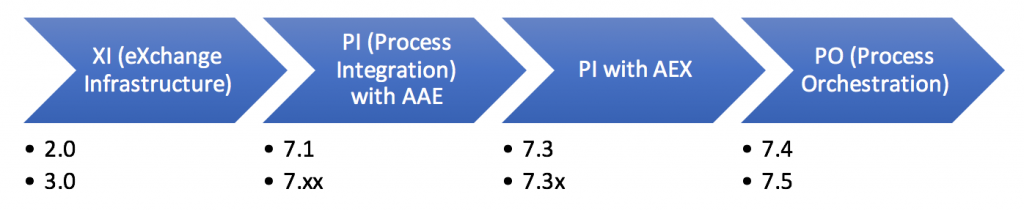 Evolution and history of SAP XI, PI and PO and their versions
To understand the differences between these versions, let’s look at the major architecture changes of each.
SAP eXchange Infrastructure (XI) Architecture Overview:
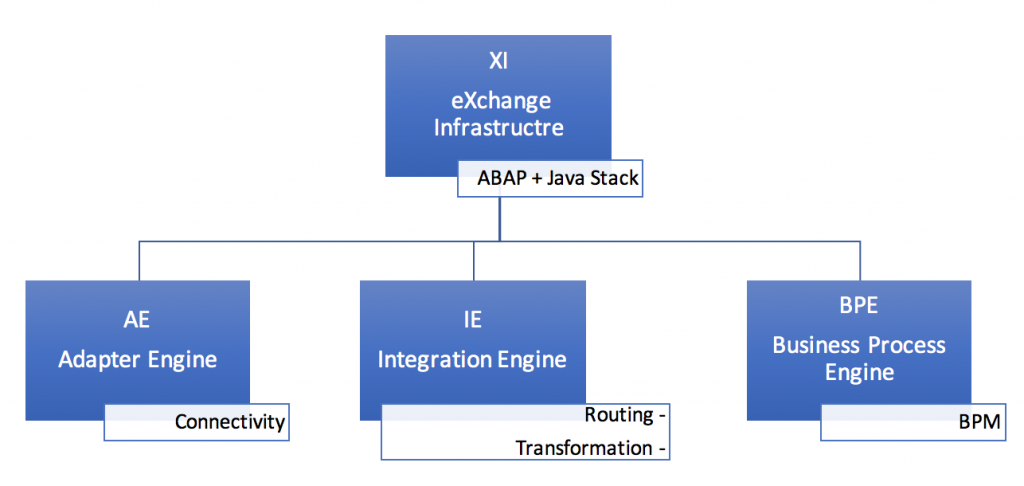 Overview of the eXchange Infrastructure
SAP eXchange Infrastructure (XI) contains Adapter Engine (AE), Integration Engine (IE), and Business Process Engine (BPE). It was installed on a dual stack Netweaver installation with ABAP and Java stacks.
-
AE – Adapter Engine
As the name suggests, the main purpose of this component was to provide connectivity functionality. Adapter engine provided capabilities of talking to different communication protocols using different adapters.
-
IE – Integration Engine
SAP XI component which was responsible for transformation and routing of the messages. Integration Engine also provided a runtime to the message communication. In XI heavy message processing was done through IE as each message was routed, transformed and executed by this component.
-
BPE – Business Process Engine
Engine which executed ccBPM (Cross Component Business Process Management) workflows. ccBPM is based on Business Process Execution Language (BPEL) and required a dual stack installation as its runtime enviornment was on Web AS ABAP.
Drawbacks and Challenges with eXchange Infrastructure (XI):
One major drawback of XI inefficient performance due to back and forth communication between components. Also due to the dual stack arcitecture and multipole components, message persistence impacted the performance.
SAP Process Integration (PI) Architecture Overview:
With SAP introducing Advanced Adapter Engine (AAE), PI was able to process messages end to end without Integration Engine (IE) runtime. This reduced the cross communication between components and improved performance massively.
-
AAE – Advanced Adapter Engine
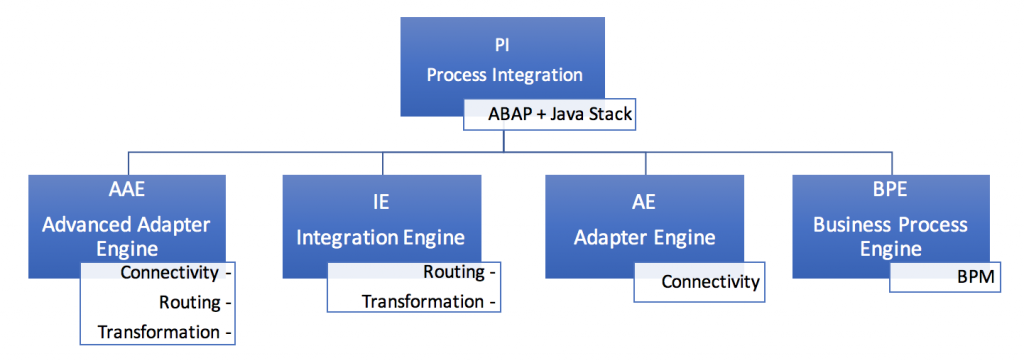 Process Integration (PI) Architectre Overview with AAE
AAE has capabilities to handle routing, transformation and connectivity which were segregated to different components in SAP XI. Integration Configuration Object (ICO) was introduced for design time instead of traditional XI objects such as sender agreement, receiver determination and receiver agreement. ICO made it possible to connect, transform and route message in AAE without Integration Engine (IE) runtime. Also, dual stack message persistence was eliminated since ICO scenarios were executed independently by AS Java.
Drawbacks and Challenges of PI with AAE
Although PI installation with AAE enhanced performance in comparison with XI, still improvements were needed to extend connectivity and performance. AAE could only handle limited set of connections and still required IE runtime for development and administrative purposes. Plus, RNIF adapter and the CIDX was not available in AAE. Also, earlier versions of AAE did not include iDoc and http adapters since they belonged to ABAP stack. Moreover, BPE still required ABAP stack for runtime as it was ccBPM. As you notice, although performance was improved compared to XI, SAP couldn’t completely decouple the need of Integration Engine (IE).
-
B2B Add-on
B2B add-on was also introduced to PI with versions PI 7.1. B2B comes with a set of B2B protocol adapters, converter modules and B2B infrastructure services for serving the EDI integration needs of most industries.
-
AEX -Advanced Adapter Engine Extended
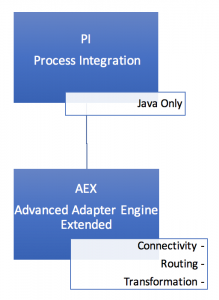 Process Integration (PI) Overview with Advanced Adapter Engine Extended (AEX)
Finally, with SAP PI 7.30 version SAP eliminated the need of Integration Engine (IE) and introduced the Advanced Adapter Extended (AEX). AEX is a single engine which includes Enterprise Service Bus (ESB), Integration Directory (ID) and AAE capabilities. With AEX, PI became a Java AS only installation and SAP completely decoupled ABAP stack. Also with PI 7.3 SAP introduced iDoc_AAE adapter and http_AAE which run on Java. The complete removal of ABAP stack is a major change in the SAP PI architecture.
Drawbacks and Challenges of PI with AEX
Although PI with AEX improved performances by completely decoupling ABAP stack and the need of Integration Engine (IE), it did not include Business Process Management (BPM) capabilities.
SAP Process Orchestration (PO) Architecture Overview:
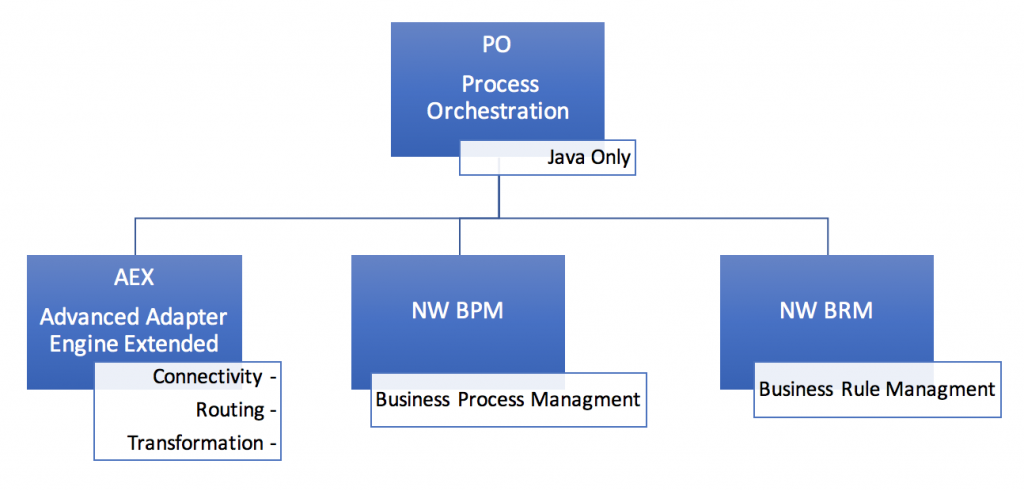 Overview of the Architecture of Process Orchestration
To overcome all these challenges with PI, SAP released Process Orchestration which was a Java only installation. Yes! No ABAP stack installation was availabe from PO 7.31. Plus, with new PO version SAP has added fully functional Netweaver Business Process Management (NW BPM) and Business Rule Management (BRM) which were fully executable on Java. Therefore, Process Orchestration (PO) is a combination of Process Integration (PI) with AEX, Business Process Management (BPM) and Business Rule Management (BRM) which only runs on Java.
-
NW BPM – Netweaver Business Process Management
Unlike ccPBM, NW BPM runs on Java-based environment called CE (Composite Environment). Also, NW BPM uses Business Process Model Notation (BPMN) language while ccBPM uses Business Process Execution Language (BPEL). Although ccBPM design time was on ABAP stack, you require Eclipse based tool NWDS (Netweawer Development Studio) for NW BPM. Even if you have extensive experience in ccBPM, you need to start learning NW BPM from scratch.
-
BRM – Business Rule Management
Business Rule Management (BRM) contains modeling capabilities targeting business analysts. Rules are owned by LoB not by IT.
Summary:
To conclude, SAP PO contains all the functionalities of PI, plus BPM and BRM in a single Java stack. I hope you were able to visualize the evolution of SAP middleware. By looking at the history of changes to SAP middleware architecture from XI to PI to PO, you can see the reasoning behind these changes. If you have any more questions comment below!
来自 “ ITPUB博客 ” ,链接:https://blog.itpub.net/29829936/viewspace-2649733/ ,如需转载,请注明出处,否则将追究法律责任。

最新文章
- 那些适用于跨境电商的 ERP 系统
- On the decline of SAP consulting industry
- Matters Needing Attention as A SAP Freelancer
- The development prospect of SAP consultants in China in the next decade
- SAP WM中阶下架策略A(Partial Pallet Quantity)
- SAP WM高阶之上架策略C(Open Storage)
- SAP WM高阶之上架策略B (Bulk Storage)
- SAP WM高阶之上架策略P(Storage Unit Type)
- SAP WM高阶之2-Step Picking
- SAP QM 高阶之Physical Sample Management
