7. Which two statements are true regarding the USING and ON clauses in table joins? (Choose two.)
A. Both USING and ON clauses can be used for equijoins and nonequijoins.
B. A maximum of one pair of columns can be joined between two tables using the ON clause.
C. The ON clause can be used to join tables on columns that have different names but compatible data types.
D. The WHERE clause can be used to apply additional conditions in SELECT statements containing the ON or the USING clause.
关于表连接中using 和 on子句的用法 正确的是
答案:CD
A.错. using 子句用于等值连接,且两个表中连接列名称要相同

B.错.on子句可以连接多个列
C.正确。on子句用于连接表的列可以是不同的名字,但是数据类型要兼容。
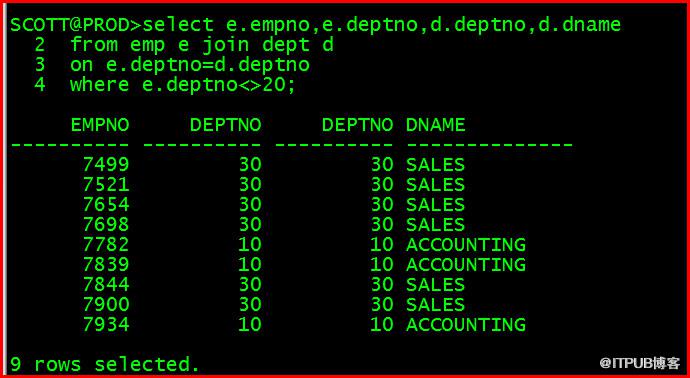
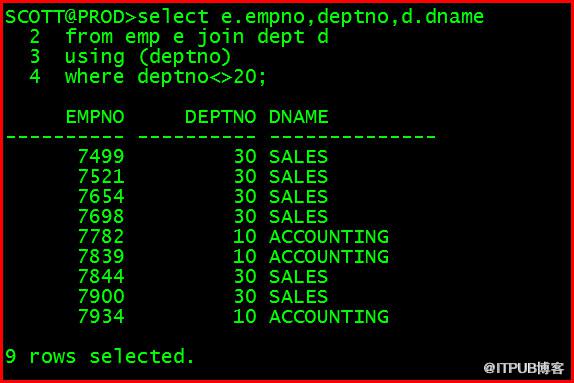
D.正确。 在包含on或using子句的select语句中,可以使用where限定附加的条件。
SCOTT@PROD>select e.empno,e.deptno,d.deptno,d.dname
2 from emp e join dept d
3 on e.deptno=d.deptno
4 where e.deptno<>20;
SCOTT@PROD>select e.empno,deptno,d.dname
2 from emp e join dept d
3 using (deptno)
4 where deptno<>20;
A. Both USING and ON clauses can be used for equijoins and nonequijoins.
B. A maximum of one pair of columns can be joined between two tables using the ON clause.
C. The ON clause can be used to join tables on columns that have different names but compatible data types.
D. The WHERE clause can be used to apply additional conditions in SELECT statements containing the ON or the USING clause.
关于表连接中using 和 on子句的用法 正确的是
答案:CD
A.错. using 子句用于等值连接,且两个表中连接列名称要相同
B.错.on子句可以连接多个列
C.正确。on子句用于连接表的列可以是不同的名字,但是数据类型要兼容。
D.正确。 在包含on或using子句的select语句中,可以使用where限定附加的条件。
SCOTT@PROD>select e.empno,e.deptno,d.deptno,d.dname
2 from emp e join dept d
3 on e.deptno=d.deptno
4 where e.deptno<>20;
SCOTT@PROD>select e.empno,deptno,d.dname
2 from emp e join dept d
3 using (deptno)
4 where deptno<>20;
来自 “ ITPUB博客 ” ,链接:https://blog.itpub.net/29475508/viewspace-2089373/ ,如需转载,请注明出处,否则将追究法律责任。

请登录后发表评论
登录
全部评论
最新文章
- 【OCM】Oracle 12C OCMU 12c OCM升级考试大纲
- 【OGG】Oracle GoldenGate 11g (二) GoldenGate 11g 单向同步配置 下
- 【OGG】Oracle GoldenGate 11g (二) GoldenGate 11g 单向同步配置 上
- 【OGG】Oracle GoldenGate 11g (一) 安装GoldenGate 11g on Linux
- 【Linux】Linux操作系统 virtualbox虚拟机挂载光驱iso镜像文件安装oracle数据库软件
- 【Oracle】Windows安装oracle11gR1 database 11.1.0.6
- 【Linux】Linux网络配置基础4 RHEL6 操作系统更换网卡
- 【Oracle】Linux7安装11g Error in invoking target 'agent nmhs' of makefile
- 【Linux】Linux7服务管理 OracleLinux7 关闭、禁用防火墙服务
- 【Linux】Virtualbox 安装 Oracle Linux 7 -64位
