11GR2增加了递归With子查询
详见 剑破冰山 429页
树形遍历有了新方法.
原来使用sys_connect_by_path函数
递归With新写法.
由两个SQL union all而成.
上面的SQL是起始的条件.
下面的SQL是递归的条件.
搜索子句
SEARCH
① { DEPTH FIRST BY c_alias [, c_alias]...
[ ASC | DESC ]
[ NULLS FIRST | NULLS LAST ]
② | BREADTH FIRST BY c_alias [, c_alias]...
[ ASC | DESC ]
[ NULLS FIRST | NULLS LAST ]
}
③ SET ordering_column
注:
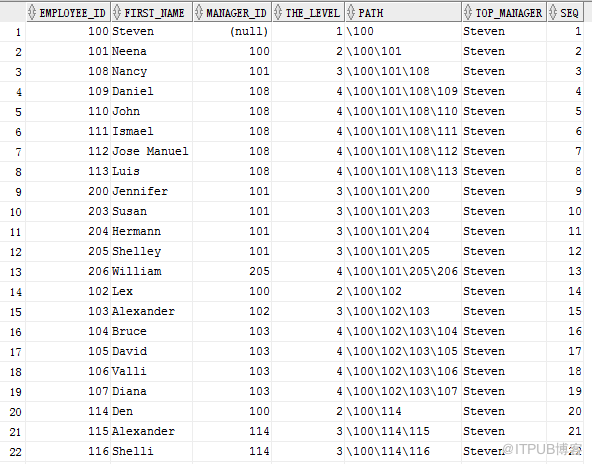
①DEPTH FIRST表示按深度优先的顺序来输出。BY后面的列名及其升降序、空值放置顺序指明了在深度优先的前提下,同一层次的数据的排序情况。
这和原来CONNECT BY查询中的ORDER SIBLING BY子句是一样的。
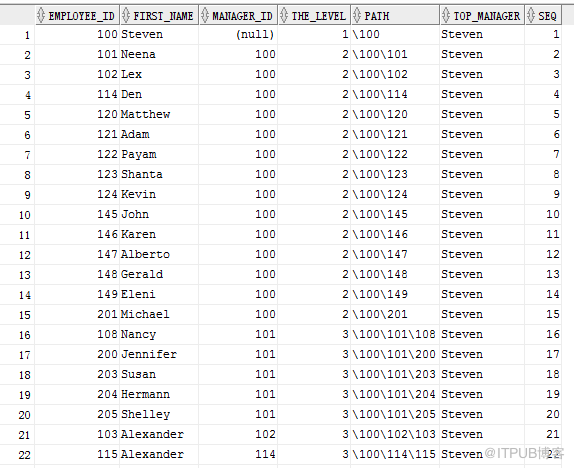
②BREADTH FIRST表示按广度优先的顺序来输出。BY后面的列名及其升降序、空值放置顺序指明了在广度优先的前提下,同一层次的数据的排序情况。
③列名ordering_column用于存放排序后的序号,是一个从1开始的连续正整数。后续的查询中可以利用这个列得知某行数据在整个结果集中的位置。
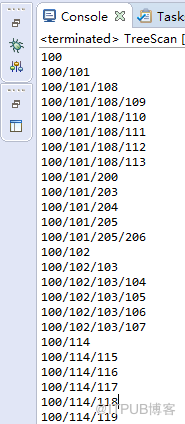
sys_connect_by_path结果:
深度优先遍历
广度优先遍历
参考:
http://www.oracle.com/technetwork/cn/articles/hartley-recursive-086819-zhs.html
详见 剑破冰山 429页
树形遍历有了新方法.
原来使用sys_connect_by_path函数
- select
- employee_id,
- first_name,
- manager_id,
- level,
- sys_connect_by_path(employee_id,'\') as path,
- connect_by_root(first_name) as top_manager
- from employees
- start with manager_id is null
- connect by prior employee_id=manager_id;
递归With新写法.
由两个SQL union all而成.
上面的SQL是起始的条件.
下面的SQL是递归的条件.
- with t(employee_id,first_name,manager_id,the_level,path,top_manager) as
- (
- select
- employee_id,
- first_name,
- manager_id,
- 1 as the_level,
- '\'||employee_id as path,
- first_name as top_manager
- from employees
- where manager_id is null
- union all
- select
- e.employee_id,
- e.first_name,
- e.manager_id,
- 1+t.the_level as the_level,
- t.path||'\'||e.employee_id as path,
- t.top_manager
- from t,employees e
- where t.employee_id=e.manager_id
- )
- select * from t;
搜索子句
SEARCH
① { DEPTH FIRST BY c_alias [, c_alias]...
[ ASC | DESC ]
[ NULLS FIRST | NULLS LAST ]
② | BREADTH FIRST BY c_alias [, c_alias]...
[ ASC | DESC ]
[ NULLS FIRST | NULLS LAST ]
}
③ SET ordering_column
注:
①DEPTH FIRST表示按深度优先的顺序来输出。BY后面的列名及其升降序、空值放置顺序指明了在深度优先的前提下,同一层次的数据的排序情况。
这和原来CONNECT BY查询中的ORDER SIBLING BY子句是一样的。
②BREADTH FIRST表示按广度优先的顺序来输出。BY后面的列名及其升降序、空值放置顺序指明了在广度优先的前提下,同一层次的数据的排序情况。
③列名ordering_column用于存放排序后的序号,是一个从1开始的连续正整数。后续的查询中可以利用这个列得知某行数据在整个结果集中的位置。
sys_connect_by_path结果:
深度优先遍历
- with t(employee_id,first_name,manager_id,the_level,path,top_manager) as
- (
- select
- employee_id,
- first_name,
- manager_id,
- 1 as the_level,
- '\'||employee_id as path,
- first_name as top_manager
- from employees
- where manager_id is null
- union all
- select
- e.employee_id,
- e.first_name,
- e.manager_id,
- 1+t.the_level as the_level,
- t.path||'\'||e.employee_id as path,
- t.top_manager
- from t,employees e
- where t.employee_id=e.manager_id
- )
- search depth first by manager_id set seq
- select * from t;
广度优先遍历
- with t(employee_id,first_name,manager_id,the_level,path,top_manager) as
- (
- select
- employee_id,
- first_name,
- manager_id,
- 1 as the_level,
- '\'||employee_id as path,
- first_name as top_manager
- from employees
- where manager_id is null
- union all
- select
- e.employee_id,
- e.first_name,
- e.manager_id,
- 1+t.the_level as the_level,
- t.path||'\'||e.employee_id as path,
- t.top_manager
- from t,employees e
- where t.employee_id=e.manager_id
- )
- search BREADTH first by manager_id set seq
- select * from t;
参考:
http://www.oracle.com/technetwork/cn/articles/hartley-recursive-086819-zhs.html
来自 “ ITPUB博客 ” ,链接:https://blog.itpub.net/29254281/viewspace-1965778/ ,如需转载,请注明出处,否则将追究法律责任。
上一篇:
使用STRAIGHT_JOIN优化一则
下一篇:
井字棋解法(参考答案一解)

请登录后发表评论
登录
全部评论
