High level of Spring's web MVC
From: http://docs.spring.io/spring/docs/2.5.x/reference/mvc.html#mvc-servlet
Spring's web MVC framework is, like many other web MVC frameworks,
request-driven, designed around a central servlet that dispatches requests
to controllers and offers other functionality facilitating the development
of web applications. Spring's DispatcherServlet however, does more than just that. It is completely integrated with the
Spring IoC container and as such allows you to use every other feature
that Spring has.
The request processing workflow of the Spring Web MVC DispatcherServlet is illustrated in the following diagram. The pattern-savvy reader will recognize that the DispatcherServlet is an expression of the “Front Controller” design pattern (this is a pattern that Spring Web MVC shares with many other leading web frameworks).

The requesting processing workflow in Spring Web MVC (high level)
The DispatcherServlet is an actual Servlet (it inherits from the HttpServlet base class), and as such is declared in the web.xml of your web application. Requests that you want the DispatcherServlet to handle will have to be mapped using a URL mapping in the same web.xml file. This is standard J2EE servlet configuration; an example of such a DispatcherServlet declaration and mapping can be found below.
<web-app>

    <servlet>
        <servlet-name>example</servlet-name>
        <servlet-class>org.springframework.web.servlet.DispatcherServlet</servlet-class>
        <load-on-startup>1</load-on-startup>
    </servlet>

    <servlet-mapping>
        <servlet-name>example</servlet-name>
        <url-pattern>*.form</url-pattern>
    </servlet-mapping>

</web-app>
In the example above, all requests ending with .form will be handled by the 'example' DispatcherServlet. This is only the first step in setting up Spring Web MVC... the various beans used by the Spring Web MVC framework (over and above the DispatcherServlet itself) now need to be configured.
As detailed in the section entitled Section 3.8, “The ApplicationContext”, ApplicationContext instances in Spring can be scoped. In the web MVC framework, each DispatcherServlet has its own WebApplicationContext, which inherits all the beans already defined in the root WebApplicationContext. These inherited beans defined can be overridden in the servlet-specific scope, and new scope-specific beans can be defined local to a given servlet instance.
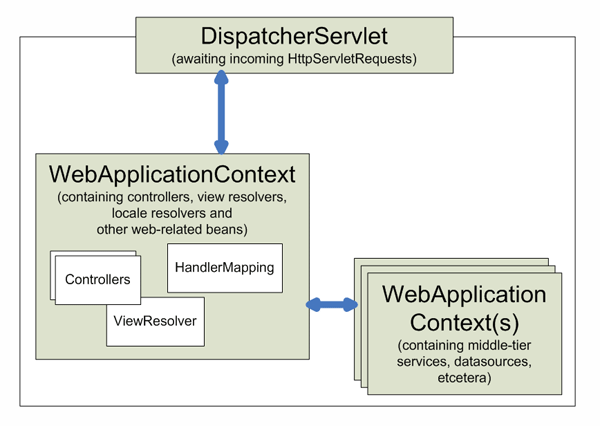
Context hierarchy in Spring Web MVC
The framework will, on initialization of a DispatcherServlet, look for a file named [servlet-name]-servlet.xml in the WEB-INF directory of your web application and create the beans defined there (overriding the definitions of any beans defined with the same name in the global scope).
Consider the following DispatcherServlet servlet configuration (in the 'web.xml' file.)
<web-app>

    <servlet>
        <servlet-name>golfing</servlet-name>
        <servlet-class>org.springframework.web.servlet.DispatcherServlet</servlet-class>
        <load-on-startup>1</load-on-startup>
    </servlet>

    <servlet-mapping>
        <servlet-name>golfing</servlet-name>
        <url-pattern>*.do</url-pattern>
    </servlet-mapping>

</web-app>
With the above servlet configuration in place, you will need to have a file called '/WEB-INF/golfing-servlet.xml' in your application; this file will contain all of your Spring Web MVC-specific components (beans). The exact location of this configuration file can be changed via a servlet initialization parameter (see below for details).
The WebApplicationContext is an extension of the plain ApplicationContext that has some extra features necessary for web applications. It differs from a normal ApplicationContext in that it is capable of resolving themes (see Section 13.7, “Using themes”), and that it knows which servlet it is associated with (by having a link to the ServletContext). The WebApplicationContext is bound in the ServletContext, and by using static methods on the RequestContextUtils class you can always lookup the WebApplicationContext in case you need access to it.
The Spring DispatcherServlet has a couple of special beans it uses in order to be able to process requests and render the appropriate views. These beans are included in the Spring framework and can be configured in the WebApplicationContext, just as any other bean would be configured. Each of those beans is described in more detail below. Right now, we'll just mention them, just to let you know they exist and to enable us to go on talking about the DispatcherServlet. For most of the beans, sensible defaults are provided so you don't (initially) have to worry about configuring them.
来自 “ ITPUB博客 ” ,链接:https://blog.itpub.net/20864683/viewspace-2086018/ ,如需转载,请注明出处,否则将追究法律责任。

