在阅读redis的源码的时候,一直忽略了一个问题,redis的通信协议,看流程的时候,有很多操作,比如:
             selectcmd = createObject(OBJ_STRING,
                 sdscatprintf(sdsempty(),
                 "*2\r\n$6\r\nSELECT\r\n$%d\r\n%s\r\n",
                 dictid_len, llstr));
然后查了下官方,Redis 客户端使用一种称为RESP(Redis Serialization Protocal))的协议与 Redis 服务器进行通信。虽然该协议是专门为 Redis 设计的,但它也可以用于其他客户端-服务器软件项目。
官方介绍,有三个特点:
实现简单
快速解析
人类可读
按官方的说明:
RESP 是一个序列化协议,支持简单字符串、错误、整数、批量字符串(Bulk Strings)和数组
RESP中,第一个字节决定数据类型;
客户端和server端通过tcp或流来进行通信
为了防止
粘包,协议以\r\n(CRLF)结尾二进制安全
官方举了一些例子
简单字符串:第一个字节为
+,示例:+OK\r\n错误:第一个字节为
-,示例:-Error message\r\n整数:第一个字节为
:,示例::0\r\nBulk Strings(二进制安全的字符串):第一个字节为:
$,示例:$5\r\nhello\r\nnull 示例:$-1\r\n$字节后紧跟着5是字节长度,以CRLF终止紧接着就是实际的字符
hello,以CRLF终止数组:第一个字节:
*,示例:*2\r\n$5\r\nhello\r\n$5\r\nworld\r\n空数组示例:*-1\r\n*字节后紧跟着2是数组的长度以\r\n结尾$5表示 表示下一个字符hello的长度,这个字符串以\r\n结尾在数组中
$-1\r\n表示null元素
我们来看一个具体的示例:
set 5ycode yxk
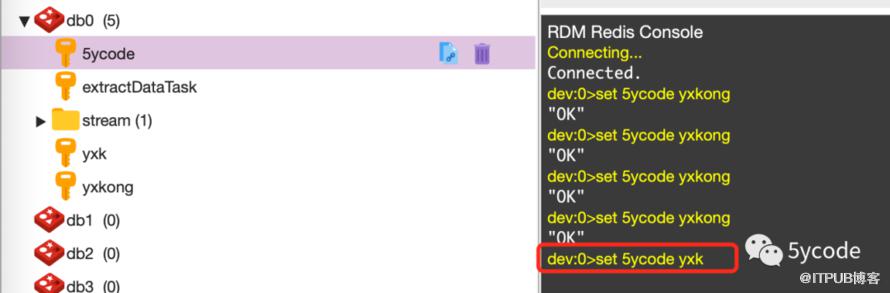
我们来看下server端接收到了什么
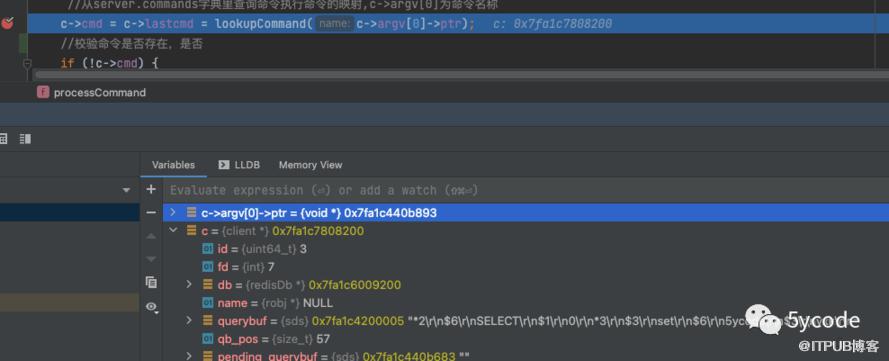
看下具体内容
querybuf = "*2\r\n$6\r\nSELECT\r\n$1\r\n0\r\n*3\r\n$3\r\nset\r\n$6\r\n5ycode\r\n$3\r\nyxk\r\n"
对于server来说,接收到了两条命令
一条是
select 0一条是
set 5ycode yxk
看下内存里的内容

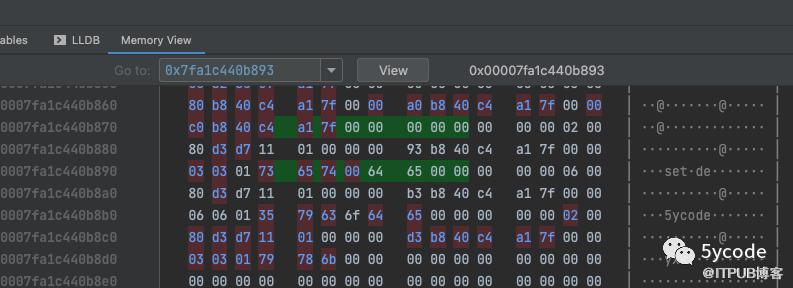
和官方说明上对上了。
我们看下java是如何封装的,就拿一个最简单的操作命令
redisTemplate.opsForValue().set(key, value);
我们直接追set方法
 public interface ValueOperations<K, V> {

     /**
      * Set {@code value} for {@code key}.
      *
      * @param key must not be {@literal null}.
      * @param value must not be {@literal null}.
      * @see <a href="https://redis.io/commands/set">Redis Documentation: SET</a>
      */
     void set(K key, V value);
 }

 class DefaultValueOperations<K, V> extends AbstractOperations<K, V> implements ValueOperations<K, V> {
     @Override
     public void set(K key, V value) {

         byte[] rawValue = rawValue(value);
         execute(new ValueDeserializingRedisCallback(key) {

             @Override
             protected byte[] inRedis(byte[] rawKey, RedisConnection connection) {
                 //最终是这里进行了调用
                 connection.set(rawKey, rawValue);
                 return null;
             }
         }, true);
 }

 }
继续翻代码
 public interface RedisStringCommands {
 @Nullable
 Boolean set(byte[] key, byte[] value);
 }
因为我们操作的是string,我们直接看
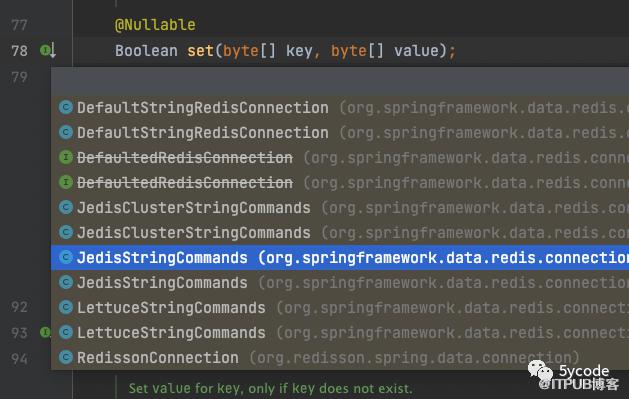
 package org.springframework.data.redis.connection.jedis;

 class JedisStringCommands implements RedisStringCommands {
     public Boolean set(byte[] key, byte[] value) {
         Assert.notNull(key, "Key must not be null!");
         Assert.notNull(value, "Value must not be null!");

         try {
             if (this.isPipelined()) {
                 this.pipeline(this.connection.newJedisResult(this.connection.getRequiredPipeline().set(key, value), Converters.stringToBooleanConverter()));
                 return null;
             } else if (this.isQueueing()) {
                 this.transaction(this.connection.newJedisResult(this.connection.getRequiredTransaction().set(key, value), Converters.stringToBooleanConverter()));
                 return null;
             } else {
                 return Converters.stringToBoolean(this.connection.getJedis().set(key, value));
             }
         } catch (Exception var4) {
             throw this.convertJedisAccessException(var4);
         }
     }
 }
我们就是一次普通的调用,直接看return Converters.stringToBoolean(this.connection.getJedis().set(key, value));我们直接看Jedis
 package redis.clients.jedis;

 public class Jedis extends BinaryJedis implements JedisCommands, MultiKeyCommands,
     AdvancedJedisCommands, ScriptingCommands, BasicCommands, ClusterCommands, SentinelCommands,
     ModuleCommands {
   @Override
   public String set(final String key, final String value) {
     checkIsInMultiOrPipeline();
     client.set(key, value);
     return client.getStatusCodeReply();
   }

 }
最终我们追到
 package redis.clients.jedis;

 public class Connection implements Closeable {
 public void sendCommand(final ProtocolCommand cmd, final byte[]... args) {
     try {
       connect();
       //协议处理在这里
       Protocol.sendCommand(outputStream, cmd, args);
     } catch (JedisConnectionException ex) {
       try {
         String errorMessage = Protocol.readErrorLineIfPossible(inputStream);
         if (errorMessage != null && errorMessage.length() > 0) {
           ex = new JedisConnectionException(errorMessage, ex.getCause());
         }
       } catch (Exception e) {
       }
       // Any other exceptions related to connection?
       broken = true;
       throw ex;
     }
   }
 }
我们看下最终的协议处理,我把常量转成具体的值看更直观些
 public final class Protocol {
  public static void sendCommand(final RedisOutputStream os, final ProtocolCommand command,
       final byte[]... args) {
     sendCommand(os, command.getRaw(), args);
   }

   private static void sendCommand(final RedisOutputStream os, final byte[] command,
       final byte[]... args) {
     try {
       //以*号开头
       os.write("*");
       //长度\r\n
       os.writeIntCrLf(args.length + 1);
       os.write("$");
       //写了命令长度以后,又写了\r\n
       os.writeIntCrLf(command.length);
       //写具体命令
       os.write(command);
       //写\r\n
       os.writeCrLf();

       for (final byte[] arg : args) {
         os.write("$");
         //写了参数长度以后,又写了\r\n
         os.writeIntCrLf(arg.length);
         //具体值
         os.write(arg);
         //最后的\r\n
         os.writeCrLf();
       }
     } catch (IOException e) {
       throw new JedisConnectionException(e);
     }
   }
 }
最终也转换成了*3\r\n$3\r\nset\r\n$6\r\n5ycode\r\n$3\r\nyxk\r\n
原文作者:5ycode;如有侵权,请联系管理员删除。

最新文章
- DeepSeek+ragflow构建企业知识库之工作流,突然觉的dify又香了
- dify1.0.0版本升级及新功能预览
- DeepSeek+ragflow构建企业知识库:突然觉的dify不香了(1)
- DeepSeek官方充值终于开放了,相关工具推荐
- 聊聊dify权限验证的三种方案及实现
- DeepSeek+dify 工作流应用,自然语言查询数据库信息并展示
- DeepSeek+dify知识库,查询数据库的两种方式(api+直连)
- DeepSeek+dify 本地知识库:高级应用Agent+工作流
- 腾讯有Dify团队吗?difySandbox成了腾讯Dify团队开源的
- Deepseek+Dify本地知识库相关问题汇总
