
1
Op在虚拟机里的执行
1.1 PhysicalRun和InstructionsBuilder
上一篇文章《OneFlow源码解析:Op、Kernel与解释器》中提到:
PhysicalRun接受一个lambda函数作为参数,这里即InstructionsBuilder->Call方法,该方法接受kernel、input/output的eager blob object、kernel执行的上下文作为参数。Call方法实际会完成OpCall指令的构建,并最终将其派发至vm指令列表中,等待VM实际调度执行。
这个PhysicalRun函数里包裹着一个lambda函数:
JUST(PhysicalRun([&](InstructionsBuilder* builder) -> Maybe<void> {return builder->Call(xxx);}));
其中,lambda函数接受一个InstructionsBuilder指针(builder),并调用builder->Call方法,用于实际完成Op指令在VM中的构建。而PhysicalRun(https://github.com/Oneflow-Inc/oneflow/blob/88f147d50e75d1644e552ed445dd58f9b5121ea5/oneflow/core/framework/instructions_builder.h#L160)在 oneflow/core/framework/instructions_builder.h中定义,其接受lambda函数作为模版参数(CallbackT):
// Make VM instructions with instruction builder and run instructions with physical/local view.template<typename CallbackT>Maybe<void> PhysicalRun(const CallbackT& Build) {vm::InstructionList instruction_list;InstructionsBuilder instructions_builder(&instruction_list);JUST(Build(&instructions_builder));JUST(vm::Run(instructions_builder.mut_instruction_list()));return Maybe<void>::Ok();}
可见,PhysicalRun函数中,首先初始化一个InstructionsBuilder,然后将InstructionsBuilder指针作为参数传给lambda函数,完成实际指令的构建;最后通过vm::Run()方法将该指令发送至VM,等候VM实际调度和执行。Run方法如下:
Maybe<void> Run(vm::InstructionList* instruction_list) {auto* virtual_machine = JUST(SingletonMaybe<VirtualMachine>());JUST(virtual_machine->Receive(instruction_list));return Maybe<void>::Ok();}
可以看见,Run()方法获取了全局单例的VM对象指针,然后通过vm的Receive()方法,将该条指令发送给虚拟机(所以这里Run其实有点歧义,更贴切的意思,其实是指令发送或传送)。
这个VirtualMachine->Receive方法很重要,会在后面的第2.章节中详细展开。
1.2 InstructionsBuilder
上面PhysicalRun函数中的InstructionsBuilder,类似一个指令构建的helper,InstructionsBuilder的系列方法配合指令策略(InstructionPolicy),可以帮助构建不同类型的vm指令。
从InstructionsBuilder
(https://github.com/Oneflow-Inc/oneflow/blob/88f147d50e75d1644e552ed445dd58f9b5121ea5/oneflow/core/framework/instructions_builder.h#L47)的定义中,我们可以看到指令的构建方法,其中常用方法如下:
// 用于lazy mode(nn.Graph)// Build VM execution instructions with NNGraph's inputs/outputs/parameters for NNGraph execution.Maybe<void> LaunchLazyJob(const vm::EagerBlobObjectListPtr& inputs,const vm::EagerBlobObjectListPtr& outputs,const vm::EagerBlobObjectListPtr& parameters,const std::shared_ptr<NNGraphIf>& nn_graph);// 用于全局同步,同步等待所有指令调用完成Maybe<void> GlobalSync();// 用于Tensor内存释放(归还allocator)Maybe<void> ReleaseTensor(const std::shared_ptr<vm::EagerBlobObject>& eager_blob_object);// 操作Tensor实际内存(blob)template<typename T>Maybe<void> AccessBlobByCallback(const T tensor,const std::function<void(ep::Stream*, const std::shared_ptr<vm::EagerBlobObject>&)>& callback,const std::string& modifier);// 最常用的指令构建方法,用于构造op执行所需的OpCall指令Maybe<void> Call(const std::shared_ptr<one::StatefulOpKernel>& opkernel,vm::EagerBlobObjectList&& input_eager_blob_objects,vm::EagerBlobObjectList&& output_eager_blob_objects,const one::OpExprInterpContext& ctx, Symbol<Stream> stream);
1.3 InstructionPolicy
InstructionPolicy
(https://github.com/Oneflow-Inc/oneflow/blob/88f147d50e75d1644e552ed445dd58f9b5121ea5/oneflow/core/vm/instruction_policy.h#L34)——指令策略,通常用于配合InstructionsBuilder实际构建出不同的vm指令。InstructionPolicy的子类实现如下:
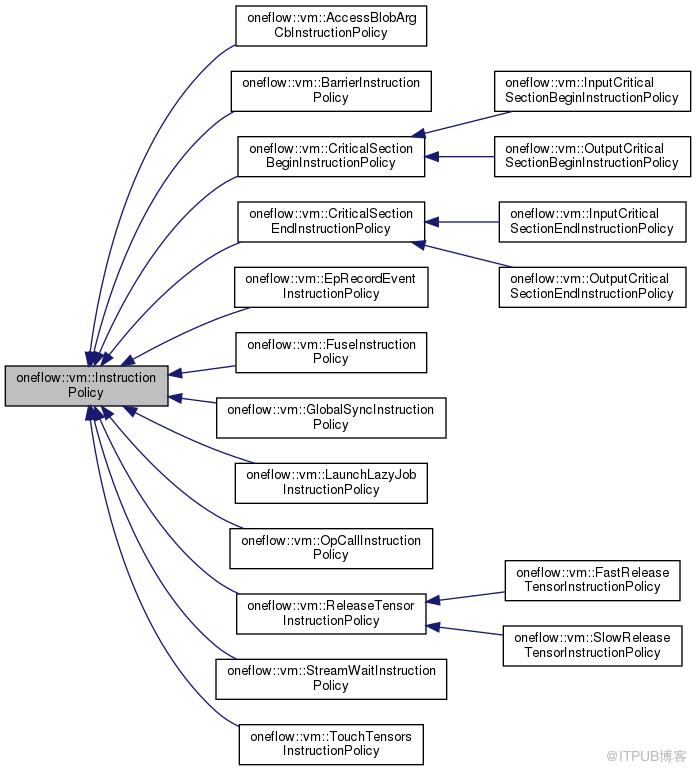
这些子类的InstructionPolicy可近似认为是指令类型。如,用于Op执行的OpCallInstructionPolicy、用于Tensor内存释放的ReleaseTensorInstructionPolicy、用于屏障阻塞的BarrierInstructionPolicy等。
以Op执行为例:
JUST(PhysicalRun([&](InstructionsBuilder* builder) -> Maybe<void> {return builder->Call(xxx);}));
实际上是通过InstructionsBuilder的Call方法
(https://github.com/Oneflow-Inc/oneflow/blob/88f147d50e75d1644e552ed445dd58f9b5121ea5/oneflow/core/framework/instructions_builder.cpp#L355),配合OpCall的指令策略(OpCallInstructionPolicy),构造了OpCall指令:
Maybe<void> InstructionsBuilder::Call(const std::shared_ptr<one::StatefulOpKernel>& opkernel,vm::EagerBlobObjectList&& input_eager_blob_objects,vm::EagerBlobObjectList&& output_eager_blob_objects,const std::shared_ptr<const one::GlobalTensorInferResult>& global_tensor_infer_result,const one::OpExprInterpContext& ctx, Symbol<Stream> stream) {......// 获取当前vm streamauto* vm_stream = JUST(Singleton<VirtualMachine>::Get()->GetVmStream(stream));// 通过OpCallInstructionPolicy初始化OpCall指令auto instruction = intrusive::make_shared<vm::Instruction>(vm_stream, std::make_shared<vm::OpCallInstructionPolicy>(vm_stream, opkernel, std::move(input_eager_blob_objects),std::move(output_eager_blob_objects), global_tensor_infer_result, ctx,*one::CurrentDevVmDepObjectConsumeMode()));// 指令入列表instruction_list_->EmplaceBack(std::move(instruction));return Maybe<void>::Ok();}
并将构建好的指令塞入指令列表,待后续VM调度并实际执行。
2
虚拟机的运行原理
2.1 VM初始化
OneFlow环境初始化时,会触发VirtualMachineScope
(https://github.com/Oneflow-Inc/oneflow/blob/88f147d50e75d1644e552ed445dd58f9b5121ea5/oneflow/core/vm/virtual_machine_scope.cpp#L24)的初始化:
VirtualMachineScope::VirtualMachineScope(const Resource& resource) {Singleton<VirtualMachine>::New();}
进而触发VM对象——VirtualMachine
(https://github.com/Oneflow-Inc/oneflow/blob/88f147d50e75d1644e552ed445dd58f9b5121ea5/oneflow/core/vm/virtual_machine.cpp#L81)的初始化。VM作为一个Singleton对象,全局唯一。
VirtualMachine::VirtualMachine() : disable_vm_threads_(false), scheduler_stopped_(false) {// Class VirtualMachineEngine only cares the basic logical of vm, while class VirtualMachine// manages threads and condition variables.// In order to notify threads in VirtualMachineEngine, a notify callback lambda should be take as// an argument for VirtualMachineEngine's constructor.engine_ = intrusive::make_shared<vm::VirtualMachineEngine>();OF_PROFILER_NAME_THIS_HOST_THREAD("_Main");std::function<void()> SchedulerInitializer;GetSchedulerThreadInitializer(&SchedulerInitializer);schedule_thread_ = std::thread(&VirtualMachine::ScheduleLoop, this, SchedulerInitializer);transport_local_dep_object_.Reset();}
VM初始化中最重要的内容,便是:
1.初始化了一个VM的执行引擎——VirtualMachineEngine
2.通过VirtualMachine::ScheduleLoop启动了VM的调度线程
VirtualMachine::ScheduleLoop
void VirtualMachine::ScheduleLoop(const std::function<void()>& Initializer) {SyncVmModeGuard guard(SyncVmMode::kEnable);Initializer();MultiThreadScheduleCtx schedule_ctx{};while (pending_notifier_.WaitAndClearNotifiedCnt() == kNotifierStatusSuccess) {OF_PROFILER_RANGE_GUARD("VirtualMachine::ScheduleLoop");auto start = std::chrono::steady_clock::now();static constexpr int kWorkingMicroseconds = 1000;// Every time this thread wakes up, engine_ is scheduled for about `kWorkingMicroseconds`.// The cost of os thread switching is about 5-10 microseconds. Doing more scheduling in// a single waiting up can reach higher performance.do {do {const size_t total_inserted = engine_->total_inserted_instruction_cnt();const size_t total_erased = engine_->total_erased_instruction_cnt();engine_->Schedule(schedule_ctx);if (ThreadLocalEnvBool<ONEFLOW_VM_ENABLE_SCHEDULE_YIELD>()&& total_inserted == engine_->total_inserted_instruction_cnt()&& total_erased == engine_->total_erased_instruction_cnt()) { // nothing handled.std::this_thread::yield();}} while (!engine_->SchedulerThreadUnsafeEmpty());} while (MicrosecondsFrom(start) < kWorkingMicroseconds);}ScheduleUntilVMEmpty(engine_.Mutable(), schedule_ctx);CHECK_JUST(ForEachThreadCtx(engine_.Mutable(), [&](vm::ThreadCtx* thread_ctx) -> Maybe<void> {thread_ctx->mut_notifier()->Close();return Maybe<void>::Ok();}));{std::unique_lock<std::mutex> lock(worker_threads_mutex_);for (const auto& worker_thread : worker_threads_) { worker_thread->join(); }}scheduler_stopped_ = true;}
class Notifier final {public:OF_DISALLOW_COPY_AND_MOVE(Notifier);Notifier() : notified_cnt_(0), is_closed_(false) {}~Notifier() = default;NotifierStatus Notify();NotifierStatus WaitAndClearNotifiedCnt();void Close();private:size_t notified_cnt_;std::mutex mutex_;bool is_closed_;std::condition_variable cond_;};
while (pending_notifier_.WaitAndClearNotifiedCnt() == kNotifierStatusSuccess) {auto start = std::chrono::steady_clock::now();...do {do {...engine_->Schedule(schedule_ctx);...} while (!engine_->SchedulerThreadUnsafeEmpty());} while (MicrosecondsFrom(start) < kWorkingMicroseconds);}
2.2 VM指令调度
void VirtualMachineEngine::Schedule(const ScheduleCtx& schedule_ctx) {// Release finished instructions and try to schedule out instructions in DAG onto ready list.if (unlikely(mut_active_stream_list()->size())) { ReleaseFinishedInstructions(schedule_ctx); }// Try run the first barrier instruction.if (unlikely(mut_barrier_instruction_list()->size())) { TryRunBarrierInstruction(schedule_ctx); }// Handle pending instructions, and try schedule them to ready list.// Use thread_unsafe_size to avoid acquiring mutex lock.// The inconsistency between pending_instruction_list.list_head_.list_head_.container_ and// pending_instruction_list.list_head_.list_head_.size_ is not a fatal error because// VirtualMachineEngine::Schedule is always in a buzy loop. All instructions will get handled// eventually.// VirtualMachineEngine::Receive may be less effiencient if the thread safe version// `pending_instruction_list().size()` used here, because VirtualMachineEngine::Schedule is more// likely to get the mutex lock.if (unlikely(local_pending_instruction_list().size())) {HandleLocalPending();} else if (unlikely(pending_instruction_list().thread_unsafe_size())) {// MoveTo is under a lock.mut_pending_instruction_list()->MoveTo(mut_local_pending_instruction_list());if (local_pending_instruction_list().size()) { HandleLocalPending(); }}// dispatch ready instructions and try to schedule out instructions in DAG onto ready list.if (unlikely(mut_ready_instruction_list()->size())) {DispatchAndPrescheduleInstructions(schedule_ctx);}// handle scheduler probesif (unlikely(local_probe_list_.size())) {HandleLocalProbe();} else if (unlikely(probe_list_.thread_unsafe_size())) {probe_list_.MoveTo(&local_probe_list_);if (local_probe_list_.size()) { HandleLocalProbe(); }}}
InstructionMutexedList pending_instruction_list_;local_pending_instruction_list_ should be consider as the cache of pending_instruction_list_.InstructionList local_pending_instruction_list_;ReadyInstructionList ready_instruction_list_;LivelyInstructionList lively_instruction_list_;BarrierInstructionList barrier_instruction_list_;
pending相关的instruction_list是悬挂/待处理的指令列表; lively相关的instruction_list是活跃的正在执行中的指令列表; ready相关的instruction_list则是已完成准备工作(指令融合、指令DAG构建等)待执行的指令列表;
将已完成准备工作的指令放入ready_instruction_list_中维护; 尝试运行barrier指令列表(barrier_instruction_list_)中的第一条指令; 如果本地pending指令列表(local_pending_instruction_list_)非空,则通过HandleLocalPending方法处理这些悬挂指令(指令融合、指令执行DAG图构建、插入ready列表) 如果ready指令列表非空,则通过DispatchAndPrescheduleInstructions方法进行指令派发和预调度处理。
2.3 VM指令派发
template<void (VirtualMachineEngine::*OOMHandler)(vm::Stream*, const ScheduleCtx&)>void VirtualMachineEngine::DispatchInstruction(Instruction* instruction,const ScheduleCtx& schedule_ctx) {auto* stream = instruction->mut_stream();// Prepare{// 指令的Prepareconst auto& ret = TRY(instruction->Prepare());if (unlikely(!ret.IsOk())) {// 处理指令Prepare过程中的OOM的逻辑if (ret.error()->has_out_of_memory_error()) {// 让allocator释放不必要的cacahe,再重新执行指令的Prepare(this->*OOMHandler)(stream, schedule_ctx);...}}}// 将当前指令放入running_instruction_liststream->mut_running_instruction_list()->PushBack(instruction);if (stream->active_stream_hook().empty()) { mut_active_stream_list()->PushBack(stream); }// Computeif (OnSchedulerThread(*stream)) {// StreamPolicy的Run方法触发指令的实际执行——Computestream->stream_policy().Run(instruction);} else {stream->mut_thread_ctx()->mut_worker_pending_instruction_list()->PushBack(instruction);schedule_ctx.OnWorkerLoadPending(stream->mut_thread_ctx());}}
执行指令的Prepare 执行指令的Compute
StreamPolicy::Run
class StreamPolicy {public:virtual ~StreamPolicy() = default;virtual ep::Stream* stream() = 0;virtual vm::Allocator* mut_allocator() = 0;virtual DeviceType device_type() const = 0;virtual void InitInstructionStatus(const Stream& stream,InstructionStatusBuffer* status_buffer) const = 0;virtual void DeleteInstructionStatus(const Stream& stream,InstructionStatusBuffer* status_buffer) const = 0;virtual bool QueryInstructionStatusDone(const Stream& stream,const InstructionStatusBuffer& status_buffer) const = 0;virtual void Run(Instruction* instruction) const = 0;virtual bool OnSchedulerThread(StreamType stream_type) const;virtual bool SupportingTransportInstructions() const = 0;protected:StreamPolicy() = default;};
stream()方法返回ep::Stream指针,指向的是针对不同平台的ep::stream对象。
mut_allocator()方法返回一个vm的Allocator指针,用于内存分配/释放。
InitInstructionStatus/QueryInstructionStatusDone/DeleteInstructionStatus用于创建/查询/销毁指令执行状态
Run方法则是核心,定义了该Stream具体运行时的逻辑。
这里的ep在oneflow中是execution provider的缩写,ep从本质上来讲就是一个针对不同硬件平台的executor抽象。

void EpStreamPolicyBase::Run(Instruction* instruction) const {...auto* stream = instruction->mut_stream();EpStreamPolicyBase* ep_stream_policy_base =dynamic_cast<EpStreamPolicyBase*>(stream->mut_stream_policy());...auto* ep_device = ep_stream_policy_base->GetOrCreateEpDevice();ep_device->SetAsActiveDevice();instruction->Compute();...}
2.4 VM执行执行
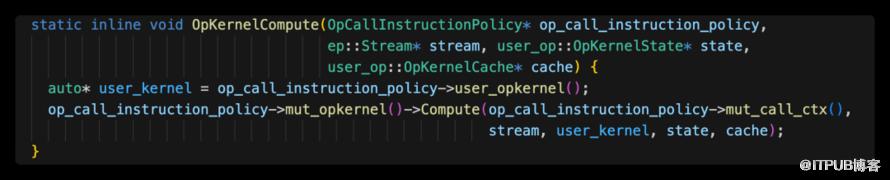
void OpCallInstructionPolicy::Compute(vm::Instruction* instruction) {OpCallInstructionUtil::Compute(this, instruction);}

TryInitOpKernelStateAndCache——初始化一些kernel计算需要的状态或缓存
OpKernelCompute——执行该op对应的kernel,kernel内主要是实际的op计算逻辑
2.5 VM指令发送
// Returns true if old scheduler_pending_instruction_list is emptyMaybe<bool> VirtualMachineEngine::Receive(InstructionList* compute_instruction_list) {OF_PROFILER_RANGE_GUARD("vm:Receive");INTRUSIVE_UNSAFE_FOR_EACH_PTR(compute_instruction, compute_instruction_list) {OF_PROFILER_RANGE_GUARD(compute_instruction->DebugName());}bool old_list_empty = mut_pending_instruction_list()->MoveFrom(compute_instruction_list);return old_list_empty;}
3
小结
3.1 UserOpExpr

3.2 Op执行的宏观脉络
ReluFunctor UserOpExpr Interpreter PhysicalRun VirtualMachine->Receive VirtualMachine->ScheduleLoop ...
3.3 虚拟机运行和调度总结
通常,我们习惯在动态图模式下训练深度学习网络,使用Python搭建网络,并通过各种op进行前向、反向、loss计算、调试debug等过程,这些Python代码可以看作是动态的op的执行序列。
OneFlow虚拟机将op执行序列抽象成了各种VM指令序列。OneFlow的虚拟机会对这些op执行序列进行动态翻译并生成VM指令序列,通过PhysicalRun构造完毕后,动态地将指令发送至VM的悬挂列表中维护。这些指令或在时间上存在先后顺序,或在数据上存在依赖关系,所以悬挂列表中的指令后续会被虚拟机进行一些指令融合、指令连边、动态构建指令DAG图的过程,然后移入就绪列表中维护,等待虚拟机调度并实际执行。虚拟机负责维护若干个指令队列,以及指令在这些队列之间的状态转换。
OneFlow虚拟机还统一了动态图模式(Eager Mode)和静态图模式(Lazy Mode)。静态图模式下,通过nn.Graph编译出深度学习网络的Job,这个Job同样被虚拟机抽象成了VM指令并接受虚拟机的调度和执行。大胆猜测一下,这也为日后动静转换、更极致的性能优化埋下了伏笔。
参考资料
-
OneFlow源码:
https://github.com/Oneflow-Inc/oneflow/tree/88f147d50e75d1644e552ed445dd58f9b5121ea5

原文作者:OneFlow;如有侵权,请联系管理员删除。

