目前架构是网关直接通过泛化调用Dubbo服务,不同于web Controller使用spring mvc模块来做到参数注解校验。不过不用担心Dubbo也考虑到了这一点,基于SPI机制提供了ValidationFilter。
那我们就来看看他是如何实现的。

- Dubbo 源码实现 -
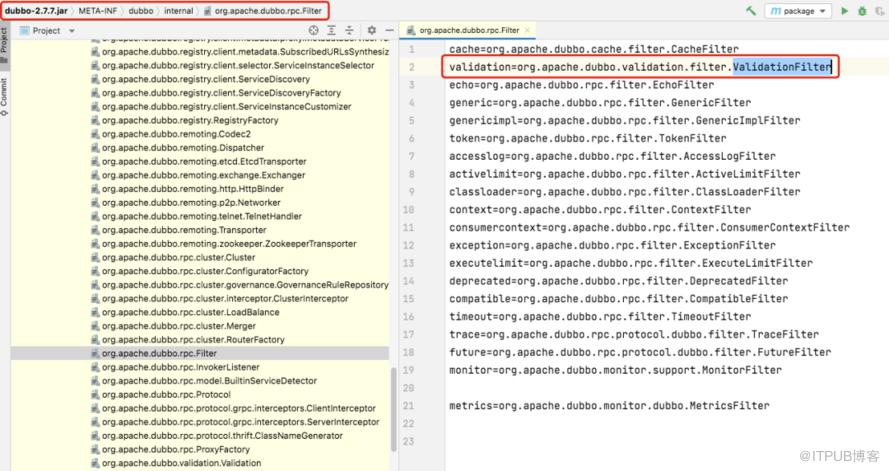
ValidationFilter说明
//在哪种服务类型激活
//这里的VALIDATION_KEY=“validation” 也就是我们在SPI中需要把key按这个规定定义
@Activate(group = {CONSUMER, PROVIDER}, value = VALIDATION_KEY, order = 10000)
public class ValidationFilter implements Filter {
    private Validation validation;

    public void setValidation(Validation validation) {
        this.validation = validation;
    }

    @Override
    public Result invoke(Invoker<?> invoker, Invocation invocation) throws RpcException {
      //如果SPI中定义了validation  那么就进行校验
        if (validation != null && !invocation.getMethodName().startsWith("$")
                && ConfigUtils.isNotEmpty(invoker.getUrl().getMethodParameter(invocation.getMethodName(), VALIDATION_KEY))) {
            try {
                //执行参数校验
                Validator validator = validation.getValidator(invoker.getUrl());
                if (validator != null) {
                    validator.validate(invocation.getMethodName(), invocation.getParameterTypes(), invocation.getArguments());
                }
            } catch (RpcException e) {
                throw e;
            } catch (ValidationException e) {
                //抛出异常 这里的ValidationException需要深挖一下,后面会说
                // only use exception's message to avoid potential serialization issue
                return AsyncRpcResult.newDefaultAsyncResult(new ValidationException(e.getMessage()), invocation);
            } catch (Throwable t) {
                return AsyncRpcResult.newDefaultAsyncResult(t, invocation);
            }
        }
        return invoker.invoke(invocation);
    }

}

- 基础使用 -
maven 依赖
springboot项目推荐使用
<dependency>
  <groupId>org.springframework.boot</groupId>
  <artifactId>spring-boot-starter-validation</artifactId>
</dependency>
手动依赖
<dependency>
  <groupId>javax.el</groupId>
  <artifactId>javax.el-api</artifactId>
  <version>3.0.0</version>
</dependency>
<dependency>
  <groupId>org.glassfish</groupId>
  <artifactId>javax.el</artifactId>
</dependency>
<dependency>
  <groupId>javax.validation</groupId>
  <artifactId>validation-api</artifactId>
</dependency>
<dependency>
  <groupId>org.hibernate</groupId>
  <artifactId>hibernate-validator</artifactId>
</dependency>

- DTO添加validation定义 -
import lombok.Data;

import javax.validation.constraints.NotBlank;
import javax.validation.constraints.NotNull;
import java.io.Serializable;

@Data
public class PracticeParam implements Serializable {
    @NotNull(message = "periodId不能为空")
    private Long periodId;
}

- 服务者interface -
public interface IPracticeService {
    boolean practiceAdd(PracticeParam practiceParam);
}

- Dubbo RPC单元测试 -
@SpringBootTest(classes = ClientApplication.class)
@RunWith(SpringRunner.class)
@Slf4j
public class PrecticeTest {
    @DubboReference(group = "user")
    private IPracticeService practiceLogicService;

    @Test
    public void add(){
        PracticeParam practiceParam=new PracticeParam();
        log.info(String.valueOf(practiceLogicService.practiceAdd(practiceParam)));
    }
}
测试结果
javax.validation.ValidationException: Failed to validate service: com.xx.contract.IPracticeService, method: practiceAdd, cause: [ConstraintViolationImpl{interpolatedMessage='periodId不能为空', propertyPath=periodId, rootBeanClass=class com.xx.request.PracticeParam, messageTemplate='periodId不能为空'}]

- 源码分析与扩展 -
Dubbo异常处理
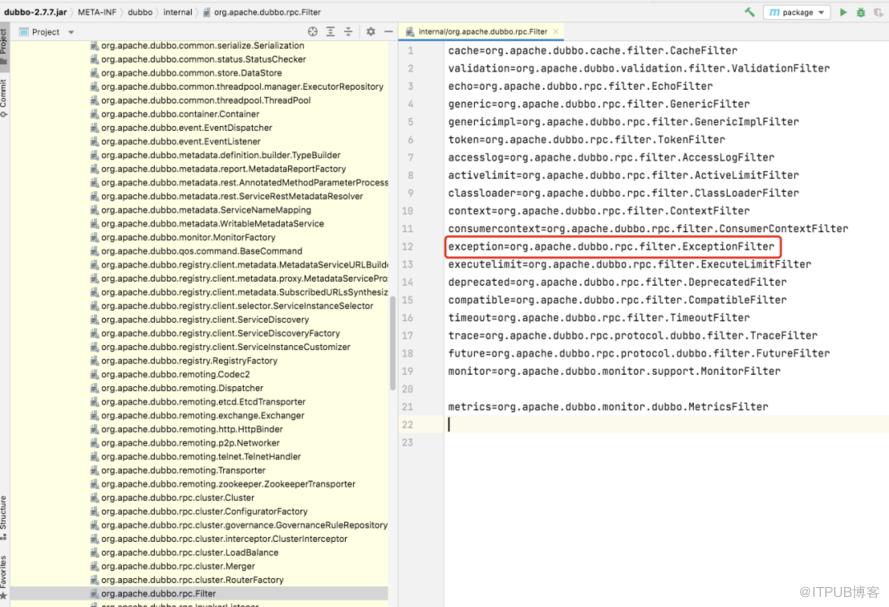

- ExceotionFilter源码分析 -
//在服务提供者端生效
@Activate(group = CommonConstants.PROVIDER)
public class ExceptionFilter implements Filter, Filter.Listener {
    private Logger logger = LoggerFactory.getLogger(ExceptionFilter.class);
    @Override
    public Result invoke(Invoker<?> invoker, Invocation invocation) throws RpcException {
        return invoker.invoke(invocation);
    }
    @Override
    public void onResponse(Result appResponse, Invoker<?> invoker, Invocation invocation) {
        //异常处理逻辑
        if (appResponse.hasException() && GenericService.class != invoker.getInterface()) {
            try {
                Throwable exception = appResponse.getException();

                // directly throw if it's checked exception
                if (!(exception instanceof RuntimeException) && (exception instanceof Exception)) {
                    return;
                }
                // directly throw if the exception appears in the signature
                try {
                    Method method = invoker.getInterface().getMethod(invocation.getMethodName(), invocation.getParameterTypes());
                    Class<?>[] exceptionClassses = method.getExceptionTypes();
                    for (Class<?> exceptionClass : exceptionClassses) {
                        if (exception.getClass().equals(exceptionClass)) {
                            return;
                        }
                    }
                } catch (NoSuchMethodException e) {
                    return;
                }

                // for the exception not found in method's signature, print ERROR message in server's log.
                logger.error("Got unchecked and undeclared exception which called by " + RpcContext.getContext().getRemoteHost() + ". service: " + invoker.getInterface().getName() + ", method: " + invocation.getMethodName() + ", exception: " + exception.getClass().getName() + ": " + exception.getMessage(), exception);

                // directly throw if exception class and interface class are in the same jar file.
                String serviceFile = ReflectUtils.getCodeBase(invoker.getInterface());
                String exceptionFile = ReflectUtils.getCodeBase(exception.getClass());
                if (serviceFile == null || exceptionFile == null || serviceFile.equals(exceptionFile)) {
                    return;
                }
                // directly throw if it's JDK exception
                String className = exception.getClass().getName();
                if (className.startsWith("java.") || className.startsWith("javax.")) {
                    return;
                }
                // directly throw if it's dubbo exception
                if (exception instanceof RpcException) {
                    return;
                }
                // otherwise, wrap with RuntimeException and throw back to the client
                //重点时这句,替换异常信息
                appResponse.setException(new RuntimeException(StringUtils.toString(exception)));
            } catch (Throwable e) {
                logger.warn("Fail to ExceptionFilter when called by " + RpcContext.getContext().getRemoteHost() + ". service: " + invoker.getInterface().getName() + ", method: " + invocation.getMethodName() + ", exception: " + e.getClass().getName() + ": " + e.getMessage(), e);
            }
        }
    }
    @Override
    public void onError(Throwable e, Invoker<?> invoker, Invocation invocation) {
        logger.error("Got unchecked and undeclared exception which called by " + RpcContext.getContext().getRemoteHost() + ". service: " + invoker.getInterface().getName() + ", method: " + invocation.getMethodName() + ", exception: " + e.getClass().getName() + ": " + e.getMessage(), e);
    }
    // For test purpose
    public void setLogger(Logger logger) {
        this.logger = logger;
    }
}

-     基础使用    -

定义SPI
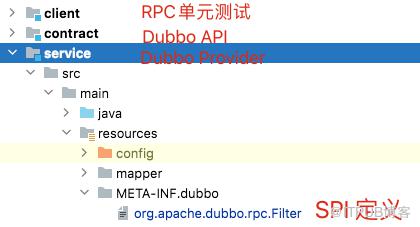
文件定义(Dubbo SPI需要严格按如下路径和文件名)
src/main/resources/META-INF/dubbo/org.apache.dubbo.rpc.Filter
文件内容
validation=com.xx.xx.config.DubboValidationFilter
exception=com.xx.xx.config.DubboExceptionFilter
自定义DubboValidationFilter
import com.xx.exception.ParamException;
import org.apache.dubbo.common.extension.Activate;
import org.apache.dubbo.common.utils.ConfigUtils;
import org.apache.dubbo.rpc.*;
import org.apache.dubbo.validation.Validation;
import org.apache.dubbo.validation.Validator;

import javax.validation.ConstraintViolation;
import javax.validation.ConstraintViolationException;
import java.util.Set;

import static org.apache.dubbo.common.constants.CommonConstants.PROVIDER;
import static org.apache.dubbo.common.constants.FilterConstants.VALIDATION_KEY;

@Activate(group = {PROVIDER}, value = VALIDATION_KEY, order = -1)
public class DubboValidationFilter implements Filter {

    private Validation validation;

    public void setValidation(Validation validation) {
        this.validation = validation;
    }

    @Override
    public Result invoke(Invoker<?> invoker, Invocation invocation) throws RpcException {
        if (validation != null && !invocation.getMethodName().startsWith("$")
                && ConfigUtils.isNotEmpty(invoker.getUrl().getMethodParameter(invocation.getMethodName(), VALIDATION_KEY))) {
            try {
                Validator validator = validation.getValidator(invoker.getUrl());
                if (validator != null) {
                    //挖掘点 validate函数的源码
                    validator.validate(invocation.getMethodName(), invocation.getParameterTypes(), invocation.getArguments());
                }
            }
          //Dubbo源码里捕获的是ValidationException这个异常,原始信息变成了字符串,所以接下来
          //通过JValidator源码分析进行如下扩展
          catch (ConstraintViolationException e) {
                //获取我们的异常,这里的异常时集合的,因为我们参数可能多个都不通过
                StringBuilder message = new StringBuilder();
                Set<ConstraintViolation<?>> violations = e.getConstraintViolations();
                for (ConstraintViolation<?> violation : violations) {
                    //这里只获取第一个不通过的原因
                    message.append(violation.getMessage().concat(";"));
                    break;
                }
                //项目自定义异常类型,网关可以捕获到该异常
                throw new ParamException(message.toString());
            } catch (RpcException e) {
                throw e;
            } catch (Throwable t) {
                return AsyncRpcResult.newDefaultAsyncResult(t, invocation);
            }
        }
        return invoker.invoke(invocation);
    }

}
JValidator源码分析
//Validated 校验过程
public void validate(String methodName, Class<?>[] parameterTypes, Object[] arguments) throws Exception {
        List<Class<?>> groups = new ArrayList<>();
        Class<?> methodClass = methodClass(methodName);
        if (methodClass != null) {
            groups.add(methodClass);
        }
        //异常返回信息 violations
        Set<ConstraintViolation<?>> violations = new HashSet<>();
        Method method = clazz.getMethod(methodName, parameterTypes);
        Class<?>[] methodClasses;
        if (method.isAnnotationPresent(MethodValidated.class)){
            methodClasses = method.getAnnotation(MethodValidated.class).value();
            groups.addAll(Arrays.asList(methodClasses));
        }
        // add into default group
        groups.add(0, Default.class);
        groups.add(1, clazz);

        // convert list to array
        Class<?>[] classgroups = groups.toArray(new Class[groups.size()]);

        Object parameterBean = getMethodParameterBean(clazz, method, arguments);
        if (parameterBean != null) {
            violations.addAll(validator.validate(parameterBean, classgroups ));
        }

        for (Object arg : arguments) {
            validate(violations, arg, classgroups);
        }

        if (!violations.isEmpty()) {
            logger.error("Failed to validate service: " + clazz.getName() + ", method: " + methodName + ", cause: " + violations);
            //这里原始异常是它,所以我们需要捕获它,得到violations
            throw new ConstraintViolationException("Failed to validate service: " + clazz.getName() + ", method: " + methodName + ", cause: " + violations, violations);
        }
    }
自定义DubboExceptionFilter
@Slf4j
@Activate(group = CommonConstants.PROVIDER)
public class DubboExceptionFilter extends ExceptionFilter {
    @Override
    public Result invoke(Invoker<?> invoker, Invocation invocation) throws RpcException {
        return invoker.invoke(invocation);
    }
    @Override
    public void onResponse(Result appResponse, Invoker<?> invoker, Invocation invocation) {
        log.error("dubbo global exception ---------->{}", appResponse.getException());
        if (appResponse.hasException() && GenericService.class != invoker.getInterface()) {
            try {
                Throwable exception = appResponse.getException();

                // 自定义异常处理
                if (exception instanceof ParamException) {
                    //按项目log收集规范输出
                    log.error("dubbo service exception ---------->{}", exception);
                    return;
                }
                ......
            } catch (Throwable e) {
                log.warn("Fail to ExceptionFilter when called by " + RpcContext.getContext().getRemoteHost() + ". service: " + invoker.getInterface().getName() + ", method: " + invocation.getMethodName() + ", exception: " + e.getClass().getName() + ": " + e.getMessage(), e);
            }
        }
    }
}

- PRC单元测试 -
org.apache.dubbo.remoting.RemotingException: com.xx.exception.ParamException: periodId不能为空;
com.xx.exception.ParamException: periodId不能为空;
高级进阶
定义validation groups,在API模块中定义两个分组。
//用于新增
public interface InsertValidation {
}

//用于更新
public interface UpdateValidation {
}
-     定义 DTO    -

@Data
public class PracticeParam implements Serializable {

    //只用于更新
    @NotNull(groups={UpdateValidation.class},message = "id不能为空")
    private Integer id;

// 如果两组校验都需要可以省去group的定义,完整的如下
//    @NotBlank(groups={InsertValidation.class, UpdateValidation.class},message = "名称不能为空")
    @NotNull(message = "periodId不能为空")
    private Long periodId;
}
服务提供者interface
public interface IPracticeService {
    //因为periodId参数是默认不区分组的,所以这里省去了Validated注解
    boolean practiceAdd(PracticeParam practiceParam);

    boolean practiceEdit(@Validated(value = {UpdateValidation.class}) PracticeParam practiceParam);
}
完工,这样我们就齐活了,截个图看看真实运行情况吧。

- 生产环境验证 -


原文作者:玄姐聊AGI;如有侵权,请联系管理员删除。
上一篇:
超越同龄人的MySQL意识
下一篇:
架构大咖说丨顶级架构师 = 技术大牛?

请登录后发表评论
登录
全部评论
