原文链接:http://www.codeceo.com/article/cpp-regex-compare.html
工作需要用到C++中的正则表达式,所以就研究了以上三种正则。
1、C regex
/* write by xingming * time:2012年10月19日15:51:53 * for: test regex * */#include#include #include #include #include #include using namespace std;const int times = 1000000;int main(int argc,char** argv){ char pattern[512]="finance.sina.cn|stock1.sina.cn|3g.sina.com.cn.*(channel=finance|_finance$|ch=stock|/stock/)|dp.sina.cn/.*ch=9&"; const size_t nmatch = 10; regmatch_t pm[10]; int z ; regex_t reg; char lbuf[256]="set",rbuf[256]; char buf[3][256] = {"finance.sina.cn/google.com/baidu.com.google.sina.cndddddddddddddddddddddda.sdfasdfeoasdfnahsfonadsdf", "3g.com.sina.cn.google.com.dddddddddddddddddddddddddddddddddddddddddddddddddddddbaidu.com.sina.egooooooooo", "http://3g.sina.com.cn/google.baiduchannel=financegogo.sjdfaposif;lasdjf.asdofjas;dfjaiel.sdfaosidfj"}; printf("input strings:n"); timeval end,start; gettimeofday(&start,NULL); regcomp(®,pattern,REG_EXTENDED|REG_NOSUB); for(int i = 0 ; i 使用正则表达式可简单的分成几步:
1.编译正则表达式
2.执行匹配
3.释放内存
首先,编译正则表达式
int regcomp(regex_t *preg, const char *regex, int cflags);reqcomp()函数用于把正则表达式编译成某种格式,可以使后面的匹配更有效。
preg: regex_t结构体用于存放编译后的正则表达式;
regex: 指向正则表达式指针;
cflags:编译模式
共有如下四种编译模式:
REG_EXTENDED:使用功能更强大的扩展正则表达式
REG_ICASE:忽略大小写
REG_NOSUB:不用存储匹配后的结果
REG_NEWLINE:识别换行符,这样‘$’就可以从行尾开始匹配,‘^’就可以从行的开头开始匹配。否则忽略换行符,把整个文本串当做一个字符串处理。
其次,执行匹配
int regexec(const regex_t *preg, const char *string, size_t nmatch, regmatch_t pmatch[], int eflags);preg: 已编译的正则表达式指针;
string:目标字符串;
nmatch:pmatch数组的长度;
pmatch:结构体数组,存放匹配文本串的位置信息;
eflags:匹配模式
共两种匹配模式:
REG_NOTBOL:The match-beginning-of-line operator always fails to match (but see the compilation flag REG_NEWLINE above). This flag may be used when different portions of a string are passed to regexec and the beginning of the string should not be interpreted as the beginning of the line.
REG_NOTEOL:The match-end-of-line operator always fails to match (but see the compilation flag REG_NEWLINE above)
最后,释放内存
void regfree(regex_t *preg);当使用完编译好的正则表达式后,或者需要重新编译其他正则表达式时,一定要使用这个函数清空该变量。
其他,处理错误
size_t regerror(int errcode, const regex_t *preg, char *errbuf, size_t errbuf_size);当执行regcomp 或者regexec 产生错误的时候,就可以调用这个函数而返回一个包含错误信息的字符串。
errcode: 由regcomp 和 regexec 函数返回的错误代号。
preg: 已经用regcomp函数编译好的正则表达式,这个值可以为NULL。
errbuf: 指向用来存放错误信息的字符串的内存空间。
errbuf_size: 指明buffer的长度,如果这个错误信息的长度大于这个值,则regerror 函数会自动截断超出的字符串,但他仍然会返回完整的字符串的长度。所以我们可以用如下的方法先得到错误字符串的长度。
当然我在测试的时候用到的也比较简单,所以就直接用了,速度一会再说!
2、C++ regex
/* write by xingming * time:2012年10月19日15:51:53 * for: test regex * */#include#include #include #include using namespace std;int main(int argc,char** argv){ regex pattern("[[:digit:]]",regex_constants::extended); printf("input strings:n"); string buf; while(cin>>buf) { printf("*******n%sn********n",buf.c_str()); if(buf == "quit") { printf("quit just now!n"); break; } match_results<:const_iterator> result; printf("run compare now! '%s'n", buf.c_str()); bool valid = regex_match(buf,result,pattern); printf("compare over now! '%s'n", buf.c_str()); if(!valid) printf("no match!n"); else printf("okn"); } return 0 ; } C++这个真心不想多说它,测试过程中发现 字符匹配的时候 ‘a’ 是可以匹配的,a+也是可以的,[[:w:]]也可以匹配任意字符,但[[:w:]]+就只能匹配一个字符,+号貌似不起作用了。所以后来就干脆放弃了这伟大的C++正则,如果有大牛知道这里面我错在哪里了,真心感谢你告诉我一下,谢谢。
3、boost regex
/* write by xingming * for:test boost regex * time:2012年10月23日11:35:33 * */ #include#include #include #include "boost/regex.hpp"using namespace std; using namespace boost; const int times = 10000000;int main() { regex pattern("finance\.sina\.cn|stock1\.sina\.cn|3g\.sina\.com\.cn.*(channel=finance|_finance$|ch=stock|/stock/)|dp\.s ina\.cn/.*ch=9&"); cout boost正则不用多说了,要是出去问,C++正则怎么用啊?那90%的人会推荐你用boost正则,他实现起来方便,正则库也很强大,资料可以找到很多,所以我也不在阐述了。
4、对比情况
总结:
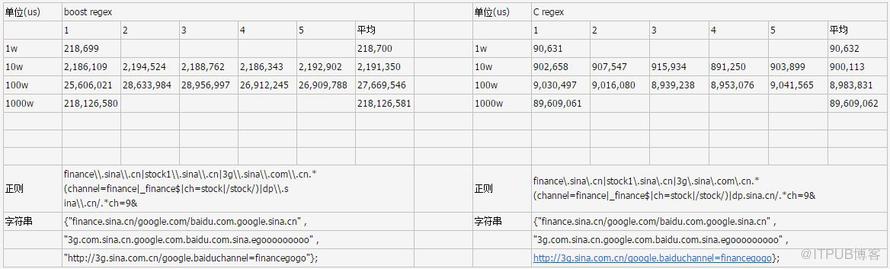
C regex的速度让我吃惊啊,相比boost的速度,C regex的速度几乎要快上3倍,看来正则引擎的选取上应该有着落了!
上面的表格中我用到的正则和字符串是一样的(在代码中C regex的被我加长了),速度相差几乎有3倍,C的速度大约在30+w/s , 而boost的速度基本在15-w/s ,所以对比就出来了!
在这里Cregex的速度很让我吃惊了已经,但随后我的测试更让我吃惊。
我以前在.net正则方面接触的比较多,就写了一个.net版本的作为对比
using System;using System.Collections.Generic;using System.Linq;using System.Text;using System.Text.RegularExpressions;namespace 平常测试 { class Program { static int times = 1000000; static void Main(string[] args) { Regex reg = new Regex(@"(?>finance.sina.cn|stock1.sina.cn|3g.sina.com.cn.*(?:channel=finance|_finance$|ch=stock|/stock/)|dp.sina.cn/.*ch=9&)",RegexOptions.Compiled); string[] str = new string[]{@"finance.sina.cn/google.com/baidu.com.google.sina.cn", @"3g.com.sina.cn.google.com.baidu.com.sina.egooooooooo", @"http://3g.sina.com.cn/google.baiduchannel=financegogo"}; int tt = 0; DateTime start = DateTime.Now; for (int i = 0; i结果发现,正则在不进行RegexOptions.Compiled 的时候,速度和C regex的基本一样,在编译只会,速度会比C regex快上一倍,这不由得让我对微软的那群人的敬畏之情油然而生啊。
但随后我去查看了一下该博客上面C regex的描述,发现我可以再申明正则的时候加入编译模式,随后我加入了上面代码里的 REG_NOSUB(在先前测试的时候是没有加入的),结果让我心理面很激动的速度出来了,C regex 匹配速度竟然达到了 300+w/s,也就是比原来的(不加入REG_NOSUB)的代码快了将近10倍。
之后我变换了匹配的字符串,将其长度生了一倍,达到每个100字符左右(代码里面所示),匹配速度就下来了,但是也能达到 100w/s左右,这肯定满足我们现在的需求了。
结果很显然,当然会选择C regex了。
来自 “ ITPUB博客 ” ,链接:https://blog.itpub.net/4648/viewspace-2801720/ ,如需转载,请注明出处,否则将追究法律责任。

