1.完整代码——Python语言实现:
#节点类,当树中叶节点最大数为n时,霍夫曼树的总节点数为2n-1
class Node(object):
    def __init__(self,name=None,value=None):
        self._name=name
        self._value=value
        self._left=None
        self._right=None
        self._codevalue='0'

#哈夫曼树类
class HuffmanTree(object):
    #根据Huffman树的思想:以叶子节点为基础,反向建立Huffman树
    def __init__(self,char_weights):
        self.codeway = {}#存储节点对应的编码数,1or0
        self.a=[Node(part[0],part[1]) for part in char_weights]  #根据输入的字符及其频数生成叶子节点
        while len(self.a)!=1:#如果没有到达根节点
            self.a.sort(key=lambda node:node._value,reverse=True)#根据节点的value进行从大到小的排序
            c=Node(value=(self.a[-1]._value+self.a[-2]._value))#对于权值最小的两个节点相加作为新节点c的value
            c._left=self.a.pop(-1)#把排序完的树叶节点挂靠在c上,作为左右节点
            c._right=self.a.pop(-1)
            self.a.append(c)#bac作为节点连在树上
        self.root=self.a[0]
#方法一
    def pre(self, tree, length,l):
        if l==0:
            self.b=[0]*length
        node = tree
        if (not node):
            return
        elif node._name:
            print(node._name + '的编码为:',end=' ')
            for i in range(l):
                print(self.b[i],end=' ')
            print('n')
            return

        #是树的左子节点的话赋值为0,直到到达叶结点之后print了编码,再对考虑右子树
        self.b[l] = 0
        self.pre(node._left, length,l + 1)
        self.b[l] = 1
        self.pre(node._right,length,l + 1)

#方法二
    # 函数得到每一个叶结点的路径
    def binaryTreePaths(self, root):
        if not root:#如果root不存在
            return []
        if not root._left and not root._right:#如果root就是一个叶节点
            return [str(root._value)]
        pathList = []#用来存储路径
        if root._left:#沿左子树下行递归遍历直到到达了叶节点
            root._left._codevalue = '0'
            pathList+=self.binaryTreePaths(root._left)
            self.codeway[root._left._value]=root._left._codevalue
        if root._right:
            root._right._codevalue='1'
            pathList+=self.binaryTreePaths(root._right)
            self.codeway[root._right._value] = root._right._codevalue
        for index, path in enumerate(pathList):#枚举pathList,得到对应节点路径的存放路径
            pathList[index]=str(root._value) + ' ' + path
        # for index,path in enumerate(self.codeway):

            # self.codeway[index] =str(root._codevalue) + ' ' + path
            # print(root._value,root._codevalue)
            #用这个打印每一节点对应的编码
        return pathList
     #生成哈夫曼编码
    def code_way(self):
        return self.codeway
if __name__=='__main__':
    #输入的是字符及其频数
    char_weights=[('a',9),('b',12),('c',6),('d',3),('e',5),('f',15)]
    tree=HuffmanTree(char_weights)
    length=len(char_weights)
#方法二
    pathList = tree.binaryTreePaths(tree.root)
    codeway=tree.code_way()
    print(codeway)
    print("路径输出为: ",pathList)
    for i in pathList:
        i=i.split(' ')[1:]#根节点不参与编码,所以切掉
        print("数字 ",i[-1],"的编码是:",end='')
        for j in i:
            print(codeway[int(j)],end='')
        print('n')
#方法一
    tree.pre(tree.root,length,0)
运行结果: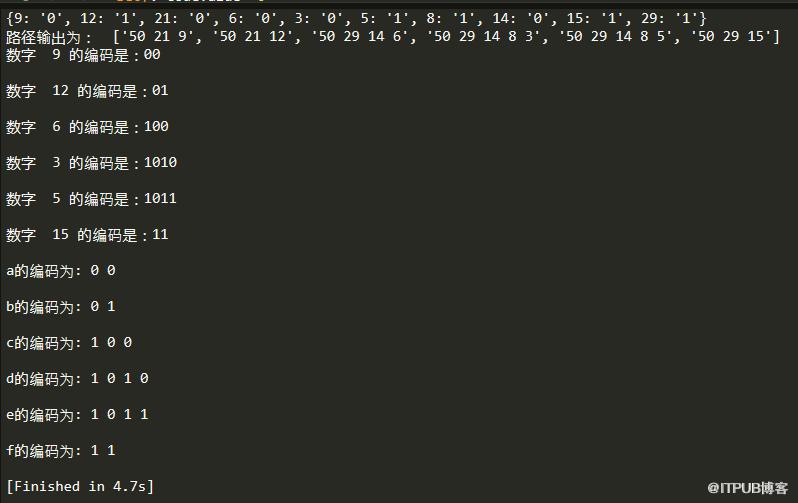
2.完整代码——C语言实现:
#include <stdio.h>
#include <stdlib.h>
#include <string.h>
#include <conio.h>

#define MAX_CHAR_KINDS 128//字符种类最大值。。
#define MAX_NUM 1000//字符串最大长度。。
FILE *in, *ou;

typedef struct TreeNode
{
	int weight;
	int id;
	short isLeaf;
	char data;
	char bin;//0或者1。。
	struct TreeNode *parent;
	struct TreeNode *lChild, *rChild;
} TreeNode;

typedef struct
{
	char data;
	char code[MAX_CHAR_KINDS];
} Code;

//字符串倒置。。
void ReverseStr(char *str)
{
    int i;
    char c;
    int length;
    length = strlen(str);
    for (i = 0; i < length / 2; i++)
    {
        c = str[length - 1 - i];
        str[length - 1 - i] = str[i];
        str[i] = c;
    }
}

void PreOrderTraverse(TreeNode *t)
{
    if ((t->rChild == NULL) && (t->lChild == NULL))
    {
        t->isLeaf = 1;
    }
    else
    {
        t->isLeaf = 0;
    }
    if (t->parent != NULL)
    {
        t->id = 2 * t->parent->id + (int)t->bin - 48;
    }
    else
    {
        t->id = 1;
        t->bin = ' ';
    }
    if (t->isLeaf == 1)
    {
        fprintf(ou, "%6d%5c%8d   '%c'n", t->id, t->bin, t->isLeaf, t->data);
    }
    else
    {
        fprintf(ou, "%6d%5c%8dn", t->id, t->bin, t->isLeaf);
    }
    if (t->lChild != NULL)
    {
        PreOrderTraverse(t->lChild);
    }
    if (t->rChild != NULL)
    {
        PreOrderTraverse(t->rChild);
    }
}

int main()
{
	char str[MAX_NUM];
	char pwd[MAX_NUM];
	TreeNode *HFTree;
	int i, j;
	int length;//字符串长度。。
	int count;//不同字符个数。。
	TreeNode *tree[MAX_CHAR_KINDS];//初始的几个小树。。
	TreeNode *eachChar[MAX_CHAR_KINDS];
	TreeNode *temp, *p;
	Code *HFCode;
	int codeBit;
	short existed;

	//输入,初始化。。
	printf("Input string to encode:n");
	gets(str);
	printf("n");
	length = strlen(str);
	count = 0;

	//开始统计字符串中各个字符出现的次数。。
	for (i = 0; i < length; i++)
	{
		existed = 0;
		for (j = 0; j < count; j++)
		{
			if (str[i] == tree[j]->data)
			{
				tree[j]->weight++;
				existed = 1;
				break;
			}
		}
		//如果不是现有的字符,拿个新盒子装。。
		if (existed == 0)
		{
			tree[count] = (TreeNode *)malloc(sizeof(TreeNode));
			tree[count]->weight = 1;
			tree[count]->data = str[i];
			tree[count]->parent = NULL;
			tree[count]->lChild = NULL;
			tree[count]->rChild = NULL;
			eachChar[count] = tree[count];//备份。。
			count++;
		}
	}

	//非法输入。。
	if (count == 0)
	{
        printf("No char!n");
        getch();
        return (0);
    }
    else if (count == 1)
    {
        printf("At least 2 kinds of char!n");
        getch();
        return (0);
    }

	//冒泡,升序。。
	for (i = 0; i < count - 1; i++)
	{
		for (j = 0; j < count - 1 - i; j++)
		{
			if (tree[j]->weight > tree[j+1]->weight)
			{
				temp = tree[j];
				tree[j] = tree[j+1];
				tree[j+1] = temp;
			}
		}
	}

	//生成Huffman树。。
	for (i = 1; i < count; i++)
	{
        temp = (TreeNode *)malloc(sizeof(TreeNode));
        temp->lChild = tree[i-1];
        temp->rChild = tree[i];
        temp->parent = NULL;
        temp->weight = tree[i-1]->weight + tree[i]->weight;
        tree[i-1]->parent = temp;
        tree[i-1]->bin = '0';
        tree[i]->parent = temp;
        tree[i]->bin = '1';
        tree[i] = temp;
        for (j = i; j < count - 1; j++)
        {
            if (tree[j]->weight > tree[j+1]->weight)
            {
                temp = tree[j];
				tree[j] = tree[j+1];
				tree[j+1] = temp;
            }
            else
            {
                break;
            }
        }
	}
	HFTree = tree[count-1];

	//保存Huffman Tree到HuffmanTree.txt文件中。。
	if ((ou = fopen("HuffmanTree.txt", "w")) == NULL)
	{
        printf("Cannot open file HuffmanTree.txtn");
        getch();
        exit(0);
    }
    fprintf(ou, "%6s%5s%8s%6sn", "NodeID", "Bin", "IsLeaf", "Data");
    PreOrderTraverse(HFTree);
    fclose(ou);

    //冒泡后求各个字符的哈夫曼编码。。
    for (i = 0; i < count - 1; i++)
	{
		for (j = 0; j < count - 1 - i; j++)
		{
			if (eachChar[j]->weight > eachChar[j+1]->weight)
			{
				temp = eachChar[j];
				eachChar[j] = eachChar[j+1];
				eachChar[j+1] = temp;
			}
		}
	}
    HFCode = (Code *)malloc(count * sizeof(Code));
    for (i = 0; i < count; i++)
    {
        temp = eachChar[i];
        HFCode[i].data = temp->data;
        codeBit = 0;
        while (temp->parent != NULL)
        {
            HFCode[i].code[codeBit] = temp->bin;
            temp = temp->parent;
            codeBit++;
        }
        HFCode[i].code[codeBit] = '
来自 “ ITPUB博客 ” ,链接:https://blog.itpub.net/3522/viewspace-2823619/ ,如需转载,请注明出处,否则将追究法律责任。
上一篇:
月薪3k的后端面试点-Java GC
下一篇:
函数与方法的区别

请登录后发表评论
登录
全部评论
