MySQL技术内幕 SQL编程 58页
首先创建实验表
create table t(a int primary key);
insert into t values(1);
insert into t values(2);
insert into t values(3);
insert into t values(100);
insert into t values(101);
insert into t values(103);
insert into t values(104);
insert into t values(105);
commit;
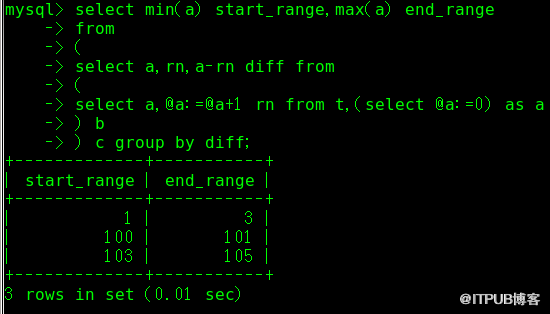
实验目标是求数字的连续范围,以上面的数据为例,应该求得的连续范围为
1-3
100-101
103-105
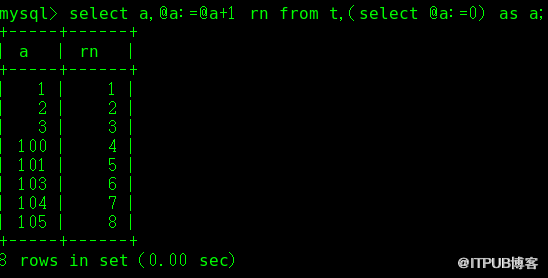
第一步,给数据增加行号
select a,@a:=@a+1 rn from t,(select @a:=0) as a;
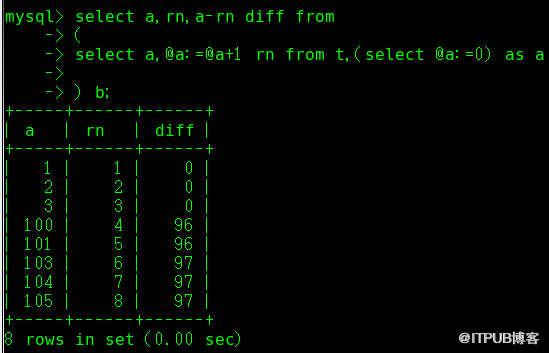
第二步,求得数据与行号的差值
第三步 获得结果
用之前的签到实验说明这个连续范围的用法.
http://blog.itpub.net/29254281/viewspace-1379159/
award_chance_history是活动的签到表,userid记录用户的ID,createtime记录用户的签到时间.
实验求每个用户的连续签到时间.
第一步,获取用户每天的签到情况
获取用户签到时间和现在时间的差值,并且用distinct过滤用户在一天内多次签到的记录
select
distinct
userid,
date_format(createtime,'%Y-%m-%d') createtime,
datediff(createtime,now()) diff
from award_chance_history order by userid,createtime
第二步,模拟分析函数,每个用户都产生一个自己的序列
select
b.*,
@gid := @cgid,
@cgid := b.userid,
if(@gid = @cgid, @rank := @rank + 1, @rank := 1) rank,
b.diff-@rank flag from (
select
distinct
userid,
date_format(createtime,'%Y-%m-%d') createtime,
datediff(createtime,now()) diff
from award_chance_history order by userid,createtime
) b, (SELECT @gid := 1, @cgid := 1, @rank := 1) as a
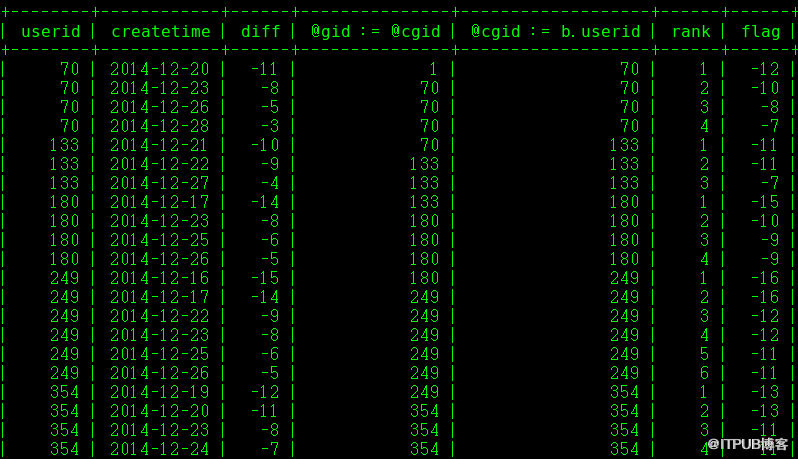
diff和rank序列相减,作为flag字段,flag相同说明用户是连续签到.
如下图的249用户,在16,17日连续签到,他们的flag都是-16.
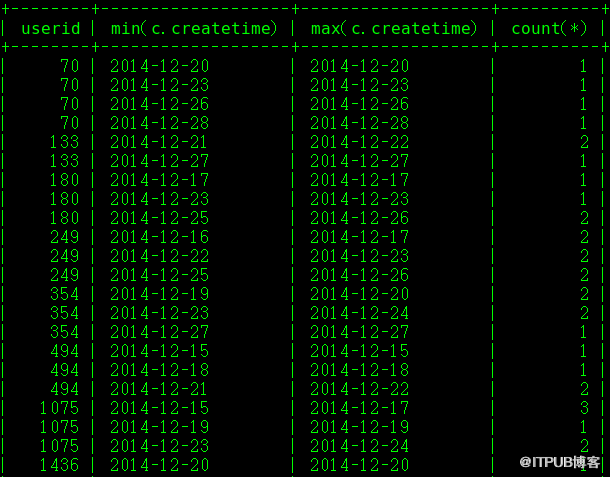
第三步,根据分组得到连续签到的结果
第四步,求每个用户最长的连续签到时间段
在第三步的基础上,再模拟一次分析函数
首先创建实验表
create table t(a int primary key);
insert into t values(1);
insert into t values(2);
insert into t values(3);
insert into t values(100);
insert into t values(101);
insert into t values(103);
insert into t values(104);
insert into t values(105);
commit;
实验目标是求数字的连续范围,以上面的数据为例,应该求得的连续范围为
1-3
100-101
103-105
第一步,给数据增加行号
select a,@a:=@a+1 rn from t,(select @a:=0) as a;
第二步,求得数据与行号的差值
-
select a,rn,a-rn diff from
-
(
-
select a,@a:=@a+1 rn from t,(select @a:=0) as a
-
- ) b;
第三步 获得结果
-
select min(a) start_range,max(a) end_range
-
from
-
(
-
select a,rn,a-rn diff from
-
(
-
select a,@a:=@a+1 rn from t,(select @a:=0) as a
-
) b
- ) c group by diff;
用之前的签到实验说明这个连续范围的用法.
http://blog.itpub.net/29254281/viewspace-1379159/
award_chance_history是活动的签到表,userid记录用户的ID,createtime记录用户的签到时间.
实验求每个用户的连续签到时间.
-
create table award_chance_history
-
(
-
id int primary key auto_increment,
-
userid int,
-
createtime datetime
-
);
-
-
insert into award_chance_history(userid,createtime)
- select ceil(rand()*10000),str_to_date('2014-12-15','%Y-%m-%d')+interval ceil(rand()*10000) minute from nums where id<30;
-
insert into award_chance_history(userid,createtime)
-
select userid,createtime + interval ceil(rand()*10) day from award_chance_history,nums
- where nums.id <10 order by rand() limit 150;
第一步,获取用户每天的签到情况
获取用户签到时间和现在时间的差值,并且用distinct过滤用户在一天内多次签到的记录
select
distinct
userid,
date_format(createtime,'%Y-%m-%d') createtime,
datediff(createtime,now()) diff
from award_chance_history order by userid,createtime
第二步,模拟分析函数,每个用户都产生一个自己的序列
select
b.*,
@gid := @cgid,
@cgid := b.userid,
if(@gid = @cgid, @rank := @rank + 1, @rank := 1) rank,
b.diff-@rank flag from (
select
distinct
userid,
date_format(createtime,'%Y-%m-%d') createtime,
datediff(createtime,now()) diff
from award_chance_history order by userid,createtime
) b, (SELECT @gid := 1, @cgid := 1, @rank := 1) as a
diff和rank序列相减,作为flag字段,flag相同说明用户是连续签到.
如下图的249用户,在16,17日连续签到,他们的flag都是-16.
第三步,根据分组得到连续签到的结果
-
select userid,min(c.createtime),max(c.createtime),count(*) from
-
(
-
select
-
b.*,
-
@gid := @cgid,
-
@cgid := b.userid,
-
if(@gid = @cgid, @rank := @rank + 1, @rank := 1) rank,
-
b.diff-@rank flag from (
-
select
-
distinct
-
userid,
-
date_format(createtime,'%Y-%m-%d') createtime,
-
datediff(createtime,now()) diff
-
from award_chance_history order by userid,createtime
-
) b, (SELECT @gid := 1, @cgid := 1, @rank := 1) as a
- ) c group by userid,flag;
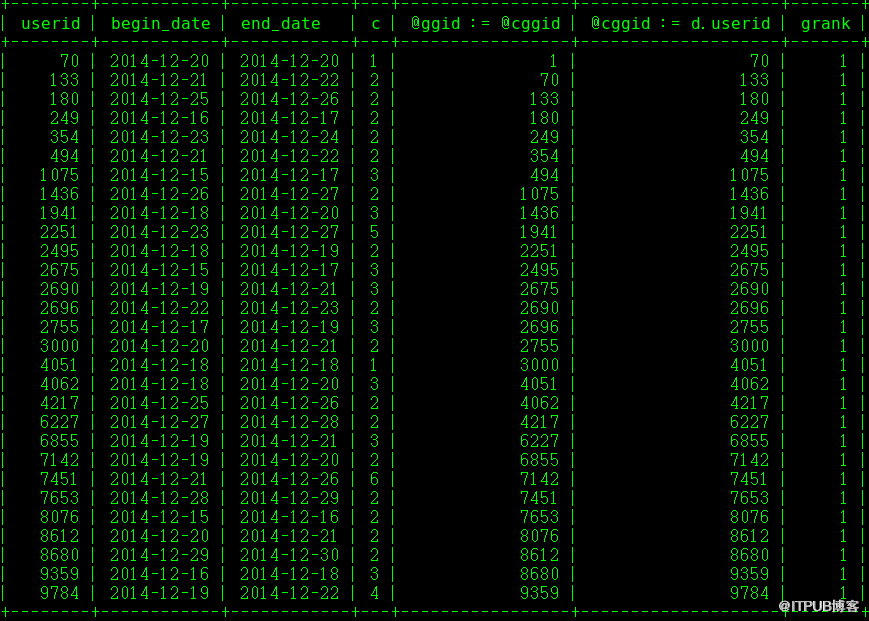
第四步,求每个用户最长的连续签到时间段
在第三步的基础上,再模拟一次分析函数
-
select * from (
-
select d.*,
-
@ggid := @cggid,
-
@cggid := d.userid,
-
if(@ggid = @cggid, @grank := @grank + 1, @grank := 1) grank
-
from
-
(
-
select userid,min(c.createtime) begin_date ,max(c.createtime) end_date,count(*) c from
-
(
-
select
-
b.*,
-
@gid := @cgid,
-
@cgid := b.userid,
-
if(@gid = @cgid, @rank := @rank + 1, @rank := 1) rank,
-
b.diff-@rank flag from (
-
select
-
distinct
-
userid,
-
date_format(createtime,'%Y-%m-%d') createtime,
-
datediff(createtime,now()) diff
-
from award_chance_history order by userid,createtime
-
) b, (SELECT @gid := 1, @cgid := 1, @rank := 1) as a
-
) c group by userid,flag
-
order by userid,count(*) desc
-
) d,(SELECT @ggid := 1, @cggid := 1, @grank := 1) as e
-
)f
- where grank=1;
来自 “ ITPUB博客 ” ,链接:https://blog.itpub.net/29254281/viewspace-1385638/ ,如需转载,请注明出处,否则将追究法律责任。
上一篇:
左百分号模糊查询的优化
下一篇:
SQL星期数问题

请登录后发表评论
登录
全部评论
