在阅读LinkedList之前,建议还是将ArrayList 源码进行大概了解,其实向外部提供的方法以及设计思路是差不多的,只是LinkedList数据结构不是array了,而是一个链表,那我们接下来就一起学习下LinkedList的源码。
首先,我们从类图上来大体了解下 LinkedList 与 ArrayList的关系: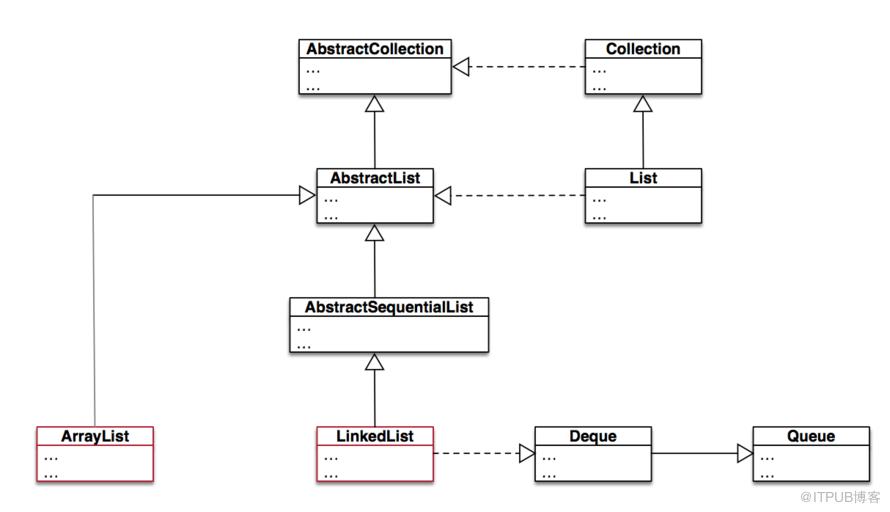
可以看出 LinkedList 不只是继承、实现了 List 的那套东西,还实现了 Dueue 这个双向队列, 什么是双向队列呢,就是在队列两端都可以“插入”、“获取” 数据。接下来我们还是以 ArrayList的分析方式去分析LinkedList。
基础成员
transient int size = 0; transient LinkvoidLink; private static final class Link { ET data; Link previous, next; Link(ET o, Link p, Link n) { data = o; previous = p; next = n; } }
这是 LinkedList 最基础的组成部分, Link 这个静态内部类是LinkedList中每一个单元的类型,数据是data,previous和next 分别指向链表的上游和下游;voidLink 可以理解是一个末尾节点,size是整个list的节点数量。从开头就可以看出,LinkedList 的数据结构是一个双向链表,这样就避免了ArrayList的自动扩容步骤,虽然在查找的时候占了些劣势(需要按照链表的指向挨个去找,不如数组直接指向角标快)。
构造方法
   /**
     * Constructs a new empty instance of {@code LinkedList}.
     */
    public LinkedList() {
        voidLink = new Link(null, null, null);
        voidLink.previous = voidLink;
        voidLink.next = voidLink;
    }    /**
     * Constructs a new instance of {@code LinkedList} that holds all of the
     * elements contained in the specified {@code collection}. The order of the
     * elements in this new {@code LinkedList} will be determined by the
     * iteration order of {@code collection}.
     *
     * @param collection
     *            the collection of elements to add.
     */
    public LinkedList(Collection extends E> collection) {        this();
        addAll(collection);
    }
LinkedList提供了两个构造方法,第一个很简单,初始化voidLink,并且将其上下游都指向自己;第二个构造方法传入一个 collection,如果不细究源码细节,根据ArrayList的经验,想必肯定是传入一个集合,将集合插入到这个空链表中。来举个例子,向一个空的 LinkedList 插入 new1 和 new2节点,我们用图示来表达下这个过程: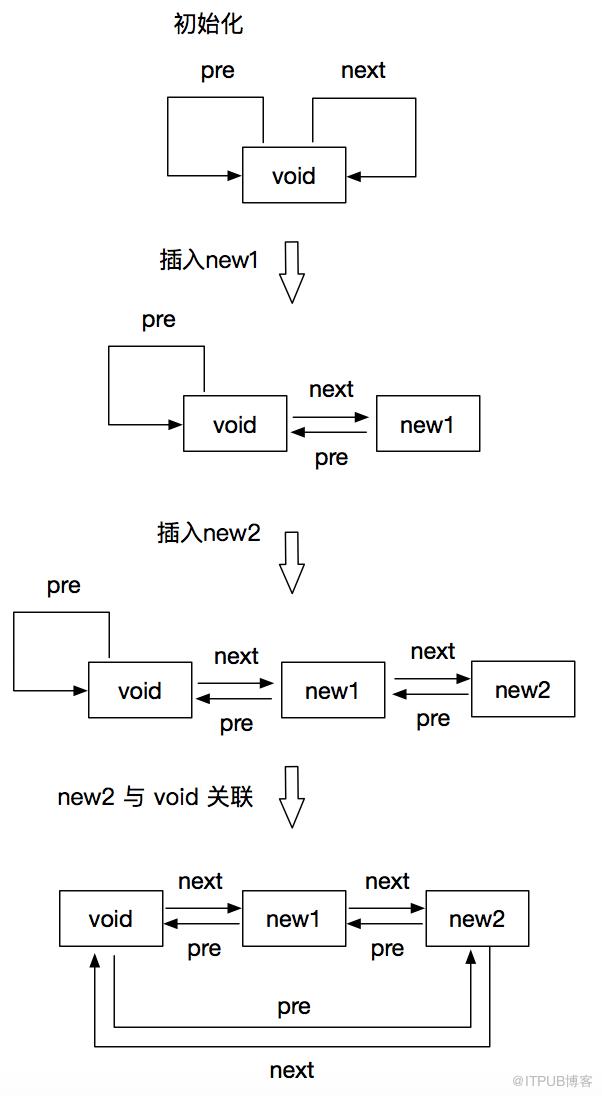
上图标注比较明显,对照代码不难理解;下边我们对源码,从添加、移除、获取等方面一一进行了解,能用图解尽量少说话:
添加
   /**
     * Adds the specified object at the end of this {@code LinkedList}.
     *
     * @param object
     *            the object to add.
     * @return always true
     */
    @Override
    public boolean add(E object) {        return addLastImpl(object);
    }    /**
     * Adds the specified object at the end of this {@code LinkedList}.
     *
     * @param object
     *            the object to add.
     */
    public void addLast(E object) {
        addLastImpl(object);
    }    private boolean addLastImpl(E object) {
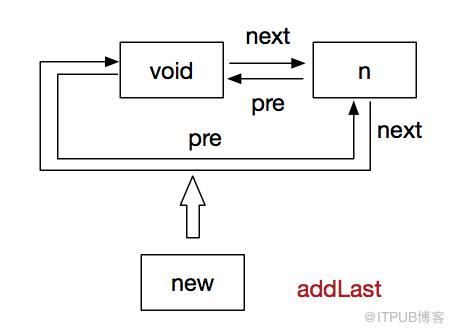
        Link oldLast = voidLink.previous;
        Link newLink = new Link(object, oldLast, voidLink);
        voidLink.previous = newLink;
        oldLast.next = newLink;
        size++;
        modCount++;        return true;
    }
   /**
     * Adds the specified object at the beginning of this {@code LinkedList}.
     *
     * @param object
     *            the object to add.
     */
    public void addFirst(E object) {
        addFirstImpl(object);
    }    private boolean addFirstImpl(E object) {
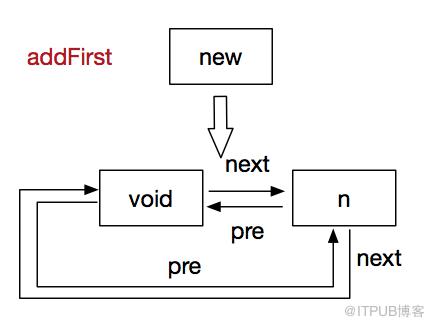
        Link oldFirst = voidLink.next;
        Link newLink = new Link(object, voidLink, oldFirst);
        voidLink.next = newLink;
        oldFirst.previous = newLink;
        size++;
        modCount++;        return true;
    }
   /**
     * Adds the objects in the specified Collection to this {@code LinkedList}.
     *
     * @param collection
     *            the collection of objects.
     * @return {@code true} if this {@code LinkedList} is modified,
     *         {@code false} otherwise.
     */
    @Override
    public boolean addAll(Collection extends E> collection) {        int adding = collection.size();        if (adding == 0) {            return false;
        }
        Collection extends E> elements = (collection == this) ?                new ArrayList(collection) : collection;

        Link previous = voidLink.previous;        for (E e : elements) {
            Link newLink = new Link(e, previous, null);
            previous.next = newLink;
            previous = newLink;
        }
        previous.next = voidLink;
        voidLink.previous = previous;
        size += adding;
        modCount++;        return true;
    }
这个方法就是构造方法里边调用的addAll(collection),这里的流程图在文章开始的时候就已经提到了,若有问题的同学可以回构造方法那里再看看。
    /**
     * Inserts the specified object into this {@code LinkedList} at the
     * specified location. The object is inserted before any previous element at
     * the specified location. If the location is equal to the size of this
     * {@code LinkedList}, the object is added at the end.
     *
     * @param location
     *            the index at which to insert.
     * @param object
     *            the object to add.
     * @throws IndexOutOfBoundsException
     *             if {@code location  size()}
     */
    @Override
    public void add(int location, E object) {        if (location >= 0 && location  link = voidLink;            if (location  location; i--) {
                    link = link.previous;
                }
            }
            Link previous = link.previous;
            Link newLink = new Link(object, previous, link);
            previous.next = newLink;
            link.previous = newLink;
            size++;
            modCount++;
        } else {            throw new IndexOutOfBoundsException();
        }
    }
这个方法的有趣之处是参数中加了一个location,最开始查找location位置的link单元时采用了简单的一种二分查找方式,之后将 含有object 元素的newLink插入到该位置,public boolean addAll(int location, Collection extends E> collection)同理,只是批量操作。由于有了 ArrayList 的基础和上边的举例讲解,这里就 不对 “获取”、“移除”、“序列化”等做详细讲解了,原理都是一样的,查找位置使用如上的二分查找,找到了就做一些响应的链表操作。
 public boolean offer(E o) {        return addLastImpl(o);
    }    public E poll() {        return size == 0 ? null : removeFirst();
    }    public E remove() {        return removeFirstImpl();
    }    public E peek() {        return peekFirstImpl();
    }    private E peekFirstImpl() {
        Link first = voidLink.next;        return first == voidLink ? null : first.data;
    }    public E element() {        return getFirstImpl();
    }    /**
     * {@inheritDoc}
     *
     * @see java.util.Deque#offerFirst(java.lang.Object)
     * @since 1.6
     */
    public boolean offerFirst(E e) {        return addFirstImpl(e);
    }    /**
     * {@inheritDoc}
     *
     * @see java.util.Deque#offerLast(java.lang.Object)
     * @since 1.6
     */
    public boolean offerLast(E e) {        return addLastImpl(e);
    }    /**
     * {@inheritDoc}
     *
     * @see java.util.Deque#peekFirst()
     * @since 1.6
     */
    public E peekFirst() {        return peekFirstImpl();
    }    /**
     * {@inheritDoc}
     *
     * @see java.util.Deque#peekLast()
     * @since 1.6
     */
    public E peekLast() {
        Link last = voidLink.previous;        return (last == voidLink) ? null : last.data;
    }    /**
     * {@inheritDoc}
     *
     * @see java.util.Deque#pollFirst()
     * @since 1.6
     */
    public E pollFirst() {        return (size == 0) ? null : removeFirstImpl();
    }    /**
     * {@inheritDoc}
     *
     * @see java.util.Deque#pollLast()
     * @since 1.6
     */
    public E pollLast() {        return (size == 0) ? null : removeLastImpl();
    }    /**
     * {@inheritDoc}
     *
     * @see java.util.Deque#pop()
     * @since 1.6
     */
    public E pop() {        return removeFirstImpl();
    }    /**
     * {@inheritDoc}
     *
     * @see java.util.Deque#push(java.lang.Object)
     * @since 1.6
     */
    public void push(E e) {
        addFirstImpl(e);
    }
由于LinkedList实现了 Deque 接口 (Deque继承Queue),上边这些方法就是具体针对Deque接口的实现方式,反正我是感觉挺乱的,功能都一样,但也要提供好多方法。。。。。。。
迭代器
这个我还是很想说的,LinkedList提供了两个获取iterator的方法,分别是
@Override public ListIteratorlistIterator(int location) { return new LinkIterator (this, location); } public Iterator descendingIterator() { return new (this); }
从方法名上我们可以看出第一个是正序遍历,第二个是倒叙遍历,分别返回了ListIterator 和 ReverseLinkIterator,这两个静态内部类的源码如下:
private static final class LinkIteratorimplements ListIterator { int pos, expectedModCount; final LinkedList list; Link link, lastLink; LinkIterator(LinkedList object, int location) { list = object; expectedModCount = list.modCount; if (location >= 0 && location = location; pos--) { link = link.previous; } } } else { throw new IndexOutOfBoundsException(); } } public void add(ET object) { if (expectedModCount == list.modCount) { Link next = link.next; Link newLink = new Link (object, link, next); link.next = newLink; next.previous = newLink; link = newLink; lastLink = null; pos++; expectedModCount++; list.size++; list.modCount++; } else { throw new ConcurrentModificationException(); } } public boolean hasNext() { return link.next != list.voidLink; } public boolean hasPrevious() { return link != list.voidLink; } public ET next() { if (expectedModCount == list.modCount) { LinkedList.Link next = link.next; if (next != list.voidLink) { lastLink = link = next; pos++; return link.data; } throw new NoSuchElementException(); } throw new ConcurrentModificationException(); } public int nextIndex() { return pos + 1; } public ET previous() { if (expectedModCount == list.modCount) { if (link != list.voidLink) { lastLink = link; link = link.previous; pos--; return lastLink.data; } throw new NoSuchElementException(); } throw new ConcurrentModificationException(); } public int previousIndex() { return pos; } public void remove() { if (expectedModCount == list.modCount) { if (lastLink != null) { Link next = lastLink.next; Link previous = lastLink.previous; next.previous = previous; previous.next = next; if (lastLink == link) { pos--; } link = previous; lastLink = null; expectedModCount++; list.size--; list.modCount++; } else { throw new IllegalStateException(); } } else { throw new ConcurrentModificationException(); } } public void set(ET object) { if (expectedModCount == list.modCount) { if (lastLink != null) { lastLink.data = object; } else { throw new IllegalStateException(); } } else { throw new ConcurrentModificationException(); } } } /* * NOTES:descendingIterator is not fail-fast, according to the documentation * and test case. */ private class ReverseLinkIterator implements Iterator { private int expectedModCount; private final LinkedList list; private Link link; private boolean canRemove; ReverseLinkIterator(LinkedList linkedList) { list = linkedList; expectedModCount = list.modCount; link = list.voidLink; canRemove = false; } public boolean hasNext() { return link.previous != list.voidLink; } public ET next() { if (expectedModCount == list.modCount) { if (hasNext()) { link = link.previous; canRemove = true; return link.data; } throw new NoSuchElementException(); } throw new ConcurrentModificationException(); } public void remove() { if (expectedModCount == list.modCount) { if (canRemove) { Link next = link.previous; Link previous = link.next; next.next = previous; previous.previous = next; link = previous; list.size--; list.modCount++; expectedModCount++; canRemove = false; return; } throw new IllegalStateException(); } throw new ConcurrentModificationException(); } }
先来看ListIterator这个内部类,expectedModCount == list.modCount 判断和ArrayList一样,都是当iterator创建好之后,看LinkedList是否经过“添加”、“移除”等操作,expectedModCount在iterator初始化时赋值为modCount,每次对iterator的操作都会判断二者是否相同,如果直接对LinkedList进行add或者remove操作,会导致modCount++,此时如果再对iterator操作时,expectedModCount没变,就会抛出ConcurrentModificationException 异常;但ListIterator比ArrayList好的地方是不仅提供了remove方法,还提供了add方法,这样,使用iterator对LinkedList操作起码是单线程安全的。另外,需要注意的是,ReverseLinkIterator 没有提供add方法,所以一定注意,使用同一个iterator实例时,这个过程中不要对LinkedList进行add操作。
来自 “ ITPUB博客 ” ,链接:https://blog.itpub.net/2752/viewspace-2812803/ ,如需转载,请注明出处,否则将追究法律责任。

