Xapian索引-文档检索过程分析

Xapian::Query term_one = Xapian::Query("T世界");
Xapian::Query term_two = Xapian::Query("T比赛");
Xapian::Query query = Xapian::Query(Xapian::Query::OP_OR, term_one, term_two); // query组装

std::cout << "query=" << query.get_description() << std::endl;

Xapian::Enquire enquire(db);
enquire.set_query(query);
Xapian::MSet result = enquire.get_mset(, 10); // 执行检索,获取结果
std::cout << "find results count=" << result.get_matches_estimated() << std::endl;

for (auto it = result.begin(); it != result.end(); ++it) {
    Xapian::Document doc = it.get_document();
    std::string data = doc.get_data();
    double doc_score_weight = it.get_weight();
    int doc_score_percent = it.get_percent();
    std::cout << "doc=" << data << ",weight=" << doc_score_weight << ",percent=" << doc_score_percent << std::endl;
}
Query::Query(const string & term, Xapian::termcount wqf, Xapian::termpos pos)
    : internal(new Xapian::Internal::QueryTerm(term, wqf, pos)) {
    LOGCALL_CTOR(API, "Query", term | wqf | pos);
}
Query(op op_, const Xapian::Query & a, const Xapian::Query & b) {
    init(op_, 2);
    bool positional = (op_ == OP_NEAR || op_ == OP_PHRASE);
    add_subquery(positional, a);
    add_subquery(positional, b);
    done();
}
MSet Enquire::Internal::get_mset(Xapian::doccount first, Xapian::doccount maxitems, Xapian::doccount check_at_least, const RSet *rset, const MatchDecider *mdecider) const {
    LOGCALL(MATCH, MSet, "Enquire::Internal::get_mset", first | maxitems | check_at_least | rset | mdecider);

    if (percent_cutoff && (sort_by == VAL || sort_by == VAL_REL)) {
        throw Xapian::UnimplementedError("Use of a percentage cutoff while sorting primary by value isn't currently supported");
    }

    if (weight == ) {
        weight = new BM25Weight;  // 如果外界没有指定打分策略,采用BM25Weight
    }

    Xapian::doccount first_orig = first;
    {
        Xapian::doccount docs = db.get_doccount();
        first = min(first, docs);
        maxitems = min(maxitems, docs - first);
        check_at_least = min(check_at_least, docs);
        check_at_least = max(check_at_least, first + maxitems);
    }

    AutoPtr<Xapian::Weight::Internal> stats(new Xapian::Weight::Internal);  // 用于记录打分用的全局信息
    // MultiMatch对象的初始化,会执行检索的初始化工作,譬如:填充stats对象,
    ::MultiMatch match(db, query, qlen, rset,
               collapse_max, collapse_key,
               percent_cutoff, weight_cutoff,
               order, sort_key, sort_by, sort_value_forward,
               time_limit, *(stats.get()), weight, spies,
               (sorter.get() != NULL),
               (mdecider != NULL));
    // Run query and put results into supplied Xapian::MSet object.
    MSet retval;
    match.get_mset(first, maxitems, check_at_least, retval, *(stats.get()), mdecider, sorter.get());  // 检索
    if (first_orig != first && retval.internal.get()) {
        retval.internal->firstitem = first_orig;
    }

    Assert(weight->name() != "bool" || retval.get_max_possible() == );

    // The Xapian::MSet needs to have a pointer to ourselves, so that it can
    // retrieve the documents.  This is set here explicitly to avoid having
    // to pass it into the matcher, which gets messy particularly in the
    // networked case.
    retval.internal->enquire = this;

    if (!retval.internal->stats) {
        retval.internal->stats = stats.release();
    }

    RETURN(retval);
}
static void prepare_sub_matches(vector<intrusive_ptr<SubMatch> > & leaves, Xapian::Weight::Internal & stats) {
    LOGCALL_STATIC_VOID(MATCH, "prepare_sub_matches", leaves | stats);
    // We use a vector<bool> to track which SubMatches we're already prepared.
    vector<bool> prepared;
    prepared.resize(leaves.size(), false);
    size_t unprepared = leaves.size();
    bool nowait = true;
    while (unprepared) {
        for (size_t leaf = ; leaf < leaves.size(); ++leaf) {
            if (prepared[leaf]) continue;
            SubMatch * submatch = leaves[leaf].get();
            if (!submatch || submatch->prepare_match(nowait, stats)) {
                prepared[leaf] = true;
                --unprepared;
            }
        }
        // Use blocking IO on subsequent passes, so that we don't go into
        // a tight loop.
        nowait = false;
    }
}


bool LocalSubMatch::prepare_match(bool nowait, Xapian::Weight::Internal & total_stats) {
    LOGCALL(MATCH, bool, "LocalSubMatch::prepare_match", nowait | total_stats);
    (void)nowait;
    Assert(db);
    total_stats.accumulate_stats(*db, rset);
    RETURN(true);
}
void Weight::Internal::accumulate_stats(const Xapian::Database::Internal &subdb, const Xapian::RSet &rset) {
#ifdef XAPIAN_ASSERTIONS
    Assert(!finalised);
    ++subdbs;
#endif
    total_length += subdb.get_total_length();
    collection_size += subdb.get_doccount();
    rset_size += rset.size();

    total_term_count += subdb.get_doccount() * subdb.get_total_length();
    Xapian::TermIterator t;
    for (t = query.get_unique_terms_begin(); t != Xapian::TermIterator(); ++t) {
        const string & term = *t;

        Xapian::doccount sub_tf;
        Xapian::termcount sub_cf;
        subdb.get_freqs(term, &sub_tf, &sub_cf);
        TermFreqs & tf = termfreqs[term];
        tf.termfreq += sub_tf;
        tf.collfreq += sub_cf;
    }

    const set<Xapian::docid> & items(rset.internal->get_items());
    set<Xapian::docid>::const_iterator d;
    for (d = items.begin(); d != items.end(); ++d) {
        Xapian::docid did = *d;
        Assert(did);
        // The query is likely to contain far fewer terms than the documents,
        // and we can skip the document's termlist, so look for each query term
        // in the document.
        AutoPtr<TermList> tl(subdb.open_term_list(did));
        map<string, TermFreqs>::iterator i;
        for (i = termfreqs.begin(); i != termfreqs.end(); ++i) {
            const string & term = i->first;
            TermList * ret = tl->skip_to(term);
            Assert(ret == NULL);
            (void)ret;
            if (tl->at_end()) {
                break;
            }
            if (term == tl->get_termname()) {
                ++i->second.reltermfreq;
            }
        }
    }
}
void MultiMatch::get_mset(Xapian::doccount first, Xapian::doccount maxitems,
             Xapian::doccount check_at_least,
             Xapian::MSet & mset,
             Xapian::Weight::Internal & stats,
             const Xapian::MatchDecider *mdecider,
             const Xapian::KeyMaker *sorter) {
........
}
PostList * LocalSubMatch::get_postlist(MultiMatch * matcher, Xapian::termcount * total_subqs_ptr) {
    LOGCALL(MATCH, PostList *, "LocalSubMatch::get_postlist", matcher | total_subqs_ptr);

    if (query.empty()) {
        RETURN(new EmptyPostList); // MatchNothing
    }

    // Build the postlist tree for the query.  This calls
    // LocalSubMatch::open_post_list() for each term in the query.
    PostList * pl;
    {
        QueryOptimiser opt(*db, *this, matcher);
        pl = query.internal->postlist(&opt, 1.0);
        *total_subqs_ptr = opt.get_total_subqs();
    }

    AutoPtr<Xapian::Weight> extra_wt(wt_factory->clone());
    // Only uses term-independent stats.
    extra_wt->init_(*stats, qlen);
    if (extra_wt->get_maxextra() != 0.0) {
        // There's a term-independent weight contribution, so we combine the
        // postlist tree with an ExtraWeightPostList which adds in this
        // contribution.
        pl = new ExtraWeightPostList(pl, extra_wt.release(), matcher);
    }

    RETURN(pl);
}
PostingIterator::Internal * QueryOr::postlist(QueryOptimiser * qopt, double factor) const {
    LOGCALL(QUERY, PostingIterator::Internal *, "QueryOr::postlist", qopt | factor);
    OrContext ctx(qopt, subqueries.size());
    do_or_like(ctx, qopt, factor);
    RETURN(ctx.postlist());
}
void QueryBranch::do_or_like(OrContext& ctx, QueryOptimiser * qopt, double factor, Xapian::termcount elite_set_size, size_t first) const {
    LOGCALL_VOID(MATCH, "QueryBranch::do_or_like", ctx | qopt | factor | elite_set_size);

    // FIXME: we could optimise by merging OP_ELITE_SET and OP_OR like we do
    // for AND-like operations.

    // OP_SYNONYM with a single subquery is only simplified by
    // QuerySynonym::done() if the single subquery is a term or MatchAll.
    Assert(subqueries.size() >= 2 || get_op() == Query::OP_SYNONYM);

    vector<PostList *> postlists;
    postlists.reserve(subqueries.size() - first);

    QueryVector::const_iterator q;
    for (q = subqueries.begin() + first; q != subqueries.end(); ++q) {
        // MatchNothing subqueries should have been removed by done().
        Assert((*q).internal.get());
        (*q).internal->postlist_sub_or_like(ctx, qopt, factor);
    }

    if (elite_set_size && elite_set_size < subqueries.size()) {
        ctx.select_elite_set(elite_set_size, subqueries.size());
        // FIXME: not right!
    }
}
LeafPostList * LocalSubMatch::open_post_list(const string& term,
                  Xapian::termcount wqf,
                  double factor,
                  bool need_positions,
                  bool in_synonym,
                  QueryOptimiser * qopt,
                  bool lazy_weight) {
    LOGCALL(MATCH, LeafPostList *, "LocalSubMatch::open_post_list", term | wqf | factor | need_positions | qopt | lazy_weight);

    bool weighted = (factor != 0.0 && !term.empty());

    LeafPostList * pl = NULL;
    if (!term.empty() && !need_positions) {
        if ((!weighted && !in_synonym) ||
            !wt_factory->get_sumpart_needs_wdf_()) {
            Xapian::doccount sub_tf;
            db->get_freqs(term, &sub_tf, NULL);
            if (sub_tf == db->get_doccount()) {
                // If we're not going to use the wdf or term positions, and the
                // term indexes all documents, we can replace it with the
                // MatchAll postlist, which is especially efficient if there
                // are no gaps in the docids.
                pl = db->open_post_list(string());
                // Set the term name so the postlist looks up the correct term
                // frequencies - this is necessary if the weighting scheme
                // needs collection frequency or reltermfreq (termfreq would be
                // correct anyway since it's just the collection size in this
                // case).
                pl->set_term(term);
            }
        }
    }

    if (!pl) {
        const LeafPostList * hint = qopt->get_hint_postlist();
        if (hint)
            pl = hint->open_nearby_postlist(term);
        if (!pl)
            pl = db->open_post_list(term);
        qopt->set_hint_postlist(pl);
    }

    if (lazy_weight) {
        // Term came from a wildcard, but we may already have that term in the
        // query anyway, so check before accumulating its TermFreqs.
        map<string, TermFreqs>::iterator i = stats->termfreqs.find(term);
        if (i == stats->termfreqs.end()) {
            Xapian::doccount sub_tf;
            Xapian::termcount sub_cf;
            db->get_freqs(term, &sub_tf, &sub_cf);
            stats->termfreqs.insert(make_pair(term, TermFreqs(sub_tf, , sub_cf)));
        }
    }

    if (weighted) {
        Xapian::Weight * wt = wt_factory->clone();
        if (!lazy_weight) {
            wt->init_(*stats, qlen, term, wqf, factor);  // BM25Weight::init()计算不涉及query跟doc相关性部分的打分(只跟term和query相关)
            stats->set_max_part(term, wt->get_maxpart());
        } else {
            // Delay initialising the actual weight object, so that we can
            // gather stats for the terms lazily expanded from a wildcard
            // (needed for the remote database case).
            wt = new LazyWeight(pl, wt, stats, qlen, wqf, factor);
        }
        pl->set_termweight(wt);
    }
    RETURN(pl);
}
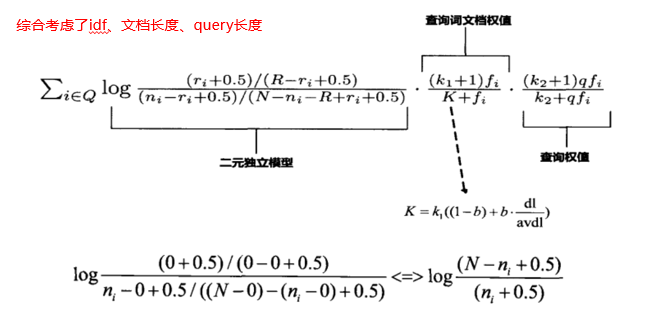
void BM25Weight::init(double factor) {
    Xapian::doccount tf = get_termfreq();

    double tw = ;
    if (get_rset_size() != ) {
        Xapian::doccount reltermfreq = get_reltermfreq();

        // There can't be more relevant documents indexed by a term than there
        // are documents indexed by that term.
        AssertRel(reltermfreq,<=,tf);

        // There can't be more relevant documents indexed by a term than there
        // are relevant documents.
        AssertRel(reltermfreq,<=,get_rset_size());

        Xapian::doccount reldocs_not_indexed = get_rset_size() - reltermfreq;

        // There can't be more relevant documents not indexed by a term than
        // there are documents not indexed by that term.
        AssertRel(reldocs_not_indexed,<=,get_collection_size() - tf);

        Xapian::doccount Q = get_collection_size() - reldocs_not_indexed;

        Xapian::doccount nonreldocs_indexed = tf - reltermfreq;
        double numerator = (reltermfreq + 0.5) * (Q - tf + 0.5);
        double denom = (reldocs_not_indexed + 0.5) * (nonreldocs_indexed + 0.5);
        tw = numerator / denom;
    } else {
        tw = (get_collection_size() - tf + 0.5) / (tf + 0.5);
    }

    AssertRel(tw,>,);

    // The "official" formula can give a negative termweight in unusual cases
    // (without an RSet, when a term indexes more than half the documents in
    // the database).  These negative weights aren't actually helpful, and it
    // is common for implementations to replace them with a small positive
    // weight or similar.
    //
    // Truncating to zero doesn't seem a great approach in practice as it
    // means that some terms in the query can have no effect at all on the
    // ranking, and that some results can have zero weight, both of which
    // are seem surprising.
    //
    // Xapian 1.0.x and earlier adjusted the termweight for any term indexing
    // more than a third of documents, which seems rather "intrusive".  That's
    // what the code currently enabled does, but perhaps it would be better to
    // do something else. (FIXME)
#if 0
    if (rare(tw <= 1.0)) {
        termweight = ;
    } else {
        termweight = log(tw) * factor;
        if (param_k3 != ) {
            double wqf_double = get_wqf();
            termweight *= (param_k3 + 1) * wqf_double / (param_k3 + wqf_double);
        }
    }
#else
    if (tw < 2) tw = tw * 0.5 + 1;
    termweight = log(tw) * factor;
    if (param_k3 != ) {
        double wqf_double = get_wqf();
        termweight *= (param_k3 + 1) * wqf_double / (param_k3 + wqf_double);
    }
#endif
    termweight *= (param_k1 + 1);

    LOGVALUE(WTCALC, termweight);

    if (param_k2 ==  && (param_b ==  || param_k1 == )) {
        // If k2 is 0, and either param_b or param_k1 is 0 then the document
        // length doesn't affect the weight.
        len_factor = ;
    } else {
        len_factor = get_average_length();
        // len_factor can be zero if all documents are empty (or the database
        // is empty!)
        if (len_factor != ) len_factor = 1 / len_factor;
    }

    LOGVALUE(WTCALC, len_factor);
}
/// 注:在调用这个函数之前会先调用next_helper函数,将第一条链表的位置向前移动一位(如果是首次调用则不移动),
/// find_next_match函数让plist[0]倒排链定位到合适的位置,当能定位到合适的位置(plist[0]和plist[1]有交集)则返回,
/// 否则说明没有交集,设置did=0后返回;调用者会通过判断did==0来确定当前链表交集是否已经做完;
PostList * MultiAndPostList::find_next_match(double w_min) {
advanced_plist0:
    if (plist[]->at_end()) {
        did = ;
        return NULL;
    }
    did = plist[]->get_docid();
    for (size_t i = 1; i < n_kids; ++i) {
        bool valid;
        check_helper(i, did, w_min, valid);
        if (!valid) {
            next_helper(, w_min);
            goto advanced_plist0;
        }
        if (plist[i]->at_end()) {
            did = ;
            return NULL;
        }
        Xapian::docid new_did = plist[i]->get_docid();
        if (new_did != did) {
            /// 两条链表的pos元素不相等,只可能是因为plist[0].pos的元素比较小,需要向前移
            skip_to_helper(, new_did, w_min);
            goto advanced_plist0;
        }
    }
    return NULL;
}
double LeafPostList::get_weight() const {
    if (!weight) return ;
    Xapian::termcount doclen = , unique_terms = ;
    // Fetching the document length and number of unique terms is work we can
    // avoid if the weighting scheme doesn't use them.
    if (need_doclength)
        doclen = get_doclength();
    if (need_unique_terms)
        unique_terms = get_unique_terms();
    double sumpart = weight->get_sumpart(get_wdf(), doclen, unique_terms); // 这里对某个doc的最终BM25打分做了汇总,利用到了前面计算的第一和第三部分打分
    AssertRel(sumpart, <=, weight->get_maxpart());
    return sumpart;
}
来自 “ ITPUB博客 ” ,链接:https://blog.itpub.net/26692020/viewspace-3125432/ ,如需转载,请注明出处,否则将追究法律责任。

请登录后发表评论
登录
全部评论
